In the past two entries, we explored glucose in depth through CGM (Continuous Glucose Monitoring) practice.
But the world of carbohydrates has another side: fructose.
While studying the metabolic pathways of alcohol, I stumbled upon a surprising fact: fructose shares an astonishingly similar metabolic mechanism with alcohol.
We all know alcohol is a notorious “liver challenger” — bypassing multiple layers of metabolic control and hurtling down the hepatic fast track, dumping the entire burden onto liver cells. Fructose, though it doesn’t make you drunk, almost exactly replicates this route. It operates silently, without any warning signs, yet may bring even more profound consequences.
In a sense, fructose is “the alcohol that doesn’t get you drunk.” And precisely because it doesn’t intoxicate, it can be even more dangerous.
What Is Fructose?
Fructose is a naturally occurring monosaccharide, the “structural twin” of glucose. It’s widely found in fruits, honey, sugar cane, and other plants. Most of the sweetness we taste in fruits actually comes from fructose. It is 2–3 times sweeter than glucose, and 1.2–1.8 times sweeter than sucrose. Even a small amount delivers a massive sensory reward 1,2.
Key sensory studies (sucrose = 1.0): fructose 1.2–1.8; glucose 0.5–0.8.
The Real Problem Isn’t Fruit, But Hidden Overload in Industrial Diets
Today, most of the fructose we consume doesn’t come from fruit but from High-Fructose Corn Syrup (HFCS) — which is widespread in soft drinks, breakfast cereals, yogurt, protein bars, condiments, and all kinds of processed foods.
Products labeled “0 sucrose” or “natural juice” often seem healthy but frequently replace sucrose with HFCS or fruit concentrate, making their fructose content alarmingly high.
They may not be labeled as “sugar,” but they carry a heavier and stealthier metabolic burden than glucose.
Fructose Metabolism: A Speeding Freeway with No Limits
Fructose follows a completely different metabolic pathway from glucose.
One major difference is: Glucose is utilized by all body tissues; fructose is metabolized primarily by the liver.
Once glucose enters the bloodstream, it triggers blood sugar elevation and an insulin response, with a full set of feedback and regulatory mechanisms. Fructose, on the other hand, bypasses almost all of that, quietly entering liver cells, where it is rapidly phosphorylated by fructokinase and rushes down a nearly unregulated metabolic freeway.
Along this route, fructose quickly generates several concerning metabolic byproducts:
- Liver fat: Readily converts to fat and is a major driver of Non-Alcoholic Fatty Liver Disease (NAFLD).
- Uric acid: Rapid ATP depletion initiates purine breakdown, promoting uric acid formation.
- Lactate: Increases lactate production, inhibits uric acid excretion, potentially raising uric acid levels and aggravating chronic inflammation.
- Triglycerides: Stimulates VLDL synthesis, raising blood lipids and LDL-C.
- Glucose: Only a small portion is converted to glucose or glycogen, indirectly participating in blood sugar regulation and energy supply.
To visualize, we made a comparison chart:
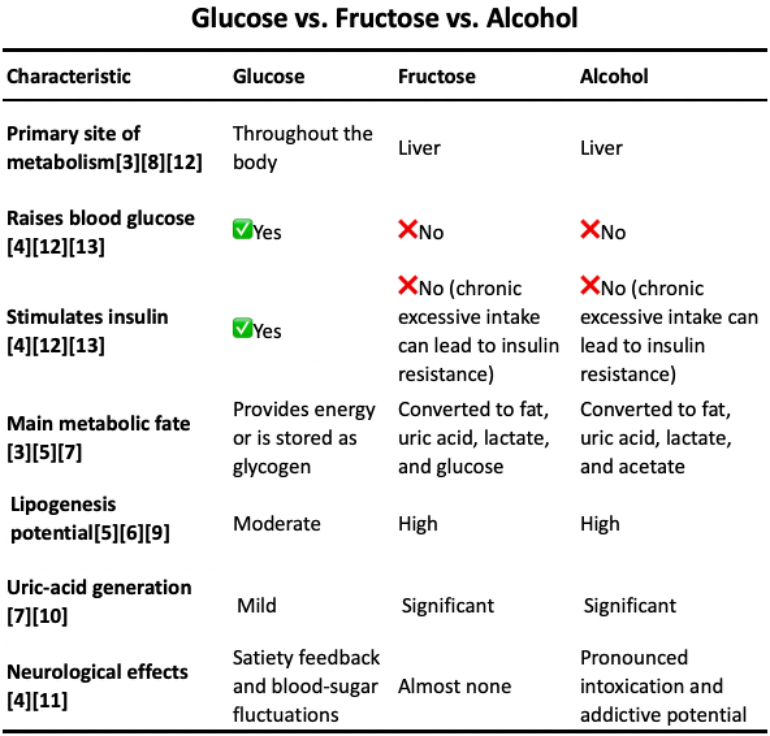
You can see, fructose’s metabolic path is more similar to alcohol than to glucose; its metabolites are also similar to alcohol’s: fat, uric acid, and lactate.
But the crucial difference is:
Alcohol sounds the alarm; fructose sneaks in unnoticed. It doesn’t knock; it walks straight in.
The Evolutionary “Sweet Trap”
From an evolutionary perspective, fructose’s fat-creating efficiency was originally a survival advantage:
- Fruit ripened only during a brief seasonal window; fructose was rare.
- It didn’t trigger insulin but rapidly converted to fat — great for storing energy for winter.
- So we evolved strong fructose metabolism: eat → store → store long.
But today’s fructose environment overfeeds that entire mechanism.
From “a few hundred grams a year” in the ancestral environment to “hundreds of grams a day” in modern life, our bodies are still in “winter prep mode,” but the famine never comes.
Are Natural Sugars Really Healthy? The Metabolic Ledger of Honey, Fruit, Juice, and Dried Fruit
We often hear that “honey is natural,” “fresh juice is healthy,” “dried fruit is nutrient-dense.” But from a metabolic perspective, the truth isn’t so sweet.
Examples:
- A glass of freshly squeezed orange juice easily contains over 20g of fructose, absorbed rapidly.
- A small handful of raisins packs over 15g of sugar — you eat them without even noticing.
- Honey contains about 40% fructose, even more than sucrose. It’s nature’s version of HFCS.
Juicing destroys the fruit’s fiber barrier, releasing free fructose that absorbs far faster than whole fruit.
Even industrial juices labeled “NFC” or “pure juice” usually have most fiber removed, causing even greater metabolic impact.
Though honey contains trace minerals and antioxidants, it delivers 40%+ fructose, 30%+ glucose, and 7% maltose — over 80% free sugar overall. Its nutritional value doesn’t outweigh its metabolic cost.
As for dried fruit — if fresh fruit is “slow-cooked fructose,” dried fruit is a “pressure-cooked sugar bomb”: higher sugar density, lower satiety, dangerously easy to overeat.
Summary
- Fructose is alcohol that doesn’t get you drunk!
- Its metabolism is quiet, but its burden is real. It doesn’t spike blood sugar or stimulate insulin like glucose, but still fuels fat synthesis and LDL elevation.
- Foods high in fructose, even if low GI, should still be considered part of a high-sugar diet.
- When consuming fructose, always evaluate: is the nutritional gain worth the metabolic cost?
Practical Advice
Absolutely avoid: High in fructose, rapid absorption, low nutrient density, addictive:
- Sugary drinks (including “vitamin C” beverages)
- Industrial juices, concentrates, functional fruit-veg drinks
- Honey water, date-paste snacks, “no-sucrose” yogurt
- Candied fruits, dried fruits, jams
- Products labeled “0 sucrose” but containing “concentrated juice” or HFCS
Consume moderately: Moderate fructose, intact structure, high nutritional density, tolerable in small amounts:
- Fresh whole fruit (especially after meals or workouts)
- Honey (small amounts for flavor)
- Homemade smoothies with optimized formulas:
Base: avocado, yogurt, soy milk, leafy greens
Sweetener: 1/4–1/2 apple or orange
Add fat/fiber: nut powder, chia, flaxseed, vegetables
Keep sugar <10g per cup
Safe to eat: Very low in fructose or metabolically friendly, with nutrient benefits outweighing metabolic cost:
- Nearly zero fructose: avocado
- Nutrient-rich: berries (blueberries, strawberries, raspberries), kiwi, lemon, tomato
These are the “worth-it sweets” in my daily diet.
One More Thing…
Understanding sugar metabolism is not about stripping sweetness from life.
It’s a reminder that every choice has a cost.
True awareness isn’t perfect control. It’s about knowing what you’re giving up and what you’re gaining. Even if the choice isn’t perfect, own it, and move forward with clarity. Metabolism is a ledger of life. We read it so we can write in it.
This principle applies to many parts of life. It’s also one of Prime Life’s three core goals: Own every day. With clarity of mind and strength of body, to fully feel, respond to, create, and experience life — moment by moment.
Appendix: Fructose’s Many Aliases in Ingredient Labels
Label names: Fructose, crystalline fructose, high-fructose corn syrup (HFCS), corn syrup, fructose-glucose syrup, glucose-fructose syrup, maple syrup, honey, dates syrup, agave syrup, concentrated juice, juice concentrate
Hidden markers:
- “Natural sweeteners”: Often high-fructose plant extracts (like honey, maple syrup, juice concentrates)
- “Fruit-flavored” products: Often contain fructose-glucose syrup or juice concentrates
- Flavored yogurts, cereal bars, energy bars: Often rely on fructose-based sweeteners for taste and texture
References13
[1]Pangborn, Rose M. “Relative Taste Intensities of Selected Sugars and Organic Acids.” Journal of Food Science, vol. 28, no. 6, 1963, pp. 726–733.
[2]Hanover, L. Mark, and John S. White. “Manufacturing, Composition, and Applications of Fructose.” The American Journal of Clinical Nutrition, vol. 58, suppl. 5, 1993, pp. 724S-732S.
[3]Tappy, Luc, and Kim-Anne Lê. “Metabolic Effects of Fructose and the Worldwide Increase in Obesity.” Nature Reviews Endocrinology, vol. 6, no. 10, 2010, pp. 637–646.
[4]Teff, Karen L., et al. “Dietary Fructose Reduces Circulating Insulin and Leptin, Attenuates Post-Prandial Suppression of Ghrelin, and Increases Triglycerides in Women.” The Journal of Clinical Endocrinology & Metabolism, vol. 89, no. 6, 2004, pp. 2963–2972.
[5]Softic, Suleiman, et al. “Divergent Effects of Glucose and Fructose on Hepatic Lipogenesis and Insulin Signalling.” The Journal of Clinical Investigation, vol. 127, no. 11, 2017, pp. 4049–4064.
[6]Stanhope, Kimber L., et al. “Consuming Fructose-Sweetened, Not Glucose-Sweetened, Beverages Increases Visceral Adiposity and Lipids and Decreases Insulin Sensitivity in Overweight/Obese Humans.” The Journal of Clinical Investigation, vol. 119, no. 5, 2009, pp.
[7]Johnson, Richard J., et al. “Hypothesis: Could Excessive Fructose Intake and Uric Acid Cause Type 2 Diabetes?” Endocrine Reviews, vol. 30, no. 1, 2009, pp. 96–116.
[8]Lieber, Charles S. “Hepatic, Metabolic and Toxic Effects of Ethanol: 1991 Update.” Alcoholism: Clinical and Experimental Research, vol. 15, no. 4, 1991, pp. 573–592.
[9]Nishida, Norihisa, et al. “Ethanol Metabolism in the Liver, the Induction of Oxidant Stress, and Alcoholic Fatty Liver.” Antioxidants, vol. 11, 2022, article 1258.
[10]Choi, Hyon K., et al. “Alcohol Intake and Risk of Incident Gout in Men: A Prospective Study.” The Lancet, vol. 363, no. 9417, 2004, pp. 1277–1280.
[11]World Health Organization. “Alcohol.” Fact Sheet, updated 2024.
[12]StatPearls Publishing. “Biochemistry, Insulin — Metabolic Effects.” StatPearls, 2023
[13]Department of Veterans Affairs. Understanding Sweeteners and Glycemic Index. 2021, Whole Health Library.