Today, we’re pulling together all the training elements we’ve previously explored — Zone 2 cardio, HIIT, resistance training, and racket sports — into a single integrated plan: a weekly training blueprint you can use as your baseline.
The goal isn’t to chase a narrow fitness outcome like fat loss or performance. This is about systematically building the physiological foundation for a long and vibrant life:
Metabolism × Cardiopulmonary × Muscular × Neurological × Circadian
This is the synthesis of everything we’ve explored so far — translated into real-world weekly action.
I. First, a quick recap of the science behind each component
1️⃣ Zone 2 Cardio: Blood Sugar Control, Fat Oxidation, Mitochondrial Activation
Core effects [1–3]:
- At 20–30 min: Helps control glucose, breaks up prolonged sitting
- At 30–60 min: Peak zone for fat oxidation and mitochondrial activity
- At 60–90 min: Expands mitochondrial “base capacity”
Target intensity: 60–70% of HRmax; RPE 10–12/20
Low fatigue, quick recovery — can be done daily
2️⃣ HIIT: Raise VO₂Max and Enhance Lactate Clearance
Core effects [4–5]:
- Raises VO₂Max ceiling
- Trains the body to clear lactate faster
Typical format: Peaks at 90–100% HRmax, Most common: 4×4 protocol
High load, slow recovery (48–72 hrs)
Important: For beginners, only add HIIT after 3–6 months of consistent Zone 2 base training.
3️⃣ Resistance Training: Control Glucose, Prevent Falls, Delay Aging
Key functions:
- Helps with glucose control
- Reduces fall risk
- Preserves muscle, coordination, and structure
Train along three axes [6–8]:
- Volume (50–60%) → Glucose control & metabolic reserve
- Functionality (25–35%) → Coordination, fall prevention
- Symmetry (10–15%) → Balance and structural resilience
4️⃣ Racket Sports: Zone 2 + HIIT + Cognitive and Social Gains
- Intensity is adjustable, combines Zone 2 and HIIT
- Open-skill sports boost cognitive health
- Social interaction improves emotional well-being
II. The Weekly Training Program: Overview
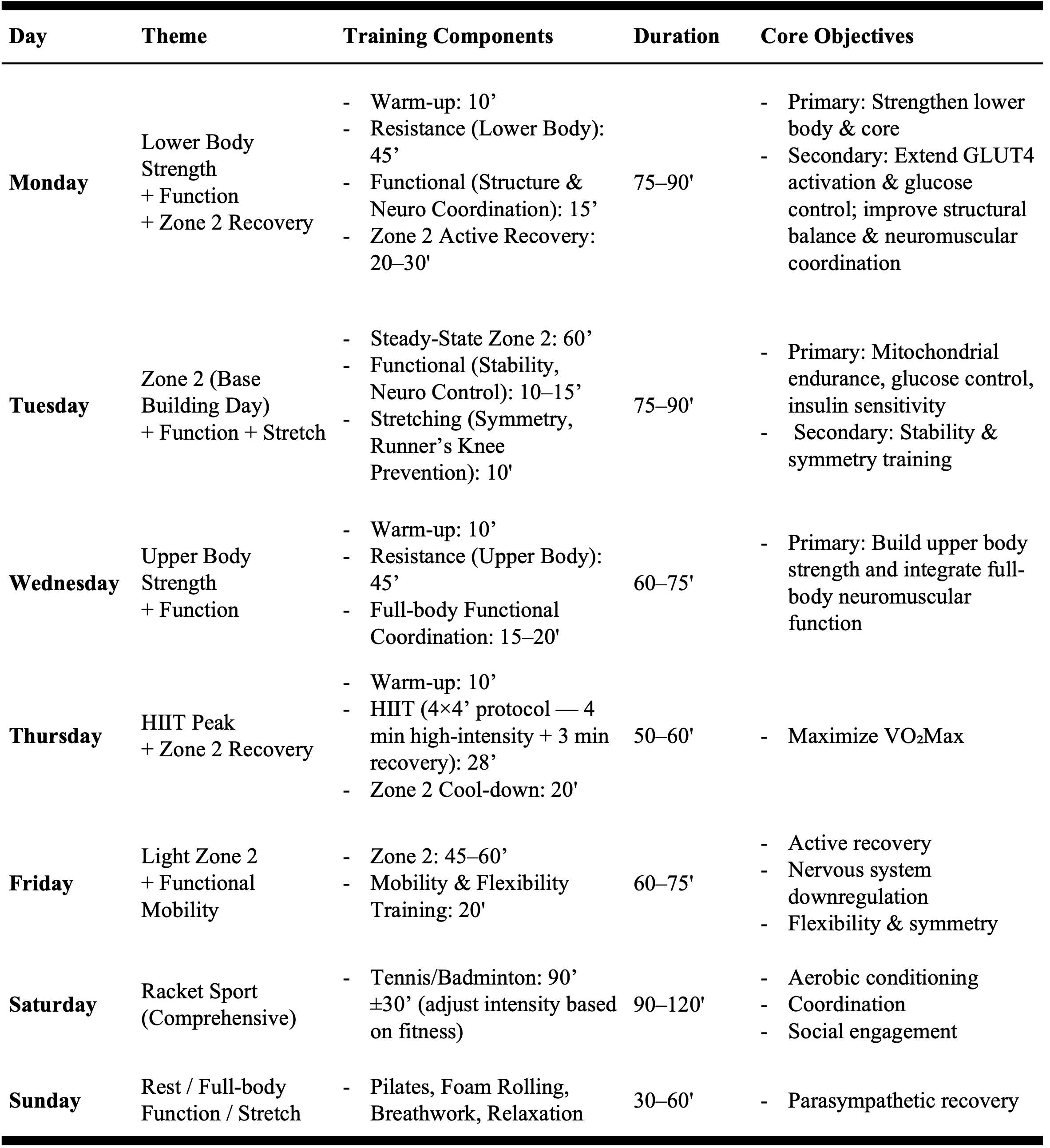
Let’s start with the visual blueprint:
Who is this program for?
Adults in their “Prime Zone” — Age 30–60, cognitively sharp, physically resilient, and metabolically flexible.
More specifically:
- Health status: No major illnesses, good checkup metrics, capable of handling moderate to high intensity (e.g., HIIT or 60–80% 1RM)
- Training background: Already working out 1–3x/week or doing Zone 2 consistently for 3+ months
- Goal alignment: Wants to address sedentary behavior, stress, or metabolic issues now, with a long-term vision for longevity
- Recovery ability: Can maintain decent nutrition and sleep; no major bad habits (e.g., heavy drinking or all-nighters)
Key Elements of the Program
1️⃣ Ensure 150+ Minutes of Zone 2 Each Week
We break this into two main types:
a. Steady-State Sessions (45–90 minutes) Once you pass the 45-minute mark, your body enters a fat-oxidation dominant state, driven primarily by mitochondrial energy systems — likely hitting your FatMax zone. This is the most efficient zone for mitochondrial activation and fat burning. Each week includes two of these sessions:
- One longer session (60–90 min) for deeper mitochondrial stimulus — this is your Base Day
- One shorter session (45–60 min) as a gentler active recovery after higher intensity days earlier in the week
b. Short Sessions (20–30 minutes) These are slotted after resistance or HIIT sessions.
They serve two purposes:
- Promote lactate clearance and speed up recovery from anaerobic effort
- Paired with resistance training, they enhance blood sugar regulation and insulin sensitivity — a powerful combo for improving metabolic health
You may notice there’s no Zone 2 after Wednesday’s strength training — this is intentional.
It’s designed to protect Thursday’s high-load HIIT session, avoiding hidden fatigue from Monday to Wednesday. But if your recovery is excellent, feel free to include it.
📊 Experimental and review studies (Richter & Hargreaves, 2013; Stanford, 2015) show: Doing 20–30 min of aerobic Zone 2 immediately after resistance training helps keep GLUT4 transporters (which shuttle glucose into cells) active at the cell membrane longer, thanks to sustained AMPK signaling.
🧬 The American Diabetes Association recommends: “Adults with type 2 diabetes should ideally combine aerobic and resistance training.” 9 This combo outperforms either method alone for improving insulin action 10,11.
All in, your weekly Zone 2 time adds up to 150–200 minutes, placing you firmly in the 150–300 minute sweet spot.
Plus, 1–2 hours of racket sports on Saturday likely gives you another hour of aerobic Zone 2 benefit — bringing your total to 200–250 minutes/week.
2️⃣ Two Full-Body Resistance Sessions Per Week
These are scheduled for Monday and Wednesday, each session lasting 60–75 minutes — in line with a typical 1-hour gym session plus 15 minutes of mobility/stretching.
Each workout roughly follows the 3-part structure:
- Volume (for glucose control and metabolic reserve)
- Functionality (for neuromuscular coordination and fall prevention)
- Symmetry (for structural balance and long-term joint health)

Functional and symmetry work is woven into each session, with varying emphasis:
- Neuromuscular coordination
- Stability and control
- Chain-based movement integration
- Flexibility and mobility
3️⃣ One HIIT Session
Thursday is your high-intensity day, defaulting to the 4×4 protocol (4 minutes intense + 3 minutes rest, repeated 4 times).
You can swap in another HIIT format if it fits your preferences.
If the intensity feels overwhelming — or you want something more engaging — you can substitute a high-intensity racket sport session (like tennis or badminton). That would give you two racket sessions per week.
Important: If you’re using tennis as a HIIT replacement, structure matters. You’ll need a coach feeding you balls or a matched opponent to maintain pace and intensity. Keep breaks, serves, and transitions short to minimize downtime.
Even so, because each rally lasts only 5–30 seconds, it takes time to hit peak heart rate zones. To ensure sufficient intensity, aim for 45–60+ minutes of total playtime.
4️⃣ One Racket Sport + Social Day
Saturday’s tennis or badminton session is your flexible “buffer.”
If your week’s been intense, keep this light and social — aiming for Zone 1–3 heart rate zones. Let your body move, recover, and enjoy.
If the week’s been too light, turn Saturday into a competitive match — boosting heart rate variability and mimicking polarized training. Whether through coach-fed drills or an evenly matched game, you’ll tap into both cardio and coordination gains.
Either way, it’s a day for fun. Unleash your energy before Sunday’s full rest.
5️⃣ One True Rest Day
Rest doesn’t mean lying around all day. It means intentional recovery — or even supercompensation — to prepare for the week ahead.
Active recovery methods include:
- Stretching
- Massage or self-myofascial release (foam roller)
- Pilates, yoga, breathwork, or meditation
Bonus recovery tools, if available:
- Red light therapy
- Hyperbaric oxygen therapy
- Cold plunge
- Infrared sauna
⚠️ A note on cold exposure: It’s great for acute recovery, but may dampen hypertrophy signals if done immediately after strength training 12,13. That’s why this plan places full rest days away from strength training (Monday and Wednesday). A Sunday cold plunge could be a powerful “reset ritual” for your parasympathetic system and mental clarity.
A Pyramid Model That Scales With You
This plan follows a Pyramidal Training Model: As intensity increases, time decreases.
- Low intensity: most time
- Moderate intensity: less
- High intensity: the least
All while allowing flexibility to adjust intensity levels.
In elite sports, Polarized Training is even more extreme — about 80% low-intensity, 20% high 14. This split maximizes aerobic gains while minimizing fatigue, enhancing VO₂max, lactate threshold, and performance.
For most people, Pyramidal Training is more than enough 15: Low intensity remains the base, with slightly more moderate than high intensity.
It’s easier to recover from, more sustainable, and effective over the long haul.
And remember — this is just a template, not a prescription. You can always adjust total time, intensity, and how Zone 2 fits into your week.
Only Have 4–6 Hours Per Week? Here’s the Efficient Version
If you can’t carve out 6–8 hours per week, no worries — here’s a condensed but powerful 4–6 hour version of the Prime Zone Program.
Key Adjustments:
- Keep all 4 pillars: Zone 2, HIIT, Resistance, Functionality
- Reduce Zone 2 to 120–150 minutes, e.g. base day: 45–60 minutes; recovery Zone 2: optional or shortened
- Fold mobility work into warm-ups and cool-downs
- Combine HIIT with high-intensity racket sports if needed
This trims 2–3 hours off your weekly training time, and keeps most daily sessions to under an hour.
Let’s pause here for today.
This weekly plan isn’t just a schedule — it’s a framework for building a Prime Life.
One that’s practical, flexible, and deeply rooted in the science of longevity.
Intervention recommendations are geared toward generally healthy individuals. If you have existing health conditions, always follow your doctor’s instructions.
References
[1]Dunstan DW, Kingwell BA, Larsen R, Healy GN, Cerin E, Hamilton MT, Shaw JE, Bertovic DA, Zimmet PZ, Salmon J, Owen N. Breaking up prolonged sitting reduces postprandial glucose and insulin responses. Diabetes Care. 2012 May;35(5):976–83
[2]Achten, Joost, and Asker E. Jeukendrup. “Maximal Fat Oxidation during Exercise in Trained Men.” International Journal of Sports Medicine, vol. 24, no. 8, 2003, pp. 603–8.
[3]Granata, Cesare, Nicholas A. Jamnick, and David J. Bishop. “Principles of Exercise Prescription, and How They Influence Exercise-Induced Changes of Transcription Factors and Other Regulators of Mitochondrial Biogenesis.” Sports Medicine, vol. 48, no. 7, 2018, pp. 1541–1559.
[4]Weston, Kathryn S., et al. “High-Intensity Interval Training in Patients with Lifestyle-Induced Cardiometabolic Disease.” British Journal of Sports Medicine, 2014.
[5]Milanović, Zoran, et al. “Effectiveness of HIT vs. Continuous Endurance Training for VO₂max.” Sports Medicine, 2015.
[6]Umpierre D, et al. Physical activity advice only or structured exercise training and association with HbA1c levels in type 2 diabetes: a systematic review and meta-analysis. JAMA. 2011 May 4;305(17):1790–9.
[7]Sherrington, Catherine, et al. “Exercise for Preventing Falls in Older People Living in the Community.” Cochrane Database of Systematic Reviews, 2019.
[8]Bull FC, et al. World Health Organization 2020 guidelines on physical activity and sedentary behaviour. Br J Sports Med. 2020 Dec;54(24):1451–1462.
[9]Physical Activity/Exercise and Diabetes: A Position Statement of the American Diabetes Association. Colberg SR, Sigal RJ, Yardley JE, et al.Diabetes Care. 2016;39(11):2065–2079.
[10]Sigal RJ,et al. Effects of aerobic training, resistance training, or both on glycemic control in type 2 diabetes: a randomized trial. Ann Intern Med. 2007 Sep 18;147(6):357–69.
[11]Church TS, et al. Effects of aerobic and resistance training on hemoglobin A1c levels in patients with type 2 diabetes: a randomized controlled trial. JAMA. 2010 Nov 24;304(20):2253–62.
[12]Roberts, Lachlan A., et al. “Post-exercise Cold Water Immersion Attenuates Acute Anabolic Signalling and Long-term Adaptations.” Journal of Physiology, 2015.
[13]Grgic, Jozo, et al. “Effects of Post-exercise CWI on Strength Gains: A Meta-analysis.” European Journal of Sport Science, 2022.
[14]Stöggl, Thomas, and Billy Sperlich. “Polarized Training Has Greater Impact on Key Endurance Variables.” Frontiers in Physiology, 2014.
[15]Santos, Andreia, et al. “Compliance and Adherence to HIIT vs MICT: Systematic Review.” Systematic Reviews, 2020/2023 updates.