In the blueprint of a Prime Life, we often talk about the four pillars of health: diet, exercise, sleep, and emotional regulation. But if you look closely, sleep underpins them all.
If the human body were a temple, food would be the bricks, exercise the beams, emotions the lighting within — and sleep would be the foundation on which the entire structure rests.
The mistake we often make? We obsessively paint the walls (supplements), reinforce the pillars (weights and reps), and fine-tune the atmosphere (meditation apps), all while ignoring the fact that our foundation is quietly sinking, night after night.
But if the sleep foundation is weak, every capsule of anti-aging miracle, every drop of sweat, every moment of mindfulness — loses its power. You can’t outrun exhaustion. And no amount of kale can reverse the metabolic toll of chronic sleep loss.
So let’s talk about the one thing we all know matters — and yet constantly sacrifice:
Sleep Duration.
When you sleep less than your body needs — even just a little — you are experiencing sleep deprivation.
Sounds like a form of torture? That’s because… it is. And we inflict it on ourselves. Every single night.
How Much Sleep Is Enough?
The U.S. National Sleep Foundation (NSF), after years of expert debate and research, defined the “golden range” for adults: 7 to 9 hours per night1. At Prime Lab, we tighten that window a bit: 7.5 to 8.5 hours, to account for modern recovery needs and lifestyle stress.
Yes, there’s a rare genetic mutation — DEC2 — that allows a tiny fraction of people to thrive on 5–6 hours. But for the rest of us? The odds of having that gene are so low they round to zero2.
The scientific literature shows a brutal U-shaped mortality curve: those sleeping less than 7 hours face higher all-cause mortality and heart disease risk. Interestingly, those sleeping more than 9 hours see similar risk increases3,4.
Don’t be alarmed by the “too much sleep” part — it’s correlation, not causation. Often, people sleep longer because they’re already sick (e.g. chronic inflammation or depression). It’s not that sleep itself is harmful.
So if you’re healthy, and you’re making up for “sleep debt” or recovering from intense training, sleeping 9+ hours can be not only acceptable — but necessary.
The goal is simple: stay snugly in the bottom of the U, the sweet spot of longevity.
A Lifetime of Sleep Deprivation
In school, there were endless problems to solve, games to play, novels to read. Sleep felt like a waste of life. I used to envy classmates who only needed five hours a night and still bounced around like they were powered by rocket fuel. We lived by the motto: “Why sleep in life, when you’ll rest when you’re dead?” 😂
Then came work. “Work Hard, Play Hard” became a convenient excuse to sacrifice sleep in both directions. Long days at the desk, longer nights at the bar. Pulling all-nighters and heading straight back to work became a badge of honor in office banter.
Then I started my own company — and the tone shifted. The suffocating pressure of survival and competition came with a side of shame. Rest started to feel like something I hadn’t earned. I became obsessed with “hacking sleep”: polyphasic tricks, power naps, timing my REM cycles to the minute.
None of it worked.
Instead, I developed something far more dangerous: revenge bedtime procrastination. That quiet sense of control, the solitude of 2AM, felt like my only compensation for days I had no say in.
Even now, knowing all I know, I still relapse once or twice a week. My average sleep time teeters at the bare-minimum 7-hour mark.
I’ve rarely experienced acute sleep deprivation — those all-nighter extremes — but I’ve been living through something worse: chronic partial sleep restriction.
And I know I’m not alone. In fact, I’m with the majority.
Even just 2–3 nights of sleeping less than your body needs (for most, that’s <7 hours) is enough to cause measurable cognitive decline5,6. That’s when your sleep debt begins to accumulate.
Thanks to hustle culture, 996 grind schedules, endless nighttime entertainment, the blue glow of screens, and remote work blurring the line between home and office — chronic sleep deprivation might be the biggest invisible epidemic of our time.
The Chilling Cost: Cognitive Decline
Dr. David Dinges at the University of Pennsylvania ran one of the most eye-opening sleep studies in modern science7,24.
Due to ethical constraints, such extreme human sleep deprivation studies are now virtually impossible to repeat — which makes this one both irreplaceable and haunting.
He split participants into four groups:
- Group A: 8 hours of sleep
- Group B: 6 hours
- Group C: 4 hours
- Group D: 0 hours for 3 days straight
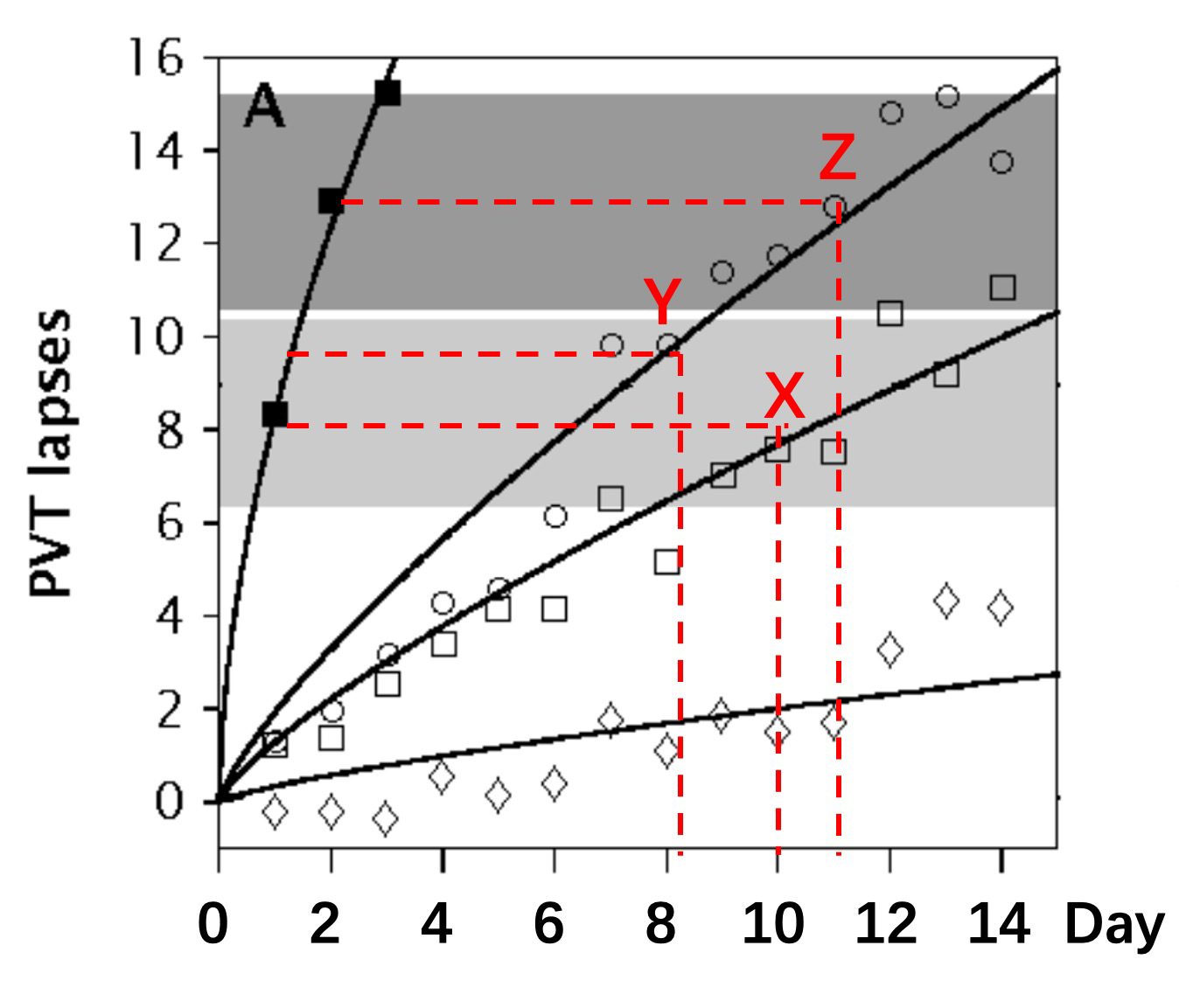
Each day, he measured cognitive performance and alertness using PVT (Psychomotor Vigilance Task), a gold-standard for sustained attention. In it, participants press a button as fast as possible when a stimulus appears on screen. Delays ≥500ms — or missed responses — are counted as “lapses”.
■Group A ○Group B □Group C ◇Group D
Here’s what happened:
After just 10 days, Group B (6 hours) showed cognitive performance that matched Group D — people who hadn’t slept at all for 24 hours. Their mental lapses increased 400% compared to the 8-hour group.
Even worse, the 4-hour group continued to decline past the 24-hour all-nighter benchmark. After 11 days, they reached the equivalent of 48 hours without sleep.
The damage was linear. Each day of mild deprivation stacked on top of the last.
The experiment was halted — not because they reached a plateau, but because it became too dangerous to continue.
Imagine what that means for those of us living in quiet sleep debt. What kind of cognitive poverty are we walking around in?
And here’s the kicker: most of us have no idea how bad it’s gotten.
■Group A ○Group B □Group C ◇Group D
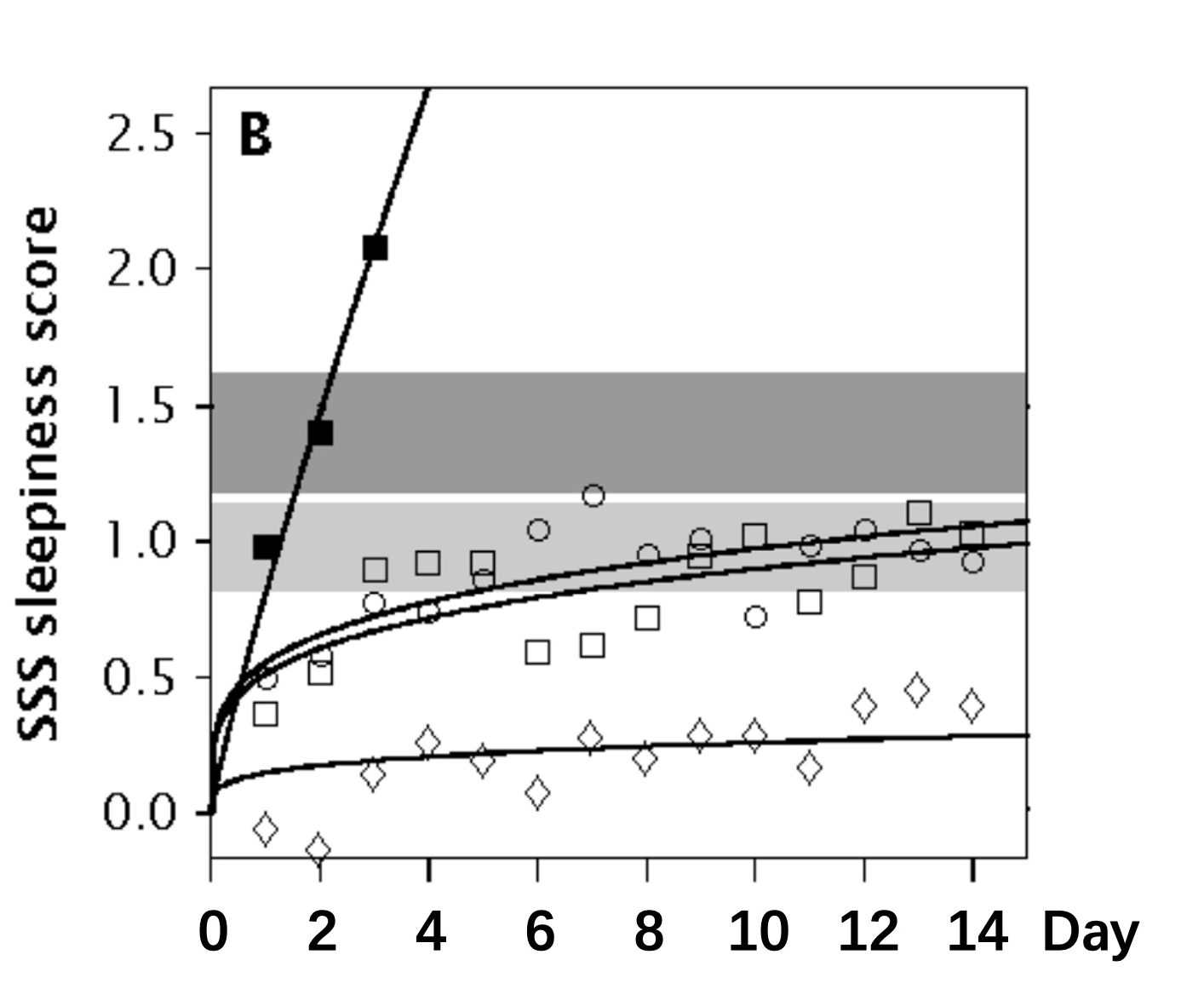
In the same study, researchers also asked participants to rate their subjective sleepiness using the Stanford Sleepiness Scale (SSS).
SSS (Stanford Sleepiness Scale): A single-item self-assessment tool where participants rate their current level of sleepiness on a scale from 1 to 7, based on how they feel at that moment. It measures state sleepiness, or momentary drowsiness, and can be used multiple times throughout the day.
Guess what?
Those in Group D (no sleep for 3 days) knew they were wrecked. They begged for rest.
But Group B (6 hours/night)? They shrugged and said, “I’m fine. Just a little tired.”
This is the illusion of adaptation. Your brain, desperate to keep you functional, blunts the internal alarm bells. You think you’ve adjusted — but your reaction speed, logic, memory, and emotional control are in free fall6,7,8.
We see ourselves as “Iron Man” — but in the eyes of data (and our coworkers), we’re more like sleep-deprived zombies.
More Dangerous Than Drunk Driving: The Hidden Threat of Micro-sleeps
Severe sleep-deprived driving may be even deadlier than drunk driving — because it robs you of the ability to react altogether.
When your sleep debt reaches a tipping point, the brain begins to forcibly shut down in short, local bursts — what’s known as micro-sleeps.
Micro-sleep is not your typical nap. It’s an involuntary, uncontrollable shutdown initiated by your brain to protect itself. During these episodes, certain regions of your cortex — or clusters of neurons — briefly enter an “OFF” state similar to slow-wave sleep. These episodes usually last between 1 and 15 seconds [9–11]24.
And it’s far more dangerous than being drunk:
Because in that moment, you black out. Your eyes may remain open, and your hands might still be mechanically gripping the wheel — but the brain’s attentional network and visual processing centers are no longer working in sync. You become incapable of processing what’s happening on the road in front of you.
Alcohol slows your reaction time. Micro-sleep cuts the circuit altogether.
For those few seconds, your brain’s perception-decision-response system goes completely dark. Effective processing of critical external information drops to nearly zero 12,13.
Now imagine this: you’re on a highway going 120 km/h. A 3-second micro-sleep means your car travels over 100 meters — at full speed, with no one mentally in control.
Under chronic sleep deprivation, your brain may experience dozens of micro-sleeps in a single day. And again, because of the illusion of adaptation, you may feel “totally fine” — but your brain is running dangerously low. These mini blackouts are enough to miss crucial signs, make fatal driving errors, or fail to respond to sudden hazards.
According to the U.S. Department of Transportation, fatigue-related crashes are just as deadly and severe as those caused by alcohol. Which means this:
Sleeping well isn’t just a lifestyle choice — it’s a moral obligation to protect your life and the lives of others 14,15.
The REM Heist: When Your Emotional Recovery Gets Cut First
Losing 1–2 hours of sleep a night doesn’t trim sleep cycles evenly. It disproportionately slices off the REM sleep that happens in the second half of the night — the phase when the brain heals emotions through dreaming 24.
As we’ve explored in previous entries, REM is essential for mood regulation and cognitive integration. But if you sleep just 6–7 hours a night, thinking “it’s probably enough,” you may lose 20–40% of your REM sleep 6,16,24.
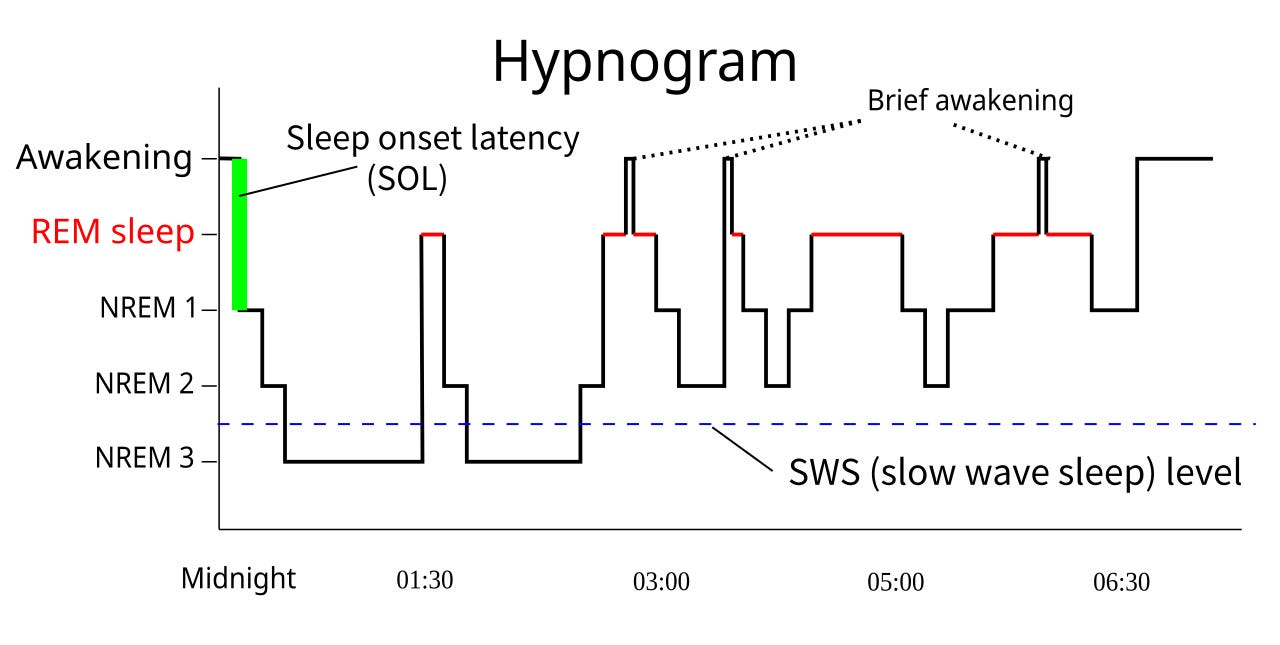
Let’s take a look at a standard hypnogram (sleep stage chart):
Typical sleep hypnogram (source: Wikipedia)
As shown, REM sleep tends to cluster more densely toward the latter part of the night. Which means shaving off that last hour or two often means losing a disproportionate chunk of REM.
Meanwhile, when sleep is consistently restricted, the brain goes into deep sleep rebound mode. It prioritizes the more life-critical NREM slow-wave sleep (deep sleep) at all costs. That’s the phase responsible for physiological repair, growth hormone release, and brain detoxification through the glymphatic system.
To preserve deep sleep, the brain sacrifices REM time. Over and over again.
So people in chronic sleep debt aren’t just sleep-deprived in quantity — they’re misaligned in quality. While the body’s “janitorial crew” (NREM) gets protected, the brain’s “emotional healing center” (REM) gets repeatedly underfunded.
This explains why long-term sleep-deprived individuals not only feel tired, but also emotionally unstable, increasingly anxious, and less creative. Their cognitive department has been running a deficit for far too long 8,17,24.
When the Body Strikes Back
Sleep loss doesn’t just dull your thinking. It quietly dismantles your body at the cellular level. Let’s touch on just a few of the most urgent effects:
1.The Brain Becomes a Garbage Dump: As mentioned earlier, the brain has a unique waste-clearance system called the glymphatic system. It only activates at high speed during deep sleep, using cerebrospinal fluid to wash away metabolic waste. One of the most notorious byproducts? Beta-amyloid, the neurotoxin linked to Alzheimer’s. Sleep less, and the cleanup crew shows up late — or not at all. Debris accumulates between neurons, eroding memory and potentially laying the groundwork for dementia decades down the line 18.
2.Hungrier, but Not Because You Need Fuel: Sleep loss disrupts your hunger hormones — leptin (which signals fullness) drops, while ghrelin (which triggers carb cravings) skyrockets. That’s why sleep-deprived people don’t crave kale; they crave fried chicken and donuts. Your hormones have hijacked your fridge 19.
3.Your Immune System Crashes: After just a few nights of poor sleep, the activity of your natural killer (NK) cells — your immune system’s first line of defense against cancer — can drop to 70% of baseline. That’s a massive blow to your body’s anti-tumor surveillance system 20,21.
4.Metabolic Chaos and Mitochondrial Stress: Chronic sleep deprivation triggers insulin resistance and low-grade systemic inflammation. In animal studies, it even induces mitochondrial oxidative stress, impairing energy production and disrupting mitochondrial repair and recycling 22,23.
Sleep as a Long-Term Investment
We often mistake productivity for “being online more.” But real productivity isn’t forcing yourself to keep running on 1% battery. It’s having fully charged mental clarity, emotional regulation, and decision-making power during your 16 waking hours.
A long-running, global epidemic of sleep deprivation is basically high-interest life debt. You mortgage your brain’s precision and your body’s metabolic health — and the interest you pay is your future healthspan.
So tonight, try this:
Go to bed one hour earlier. It’s the best ROI investment you can make — and it’s free.
In Summary
- 6 Hours Isn’t Enough: The Prime Life sleep target for adults is 7.5 to 8.5 hours of actual sleep (not just time in bed). Drop below 7, and you start paying interest.
- Beware the Boiling Frog: Sleep 6 hours a night for two weeks, and your cognition equals that of someone who just pulled an all-nighter. Don’t trust the “I’m used to it” voice. That’s just your brain going numb.
- Microsleep Is Deadlier Than Drunk Driving: It causes total blackout for 2–10 seconds — like closing your eyes at 120 km/h.
- Emotional Recovery Gets Cut First: Just 1–2 hours less sleep slashes 20–40% of your REM, the phase that stabilizes mood and fuels creativity.
- Your Brain Needs a Bath: Deep sleep is when the brain scrubs out toxins. Without it, Alzheimer’s-linked waste builds up.
- Redefine Productivity: Forget the “awake but useless” 8 hours. Optimize for the razor-sharp, fully-charged 16.
Intervention recommendations are geared toward generally healthy individuals. If you have existing health conditions, always follow your doctor’s instructions.
References
[1]Hirshkowitz, Max, et al. “National Sleep Foundation’s Updated Sleep Duration Recommendations: Final Report.” Sleep Health, vol. 1, no. 4, 2015, pp. 233–243.
[2]He, Ying, et al. “The Transcriptional Repressor DEC2 Regulates Sleep Length in Mammals.” Science, vol. 325, no. 5942, 2009, pp. 866–870.
[3]Cappuccio FP, D’Elia L, Strazzullo P, Miller MA. Sleep duration and all-cause mortality: a systematic review and meta-analysis of prospective studies. Sleep. 2010 May;33(5):585–92.
[4]Jike M, Itani O, Watanabe N, Buysse DJ, Kaneita Y. Long sleep duration and health outcomes: A systematic review, meta-analysis and meta-regression. Sleep Med Rev. 2018 Jun;39:25–36.
[5]Borbély A. The two-process model of sleep regulation: Beginnings and outlook. J Sleep Res. 2022 Aug;31(4):e13598.
[6]Banks S, Dinges DF. Behavioral and physiological consequences of sleep restriction. J Clin Sleep Med. 2007 Aug 15;3(5):519–28. PMID: 17803017; PMCID: PMC1978335.
[7]Van Dongen, Hans P. A., et al. “The Cumulative Cost of Additional Wakefulness: Dose–Response Effects on Neurobehavioral Functions and Sleep Physiology from Chronic Sleep Restriction and Total Sleep Deprivation.” Sleep, vol. 26, no. 2, 2003, pp. 117–126
[8]Reynolds, Amy C., and Leon C. Lack. “Total Sleep Deprivation, Chronic Sleep Restriction and Sleep Disruption.” In Progress in Brain Research, vol. 185, 2010, pp. 91–103.
[9]Vyazovskiy VV, Olcese U, Hanlon EC, Nir Y, Cirelli C, Tononi G. Local sleep in awake rats. Nature. 2011 Apr 28;472(7344):443–7.
[10]Summer, Jay Vera. “Microsleep: What Is It, What Causes It, and Is It Safe?” Sleep Foundation, 10 July 2025, medically reviewed by Anis Rehman, MD.
[11]D’Ambrosio, Sasha, et al. “Sleepiness as a Local Phenomenon.” Frontiers in Neuroscience, vol. 13, 2019, article 1086
[12]Ma, N., et al. “How Acute Total Sleep Loss Affects the Attending Brain: A Meta-Analysis of Neuroimaging Studies.” Sleep, vol. 38, no. 2, 2015, pp. 233–240.
[13]Lim, Julian, and David F. Dinges. “Sleep Deprivation Impairs Object-Selective Attention.” PLOS ONE, vol. 5, no. 2, 2010, e9087.
[14]Tefft BC. Acute sleep deprivation and culpable motor vehicle crash involvement. Sleep. 2018 Oct 1;41(10).
[15]National Highway Traffic Safety Administration. “Drowsy Driving: Avoid Falling Asleep Behind the Wheel” Traffic Safety Facts, U.S. Department of Transportation, 2015.
[16]Campbell, Ian G., et al. “Restricting Time in Bed in Early Adolescence Reduces Both NREM and REM Sleep but Does Not Increase Slow Wave EEG.” Sleep, vol. 39, no. 9, 2016, pp. 1663–1670
[17]Carskadon, Mary A., and William C. Dement. “Normal Human Sleep: An Overview.” Principles and Practice of Sleep Medicine, 5th ed., edited by Meir H. Kryger et al., Elsevier Saunders, 2011, pp. 16–26.
[18]Herxheimer A, Petrie KJ. Melatonin for preventing and treating jet lag. Cochrane Database Syst Rev. 2001;2002(1):CD001520.
[19]Spiegel K, Tasali E, Penev P, Van Cauter E. Brief communication: Sleep curtailment in healthy young men is associated with decreased leptin levels, elevated ghrelin levels, and increased hunger and appetite. Ann Intern Med. 2004 Dec 7;141(11):846–50.
[20]Irwin, Michael R. “Why Sleep Is Important for Health: A Psychoneuroimmunology Perspective.” Annual Review of Psychology, vol. 66, 2015, pp. 143–172.
[21]Irwin, Michael, et al. “Partial Sleep Deprivation Reduces Natural Killer Cell Activity in Humans.” Psychosomatic Medicine, vol. 56, no. 6, Nov.–Dec. 1994, pp. 493–498.
[22]Spiegel, Karine, Rachel Leproult, and Eve Van Cauter. “Impact of Sleep Debt on Metabolic and Endocrine Function.” The Lancet, vol. 354, no. 9188, 23 Oct. 1999, pp. 1435–1439.
[23]Meier-Ewert, Hans K., et al. “Effect of Sleep Loss on C-Reactive Protein, an Inflammatory Marker of Cardiovascular Risk.” Journal of the American College of Cardiology, vol. 43, no. 4, 2004, pp. 678–683.
[24]Walker, Matthew P. Why We Sleep: Unlocking the Power of Sleep and Dreams. Scribner, 2017.