Chances are, you’ve heard of the “90-minute sleep cycle.”
It’s one of those viral health ideas that sounds just scientific enough to feel credible. You may have even tried structuring your sleep around it.
The idea goes something like this: sleep is made up of repeating 90-minute blocks. If you wake up at the end of a full cycle, you’ll feel refreshed. Wake up mid-cycle, and you’ll feel groggy. So if you just “catch the cycle,” you can sleep less and still feel great.
It’s neat, intuitive, and strangely comforting — especially for those of us who wish we didn’t have to spend so much time asleep.
But today, I want to set the record straight:
The “90-minute sleep cycle” is not a scientifically sound model — and using it as a guide for how to sleep better is not just misleading, it can be harmful.
1. What the “90-Minute Sleep Cycle” Claims
Let’s start by laying out the core idea.
The popular version of this theory includes a few key points:
- Human sleep consists of multiple ~90-minute cycles
- Each cycle is a self-contained “unit” of sleep with a full sequence of stages
- Waking up at the end of a cycle feels better than waking up mid-cycle
From these assumptions, a few conclusions are often drawn:
- Ideal sleep durations are 4.5, 6, or 7.5 hours
- If you can’t get a full night’s sleep, it’s better to sleep one or two “full cycles” than to sleep longer but cut through a cycle
This logic offers a seductive promise: That you can make sleep “more efficient” — getting by on fewer hours as long as the cycles are “complete.”
Some people even take it to extremes, deliberately restricting themselves to just 3 or 4 hours of sleep per night, believing that as long as they time the cycles right, they can still function optimally.
2. Why the Theory Falls Apart
1️⃣ Sleep cycles are not fixed at 90 minutes — and the structure changes dramatically across the night.
Technically, yes: one sleep cycle refers to the progression from NREM to REM sleep.
But here’s the problem: The length of each cycle varies widely, even within the same person, and more importantly, the structure of sleep changes radically between the first and second half of the night1,2.
- Early in the night, deep NREM sleep (especially stage N3) dominates
- Later in the night, REM becomes much more prevalent, and deep sleep nearly disappears for many people
Sleep is not evenly distributed across the night — it’s dynamic, with different functions prioritized at different times.
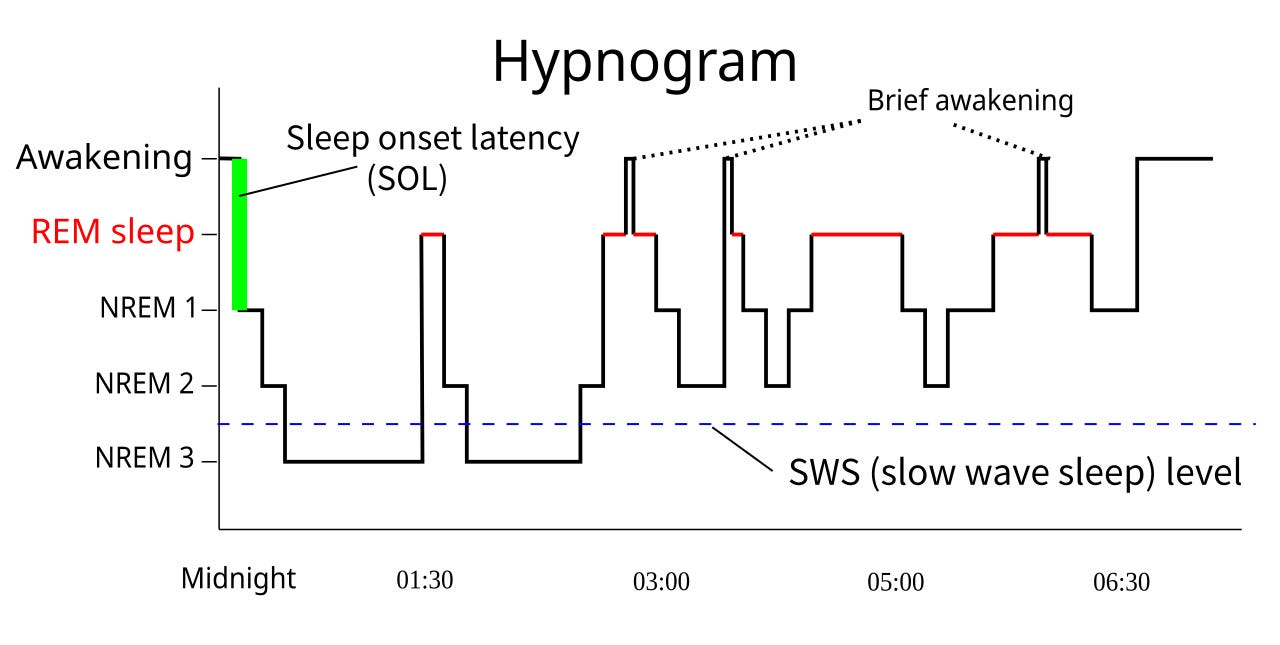
Typical sleep hypnogram (source: Wikipedia)
So when someone claims they’ve completed a “full 90-minute cycle,” especially in the second half of the night when deep sleep may be absent entirely, what does that even mean?
In actual sleep science, the term “cycle” is descriptive, not prescriptive. It reflects the oscillation between NREM and REM but was never meant to define fixed-length, repeatable blocks of sleep for optimization3.
2️⃣ There is no magical “wake-up point” every 90 minutes where you’ll feel more refreshed.
This theory conveniently explains why you sometimes wake up groggy: “You didn’t catch the right cycle.”
But that’s a false attribution.
In reality, how you feel upon waking depends on three main factors[4–6]:
- Whether you were pulled out of deep sleep (i.e. sleep inertia)
- Your current circadian rhythm (are you waking up during a biologically alert window?)
- How much total sleep debt you’ve accumulated over time
Blaming a missed “90-minute boundary” for poor wakefulness simplifies a deeply complex physiological process. Worse, it offers the illusion of control — when in truth, you may be chronically sleep-deprived and not even realize it.
Which brings us to the deeper issue:
Before you hit 7–8 hours of total sleep, any time you wake up is still a form of sleep deprivation7,8.
Sleeping just 4.5 or 6 hours may include several “cycles,” but you’ll disproportionately lose out on REM sleep — which is front-loaded into the latter part of the night. Just cutting 1–2 hours can slash your REM by 30–50% or more, impairing emotional regulation, cognitive recovery, and mental well-being1,9,10.
3️⃣ The advice to “only sleep in full cycles, never an extra 30 minutes” is dangerously misleading.
Sleep deprivation is sleep deprivation.
It happens — and the right response is to acknowledge it, and then work to improve it.
But the moment we start believing that certain forms of sleep deprivation are acceptable — or worse, can be “optimized” — we’re heading in the wrong direction entirely.
Until you reach a truly sufficient total sleep duration, every additional minute of sleep is meaningful.
And this is the most misleading — and most harmful — aspect of the 90-minute sleep cycle theory.
❓ Why Did This Theory Catch On?
Because it tells us what we want to believe:
That sleep is a waste of time. That we can hack our way around it. That there’s a neat, controllable system underneath it all.
It offers a “scientific” path to reduce sleep while boosting efficiency — and it’s easy to remember, easy to share.
In that sense, it’s not unlike the fantasy of solving sleep with a single pill.
But the reality is: sleep is complex, adaptive, and deeply biological. It’s not something to be gamified.
To improve sleep, we have to first accept — and embrace — its complexity.
3. Real-World Risks of Using the “90-Minute Cycle” as a Sleep Guide
⚠️ It systematically undervalues the real benefit of “just a bit more” sleep
When you’re sleep-deprived, those extra 30 to 60 minutes are far from “leftovers.”
This window often includes continuous core (N2) sleep and an increasing share of REM sleep — two stages essential for emotional regulation, cognitive recovery, and psychological balance.
And yet, the 90-minute sleep theory pushes in the opposite direction:
Better to sleep a bit less, it suggests, if you can wrap up a “complete cycle.”
That’s a dangerous logic — one that consistently undervalues late-night sleep and encourages people to continue trimming their sleep even when they’re already short on rest.
⚠️ It legitimizes “short sleep” under the guise of efficiency
“I only slept 4.5 hours, but it was a complete cycle.”
Statements like this are a subtle form of self-deception. They frame chronic sleep deprivation as an optimized decision — rather than a real health issue that needs to be addressed.
When short sleep is granted “scientific legitimacy,” the motivation to restore proper sleep habits erodes.
⚠️ It breeds a hard-to-disprove form of sleep anxiety
People who follow this theory often don’t sleep better.
But instead of questioning the model, they shift the explanation:
“I feel off today because I didn’t hit the cycle just right.”
It’s classic misattribution — and nearly impossible to falsify, since the whole idea of a “completed cycle” is based on subjective feelings.
The result? A self-reinforcing loop of over-analysis and stress: The more you try to calculate sleep, the more anxious and fragmented it becomes. And the pressure you carry into bed may make your mornings feel even worse.
4. What Actually Leads to Better Sleep?
▶️ First: Total Sleep Duration is the Bedrock
In the Prime Lab sleep module, the first thing we broke down was sleep length.
Why? Because among all the variables in sleep science, this one is non-negotiable.
Your long-term metabolic function, cognitive performance, and emotional stability are all determined — first and foremost — by how much sleep you get. For most adults, consistently getting 7 to 8 hours per night isn’t a luxury or idealistic goal. It’s a biological requirement — a sustainable and digestible sleep quota7,8.
🔃 Second: Consistency matters more than “perfect timing”
What really improves sleep is rhythm — something your brain can predict and trust.
That means:
- Going to bed and waking up at roughly the same time
- Keeping meals and movement anchored to stable time windows
- Reducing stimulation at night so your parasympathetic system can take over and restore you
Falling asleep, at its core, requires your brain to believe the environment is safe and predictable.
That’s why regularity trumps “precision.” It’s not about whether you hit a theoretical perfect time — it’s about whether your system can settle down at all[11–13].
At Prime Lab, our most powerful levers for improving sleep aren’t built around calculating cycles. They’re focused on reducing chronic sleep debt and misalignment with your natural rhythm.
This Wasn’t Part of the Original Plan…
This article wasn’t part of our core Prime Lab content roadmap.
But after several friends asked me what I thought about the “90-minute sleep cycle,” I realized this idea is still influencing how people make decisions about sleep — and not in a good way.
So I wanted to lay it out clearly.
Sometimes, correcting a false belief is just as valuable as building a new one.
Especially when it comes to something as foundational — and fragile — as sleep.
Intervention recommendations are geared toward generally healthy individuals. If you have existing health conditions, always follow your doctor’s instructions.
References
[1]Colten HR, Altevogt BM, editors. Sleep disorders and sleep deprivation: an unmet public health problem. Washington (DC): National Academies Press; 2006.
[2]Feinberg I, Floyd TC. Systematic trends across the night in human sleep cycles. Psychophysiology. 1979 May;16(3):283–291.
[3]Cajochen C, Reichert CF, Münch M, et al. Ultradian sleep cycles: Frequency, duration, and associations with individual and environmental factors — A retrospective study. Sleep Health. 2024 Feb;10(1 Suppl):S52-S62.
[4]Tassi P, Muzet A. Sleep inertia. Sleep Med Rev. 2000 Aug;4(4):341–353.
[5]Hilditch CJ, McHill AW. Sleep inertia: current insights. Nat Sci Sleep. 2019 Aug 22;11:155–165.
[6]Borbély AA. A two process model of sleep regulation. Hum Neurobiol. 1982;1(3):195–204.
[7]Watson NF, Badr MS, Belenky G, et al. Recommended amount of sleep for a healthy adult: a joint consensus statement of the American Academy of Sleep Medicine and Sleep Research Society. Sleep. 2015 Jun 1;38(6):843843–844.
[8]Van Dongen HPA, Maislin G, Mullington JM, Dinges DF. The cumulative cost of additional wakefulness: dose-response effects on neurobehavioral functions and sleep physiology from chronic sleep restriction and total sleep deprivation. Sleep. 2003 Mar 15;26(2):117–126.
[9]Goldstein AN, Walker MP. The role of sleep in emotional brain function. Annu Rev Clin Psychol. 2014;10:679–708.
[10]Rasch B, Born J. About sleep’s role in memory. Physiol Rev. 2013 Apr;93(2):681–766.
[11]Sletten TL, Grandner MA, Nowakowski S, et al. Sleep timing and variability: a consensus statement of the National Sleep Foundation. Sleep Health. 2023 Dec;9(6):801–820.
[12]Edinger JD, Arnedt JT, Bertisch SM, et al. Behavioral and psychological treatments for chronic insomnia disorder in adults: an American Academy of Sleep Medicine clinical practice guideline. J Clin Sleep Med. 2021;17(2):255–262.
[13]Riemann D, Spiegelhalder K, Feige B, et al. The hyperarousal model of insomnia: a review of the concept and its evidence. Sleep Med Rev. 2010 Feb;14(1):19–31.