This will be the final chapter — at least for now — of our deep dive into sleep.
Over the past twenty articles, we’ve examined sleep from nearly every angle. What you’re reading here is the distilled essence: the key insights and actionable practices drawn from both scientific evidence and firsthand experimentation.
Every sentence in this overview stands on two pillars: research and real-life testing. For any question you want to explore more deeply, click through to the linked articles for full context.
Sleep: The Operating System of Life
If you compressed the timeline of life on Earth into a single 24-hour day, humans would only appear in the final minutes. But sleep? Sleep has been running since the crack of dawn.
It predates the nervous system. It predates thought. From the earliest forms of life, biological rhythms have been synchronized with planetary rhythms.
Sleep is not just a behavior — it’s a foundational logic of life.
The Four-Dimensional Sleep Model
We evaluate sleep quality through four interlinked dimensions. These dimensions also offer concrete levers for sleep optimization.
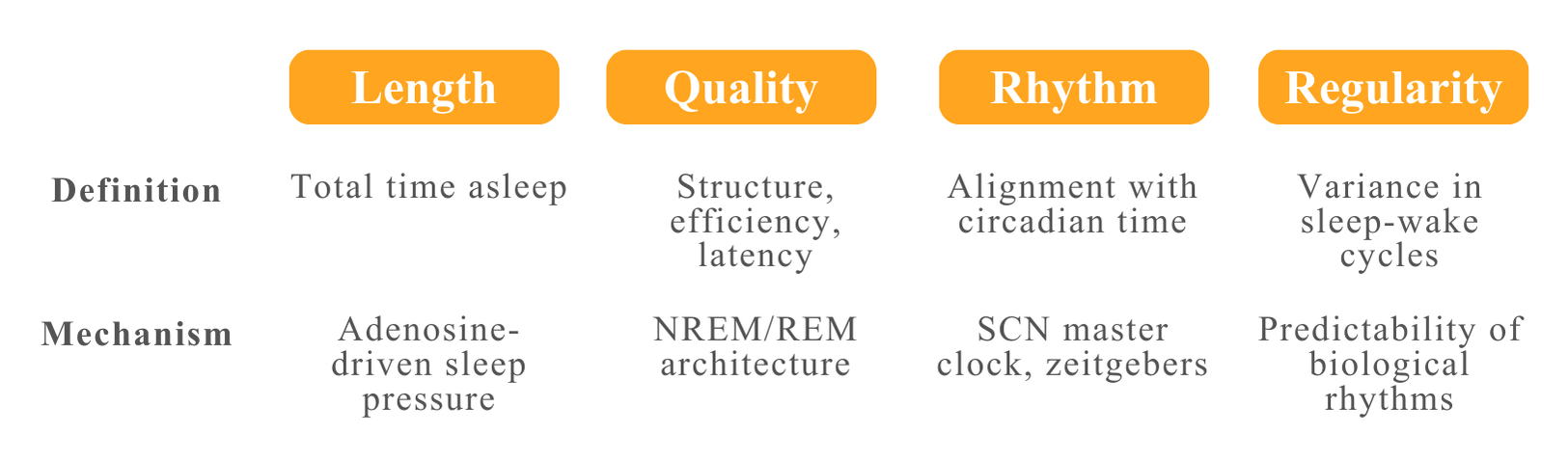
1. Length — The Total Time You’re Asleep
Sleep length refers to how long you are actually asleep (not just in bed).
- The core mechanism is adenosine buildup. Adenosine is a metabolic byproduct of daytime brain activity. It accumulates throughout wakefulness and creates “sleep pressure.” You can’t outthink it. You can’t override it with light or willpower. Deep sleep is when your brain starts “clearing the floor,” using the glymphatic system to flush out adenosine and other metabolic waste from the interstitial space.
- Ideal sleep time for adults is 7–9 hours. At Prime Lab, we recommend aiming for 7.5 to 8.5 hours. Multiple observational studies show that sleeping less than 7 hours per night significantly raises all-cause mortality and cardiovascular risk.
- Losing just one hour of sleep doesn’t only cut 1/8 of total sleep time — it can cost you 30%–50% of your REM sleep, which tends to cluster in the second half of the night.
- Chronic Sleep Deprivation Is a Slow Boil: Ten days of sleeping 6 hours a night reduces your cognitive performance to the equivalent of one full night without sleep. People often say, “I’m used to it,” but this is an illusion. Your brain learns to mask fatigue signals, yet your reaction speed, reasoning ability, and emotional control continue to degrade. And once sleep debt hits a tipping point, your brain forces micro-sleeps: 1–15 second shutdowns where you’re effectively unconscious. These can be fatal behind the wheel — more dangerous than driving drunk.
2. Quality — The Architecture of Restoration
Sleep quality has three main pillars:

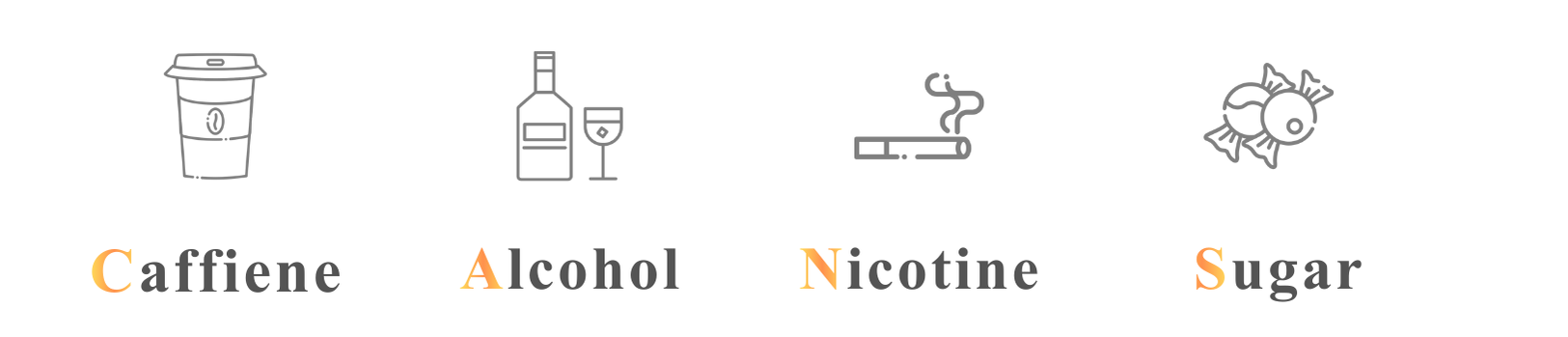
(1) The Disruptors: CANS
Caffeine, Alcohol, Nicotine, and Sugar — these four hijack nighttime recovery and wreck sleep quality.
(2) Sleep Composition: The NREM/REM Symphony
- NREM (Non-Rapid Eye Movement), especially N3 deep sleep, is when your body repairs itself, releases growth hormone, clears beta-amyloid plaques, and transfers short-term memories into long-term storage.
- REM (Rapid Eye Movement) is your emotional processing dojo. In a noradrenaline-free state, it replays emotional experiences and helps you recover psychologically and boost creativity.
Biochemical Hijackers:
- Caffeine hijacks adenosine receptors, masking the body’s natural signals of sleepiness. It also reduces the power and synchrony of slow-wave sleep (SWS). Ideally, your last cup of coffee should be before noon; even decaf should be finished before dinner.
- Alcohol induces sedation, not true sleep. It acts as a structural “power outage” in the central nervous system. Alcohol generates pseudo–slow waves that do not support physical recovery and severely disrupts REM sleep, which is critical for emotional regulation. If you must drink, limit yourself to one glass — and finish it with dinner, not after.
(3) Sleep Latency: Switching Off the War Mode
Struggling to fall asleep? You’re likely stuck in one of these three loops:

- Hyperarousal: Your threat-detection system is still running — your brain is still “on call.”
- Circadian Misalignment: You’re trying to sleep outside your natural rhythm (e.g. jet lag or night owls).
- Conditioned Arousal: Your brain now associates bed with scrolling, stress, or insomnia.
Key here: Your ability to fall asleep is deeply tied to whether your nervous system can shift from fight mode (sympathetic) to restore mode (parasympathetic).
Tactical Tools for Falling Asleep Faster:
- Heat exchange: Take a warm bath or foot soak 60–90 minutes before bed. This dilates peripheral blood vessels, helping your core temperature drop — a vital signal to initiate sleep.
- Light discipline: Avoid screens 1–2 hours before bed. Use warm lights (~2000K) in the evening and eliminate blue light exposure.
- Cognitive Off-ramping: Practice the “Four Nos”: No planning, no problem-solving, no responsibility, no evaluation. Avoid logical entanglement before sleep.
- Biochemical support: Magnesium acts like noise-canceling for your nervous system. When needed, low-dose melatonin (0.3–1.0 mg) can help phase-shift your rhythm, but it’s not a cure for chronic insomnia.
(4) Sleep Efficiency: Staying Asleep
Sleep efficiency = time asleep ÷ total time in bed.
If you’re awake for 15–20 minutes without falling asleep, leave the bed. Do something relaxing until drowsiness returns. Never let your bed become a battleground of wakefulness.
Biochemical Hijackers:
- Nicotine powerfully activates the sympathetic nervous system. Because of its short half-life, nicotine levels drop during the night, triggering withdrawal responses that fragment sleep and repeatedly pull the brain out of restorative stages.
- Sugar — especially high–glycemic-index carbohydrates — causes sharp blood glucose swings. This can lead to nocturnal reactive hypoglycemia, forcing the body to release norepinephrine and cortisol as an emergency response, abruptly interrupting nighttime repair and recovery.
Metabolic Tips for Better Sleep Efficiency:
- Avoid carbs 3–4 hours before bed. This helps stabilize overnight metabolism and prevents hypoglycemia-induced wake-ups.
- Keep your core body temperature low during the night. Make sure your bedding is breathable — while warming your hands and feet can help you fall asleep, keeping your feet cool and the environment well-ventilated is more effective for maintaining deep, uninterrupted sleep throughout the night.
3. Rhythm — Aligning With the Planet’s Clock
Master Your Zeitgebers:
- Light: Get natural light within 15 minutes of waking — even on cloudy days. Avoid blue light (460–480 nm) at night. Switch to warm light (~2000K) in the evening.
- Food Timing (eTRE): Time-restricted eating (8–10 hour window during daytime) helps sync peripheral clocks in your liver and pancreas with the brain’s master clock.
- Melatonin (low-dose): 0.3–1.0 mg is sufficient to spike plasma levels to nighttime norms. Think of it as a starter pistol for sleep, not a sedative.
4. Regularity — Stability > Extremes
Biological systems hate surprises. Consistency beats occasional perfection. Sleep regularity matters more than sleeping “early” once in a while.
- Waking up at the same time daily helps anchor your rhythm and builds sleep pressure for the next night.
- Forget the “90-minute sleep cycle” myth. Sleep architecture is inherently nonlinear — deep sleep dominates the first half of the night, while REM sleep clusters in the second half. Forcing your sleep into neatly sliced “cycles” can disproportionately cut into REM, which is critical for emotional healing. Chasing “perfect cycles” is often just a way of rationalizing self-imposed sleep deprivation.
- Sleep isn’t something you can force with willpower. Aggressive “sleep rules” can backfire and trigger stress responses. Instead, gradually shift your patterns in a way that honors your subconscious need for safety.
Special Chapter: The Healing Power of Dreams
REM sleep — the dream stage — is a powerful tool for emotional recovery.
- Dreams are not about wish fulfillment. They’re side-effects of emotional detox.
- Nightmares are often advanced-level emotional surgeries. If your dreams are dynamic and evolving, your brain is doing its healing work. Repetitive, frozen, or terrifying dreams that wake you may require professional support.
- Don’t obsess over dream interpretation. Overanalyzing can actually reinforce the emotional weight of your dreams.
- Let’s sleep on it — trust your brain’s natural cleansing power. Give yourself enough time to dream (i.e. get a full 7–8 hours of sleep).
Rebuild Your Life Around Sleep
Good sleep isn’t just a nighttime practice — it’s a daily lifestyle output.
It’s what allows you to wake up early and actually use the morning for exercise or focused work.
It’s what sharpens your thinking, balances your mood, and helps you make better decisions — which leads to better outcomes and more positive feedback from life.
But here’s the paradox: the more you try to “conquer” sleep through effort, the worse you’ll sleep. When your rhythms align, your environment feels safe, and your nervous system finally lets go — sleep just happens.
The essence of sleep is simple: In a safe moment, let go of the need to keep responding to the world.
Intervention recommendations are geared toward generally healthy individuals. If you have existing health conditions, always follow your doctor’s instructions.