In the last piece, I talked about outdoor air quality. This one is about the air indoors.
In Chinese food culture, wok hei is the soul of the dish. But while we’re reveling in the pleasure of a blazing stir-fry, the kitchen is quietly turning into a miniature heavy-industrial chemical plant.
What we call wok hei is, in reality, a mixture of oil-droplet aerosols, ultrafine particles, and volatile / semi-volatile organic compounds generated by high-heat cooking. It creates aroma — but it also creates a measurable burden of indoor air pollution. We love that smell. Our blood vessels and lungs do not.
There is one puzzling phenomenon that has long stood out: smoking rates among Chinese women are not particularly high, yet lung cancer incidence has remained stubbornly elevated. In multiple studies of women who never smoked, long-term exposure to cooking fumes from high-heat cooking has shown a signal of association with higher lung cancer risk. It is not the sole cause, but it is an important contributor [1–3].
1. The “Invisible Killers” Hiding in Wok Hei
Wok hei conceals three very different kinds of “killers”:
- Particulate matter (PM2.5): the physical assassin
It comes from the atomization of heated oil, the charring of food particles, and organic aerosols generated through pyrolysis. These tiny particles can bypass the nasal barrier and reach the alveoli directly. Some ultrafine particles (UFPs, particles smaller than PM0.1) can even cross the alveolar-capillary barrier, enter the bloodstream, and trigger systemic chronic inflammation. Oil choice, moisture content of ingredients, and cooking method all directly affect how much PM2.5 is generated [4–6].
- PAHs (polycyclic aromatic hydrocarbons) and VOCs (volatile organic compounds): chemical toxins
Representative examples include benzo[a]pyrene, a potent carcinogen, and acrolein, which carries a sharp, irritating smell. These are typically produced through the thermal oxidative breakdown of unstable oils [7–9].
- Nitrogen oxides (NOx) and carbon monoxide (CO): byproducts of open flame
NOx is a product of “air burning itself.” When you cook over an open flame, the intense heat at the center of the flame forcibly splits nitrogen molecules in the air — effectively causing the air itself to combust under high heat — and generates nitrogen oxides. These compounds can deeply oxidize the respiratory barrier, contributing to asthma and that so-called “oil-fume intoxication” feeling of dizziness and lightheadedness. Blue flames at very high temperatures are especially likely to generate NOx. Among the nitrogen oxides, the one most relevant to health and most commonly monitored is NO₂. In poorly ventilated spaces, it can linger indoors for hours and spread throughout the home. Switching to an electric or induction stove can significantly reduce this combustion-derived NO₂ exposure.
Studies show that gas stoves and gas ovens significantly increase indoor NO₂ exposure, that the gas can spread throughout the home and persist for hours, and that switching to electric or induction cooking can significantly reduce NO₂ levels 12,13.
Carbon monoxide (CO), by contrast, is a product of incomplete combustion. If the flame on a gas stove appears orange-red and soot is building up, that is a sign combustion is incomplete — and CO may be forming. Carbon monoxide is colorless and odorless, yet in poorly ventilated conditions it can cause acute poisoning and, in severe cases, even death 14,15.
In truth, once you use an open flame, harmful byproducts are produced regardless of whether the flame is a high-temperature blue or a lower-temperature yellow.
So let’s break it down one by one: how do we reduce or avoid these three categories of kitchen pollutants hidden inside wok hei?
2. How Kitchens “Manufacture” PM2.5
PM2.5 is the most visible threat in cooking fumes. Its concentration depends on the stability of the oil, the violence of the cooking method, and ventilation 16.
The stability of an oil depends on its fatty-acid structure. Seed oils such as soybean oil and corn oil are rich in polyunsaturated fatty acids. Under high heat, their molecular chains behave like brittle dry twigs — they break apart easily. By contrast, camellia oil and avocado oil, which are rich in monounsaturated fatty acids, have tighter molecular structures and stronger heat tolerance 17,18.
Repeatedly heated oil also develops a lower smoke point, and its oxidation products can trigger fresh bursts of particle generation.
**These unstable oils oxidize more easily at high temperatures and may produce more oxidative cleavage products, including aldehydes. But the amount of particulate matter emitted is also shaped by temperature and cooking method **17,19.
As for cooking technique, the higher the energy input, the more PM2.5 is produced.
Steaming and boiling are limited to around 100°C, so PM2.5 release is minimal.
Low-temperature sautéing and pan-cooking usually fall in the 120°C–150°C range. As long as the oil is not smoking, particulate release is relatively controllable.
But in the high-heat stir-frying and deep-frying that generate true wok hei, temperatures exceed 200°C. Oil undergoes near-instant pyrolysis and polymerization, and particle concentrations shoot upward fast [20–22] (with peak PM2.5 levels reaching around 20,000 μg/m³).
There is another overlooked source of PM2.5: moisture. When wet vegetables hit the pan, the burst of steam acts like a spray nozzle, physically shattering oil into tiny droplets. Draining ingredients well before adding them to the pan can meaningfully reduce PM2.5 23.
To put it a bit loosely, the essence of wok hei is basically a PM2.5 explosion in the kitchen.
The low-PM2.5 kitchen formula: high-smoke-point refined oils + temperature-controlled cooking (mainly steaming/boiling and using induction) + dry ingredients = cleaner air.
Also, turning on the range hood and keeping the kitchen ventilated (for example, leaving the window slightly open) are effective ways to lower PM2.5 concentration. When extremely smoky, high-temperature stir-frying over fierce heat is unavoidable, and the hood plus ventilation still cannot fully control PM2.5, wearing a **KN95 **mask can serve as the last physical line of defense in extreme situations.
3. Chemical Toxins: How to Avoid Them
The PAHs and VOCs mentioned above mainly come from two sources.
One is seed oils like soybean oil and corn oil. The other is unrefined oils rich in impurities.
This is where a major misunderstanding comes in. Take extra virgin olive oil, for example. We tend to think of it as the very definition of a high-quality fat. That is not wrong. But extra virgin oils contain many impurities. They are perfectly fine for room-temperature use, yet in high-heat stir-frying, their smoke points are not especially high, and they can generate large amounts of harmful compounds.
We need to correct one idea: “extra virgin” does not automatically mean healthier, and “refined” does not automatically mean inferior.
“Extra virgin” olive oil or avocado oil contains substantial amounts of fruit solids, chlorophyll, and free fatty acids. Its smoke point is lower than that of refined oil. Once heated above roughly 190–200°C, it may approach or exceed its smoke point, begin to scorch and smoke, and generate harmful substances including VOCs 24,25.
In high-temperature cooking, refining is a necessary process that removes impurities, raises smoke point, and protects the respiratory tract 26,27.
Try not to do high-heat stir-frying in the first place. But if high-temperature cooking is truly necessary, refined (Grade 1) camellia oil and refined avocado oil are better choices [28–34]:
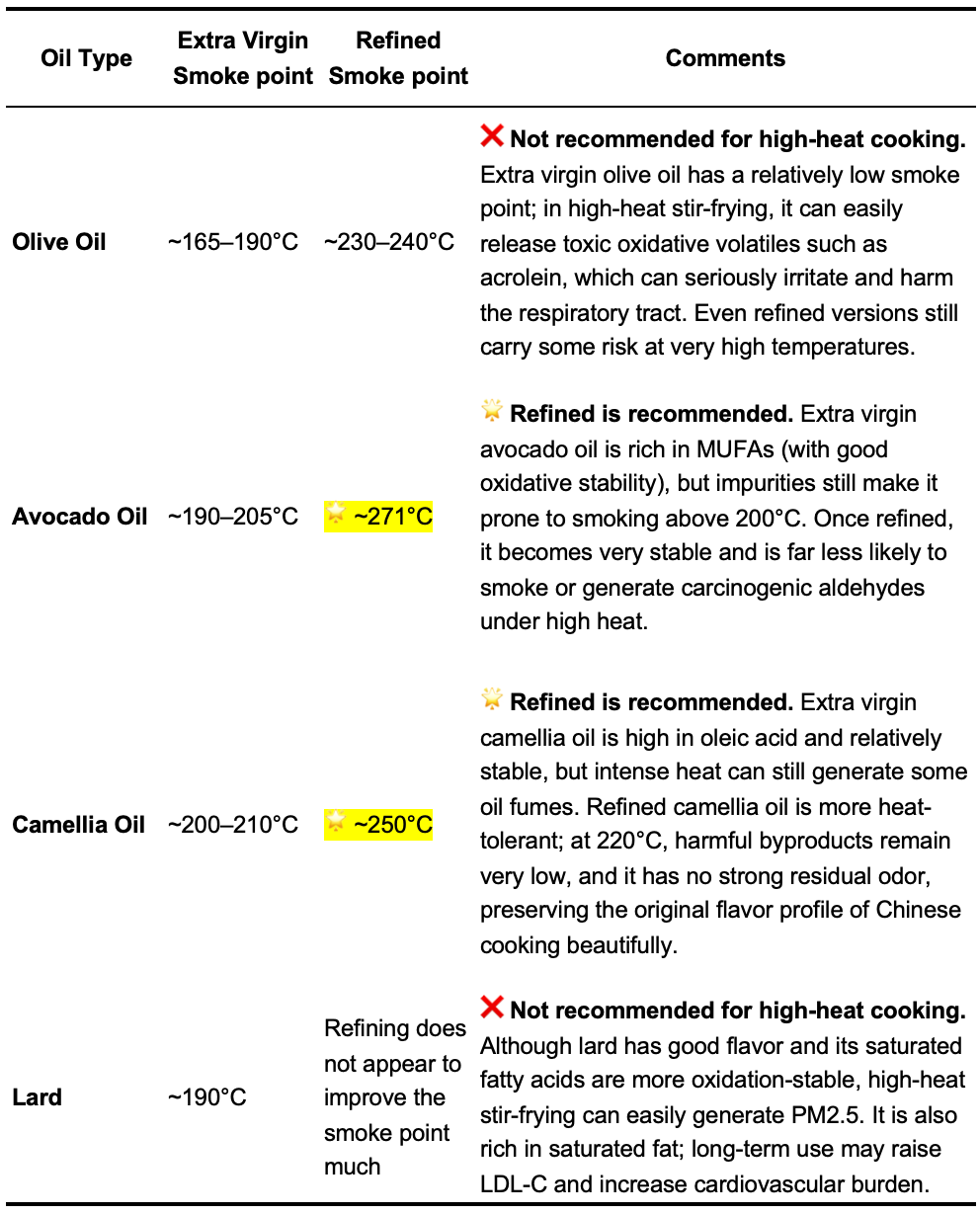
- 🥑Refined avocado oil and refined camellia oil have high smoke points and strong thermal stability. They are less likely to smoke or thermally crack, making them better everyday workhorse oils for Chinese stir-frying.
- 🥗Olive oil:relatively lower smoke point and more flavor-sensitive. Not well suited for aggressive high-heat stir-frying. Better for dressings or low-temperature cooking.
- 🐷Lard:stable and oxidation-resistant, but prone to generating PM2.5. Increased saturated fat intake may also raise LDL-C. (Recent research suggests saturated fat is not “as bad” as it was once made out to be, and its health effects depend on the food source — but it is still not recommended as a long-term daily oil for high-heat cooking.) It is not ideal as a primary high-temperature household oil.
💡 Prime Lab summary:
Use refined avocado oil and refined camellia oil as your main oils for high-heat stir-frying. Use olive oil for lower-temperature cooking. And do not rely on lard as your long-term default oil for daily high-heat cooking.
4. Nitrogen Oxides and Carbon Monoxide: The Price of Open Flame
Both are byproducts of fire itself. To deal with them, the core issue is not the oil. It is the heat source and the ventilation.
- Heat source:Avoid open flames when possible. Prioritize a high-powered induction cooker. Without an open flame, the surrounding air is no longer scorched at temperatures reaching into the thousands of degrees, and NOx generation is almost cut off at the source.
- Flame control:If you must use gas, use the “hot pan, cool oil” approach, and make sure the flame does not extend beyond the bottom edge of the pan. That reduces the amount of surrounding air exposed to extreme heat.
- Ventilation:Many people shut all doors and windows tightly when they cook. That creates a negative-pressure trap in the kitchen and causes exhaust performance to collapse. When cooking, keep the kitchen door closed, butthe window must be left slightly open. Fresh air needs to come in from outside to form a directed airflow that pushes the fumes into the hood.
And the range hood should be turned on early and turned off late: switch it on before igniting the stove, and let it continue running for another 5–10 minutes after the flame is turned off.
A Quick Summary
Wanting wok hei does not mean you have to sacrifice air quality.
From switching to a bottle of refined Grade 1 camellia oil, to learning the simple trick of “door closed, window cracked” for make-up air, to replacing open flame with an induction cooker, and even wearing a KN95 mask when necessary — these small, lightweight changes are really about reclaiming control over your own breathing from the smoke.
Intervention recommendations are geared toward generally healthy individuals. If you have existing health conditions, always follow your doctor’s instructions.
References
[1]Han B, Zheng R, Zeng H, Wang S, Sun K, Chen R, et al. Cancer incidence and mortality in China, 2022. J Natl Cancer Cent. 2024;4(1):47–53.
[2]Zeng X, Liu S, Zhang M, et al. Smoking Prevalence in Urban and Rural Areas — China, 2024. China CDC Wkly. 2025;7(22):751–759
[3]Xue Y, Jiang Y, Jin S, Li Y. Association between cooking oil fume exposure and lung cancer among Chinese nonsmoking women: A meta-analysis. Onco Targets Ther. 2016;9:2987–2992.
[4]See SW, Balasubramanian R. Physical characteristics of ultrafine particles emitted from different cooking methods. Aerosol Air Qual Res. 2006;6(1):82–92
[5]Nemmar A, Hoet PHM, Vanquickenborne B, et al. Passage of inhaled particles into the blood circulation in humans. Circulation. 2002;105(4):411–414.
[6]Brook RD, Rajagopalan S, Pope CA III, et al. Particulate matter air pollution and cardiovascular disease: An update to the scientific statement from the American Heart Association. Circulation. 2010;121(21):2331–2378.
[7]World Health Organization. WHO guidelines for indoor air quality: selected pollutants. Copenhagen: WHO Regional Office for Europe; 2010.
[8]Seaman VY, Bennett DH, Cahill TM. Indoor acrolein emission and decay rates resulting from domestic cooking events. Atmos Environ. 2009;43:6199–6204.
[9]Pellizzari ED, Michael LC, Thomas KW. The identification of 1,3-butadiene and benzene formation from cooking oils. J Air Waste Manag Assoc. 1995;45(2):101–109.
[10]Lin W, Brunekreef B, Gehring U. Meta-analysis of the effects of indoor nitrogen dioxide and gas cooking on asthma and wheeze in children. Int J Epidemiol. 2013;42(6):1724–1737. doi:10.1093/ije/dyt150.
[11]Jarvis D, et al. Nitrogen dioxide. In: WHO. WHO guidelines for indoor air quality: selected pollutants. Copenhagen: WHO Regional Office for Europe; 2010.
[12]Kashtan Y, Nicholson M, Finnegan CJ, Ouyang Z, Garg A, et al. Nitrogen dioxide exposure, health outcomes, and associated demographic disparities due to gas and propane combustion by U.S. stoves. Sci Adv. 2024;10(18):eadm8680.
[13]Paulin LM, Diette GB, Scott M, McCormack MC, Matsui EC, et al. Home interventions are effective at decreasing indoor nitrogen dioxide concentrations. Indoor Air. 2014;24(4):416–424.
[14]Traynor GW, Girman JR, Apte MG, Dillworth JF. Indoor air pollution from residential cooking: emissions of carbon monoxide, carbon dioxide, nitrogen dioxide, and particles. J Expo Anal Environ Epidemiol. 1996;6(1):83–98.
[15]Morgan GB, et al. Carbon monoxide emissions from gas ranges: field and laboratory characterization. NBS/NIST technical reports. 1980s.
[16]Lu F, Shen B, Yuan P, Li S, Sun Y, Mei X. The emission of PM2.5 in respiratory zone from Chinese family cooking and its health effect. Sci Total Environ. 2019.
[17]Zhuang Y, Dong J, He X, Wang J, Li C, et al. Impact of heating temperature and fatty acid type on the formation of lipid oxidation products during thermal processing. Front Nutr. 2022;9:913297.
[18]Moumtaz S, Percival BC, Grootveld KL, Gibson J, et al. Toxic aldehyde generation in and food uptake from culinary oils during frying practices. Sci Rep. 2019;9:
[19]Szabo C, et al. Effects of repeated heating on fatty acid composition of plant-based cooking oils. Foods. 2022;11(2):
[20]IARC Working Group on the Evaluation of Carcinogenic Risks to Humans. Household Use of Solid Fuels and High-temperature Frying. IARC Monogr Eval Carcinog Risks Hum. 2010;95. Lyon (FR): International Agency for Research on Cancer.
[21]See SW, Balasubramanian R. Physical characteristics of ultrafine particles emitted from different cooking methods. Aerosol Air Qual Res. 2006;6(1):82–92.
[22]Lyu J, et al. Characteristics of PM2.5 emissions from six types of cooking kitchens. Sci Total Environ. 2022;
[23]Chen C, Zhao Y, Zhao B. The impact of water on particle emissions from heated cooking oil. Aerosol Air Qual Res. 2020;20: (AAQR: aaqr-19–09-oa-0427).
[24]Seaman VY, Bennett DH, Cahill TM. Indoor acrolein emission and decay rates resulting from domestic cooking events. Atmos Environ. 2009;43:6199–6204.
[25]Lachowicz JI, Sówka I, et al. Cooking particulate matter: a systematic review on emission characteristics and influencing factors. Atmosphere. 2022;14(1):12.
[26]Bu Z, Chen C, Tian L, et al. Emission rates of multiple air pollutants generated from Chinese residential cooking. Environ Int. 2018;114:30–40.
[27]Chiang KM, et al. Particulate matters, aldehydes, and polycyclic aromatic hydrocarbons produced from deep-frying emissions: comparisons of three cooking oils with distinct fatty acid profiles. NPJ Sci Food. 2022;6:28.
[28]IARC Working Group. Household Use of Solid Fuels and High-temperature Frying. IARC Monographs. 2010;95.
[29]Xue Y, Jiang Y, Jin S, et al. Association between cooking oil fume exposure and lung cancer among Chinese nonsmoking women: a meta-analysis. Onco Targets Ther. 2016;9:2987–2995.
[30]De Alzaa, F., Guillaume, C., & Ravetti, L. (2018). Evaluation of Chemical and Physical Changes in Different Commercial Oils during Heating. Acta Scientific Nutritional Health, 2(6), 2–11.
[31]Grootveld, M., et al. (2001). In vivo absorption, metabolism, and toxicological effects of α,β-unsaturated aldehydes in food. Journal of Clinical Investigation.
[32]Moumtaz, S., Grootveld, M., et al. (2019). Health Effects of Heating Dietary Oils. (De Montfort University Research).
[33]Zhu, F., et al. (2019). Changes of polycyclic aromatic hydrocarbons and quality of camellia oil during heating. LWT — Food Science and Technology.
[34]McGee, H. (2004). On Food and Cooking: The Science and Lore of the Kitchen. Scribner.