From the previous two articles, we know one thing clearly: microplastic exposure is real. Microplastics have been detected in drinking water, food, air, human blood, and placenta 1,2[20–23].
But when it comes to the question, “How much clinical harm does everyday exposure actually cause?”, we still lack high-quality causal evidence 3,24,25. That means microplastics are worth optimizing around in a low-friction way, but they should not steal your attention budget from sleep, exercise, and diet.
The key here is cumulative exposure. The potential harm is more likely to come from decades of low-dose, continuous accumulation. Each reduction may be small, but over time, consistency creates compounding returns. From this perspective, microplastic prevention is perfectly aligned with the long-termist philosophy Prime Lab has always advocated 24,25.
You will not have a heart attack because you ate one meal of Coke and fried chicken. You will not be poisoned because you drank one plastic bottle of water. But thirty years of directional choices can put us on very different health trajectories.
There is one more thing we need to make clear: the logic of action is low-cost reduction of intake, not “detox.” Sweating out plastics, using probiotics to degrade microplastics, fasting to clear plastic burden from the body, chelation therapy — these claims currently do not have particularly solid human evidence. Don’t waste your money 26,27.
Priority 1: Don’t Let Hot Food Touch Plastic
If you remember only one thing from this article, remember this:
Anything too hot to touch should not touch plastic.
Temperature is a powerful amplifier of microplastic release. Release can increase by several-fold to dozens-fold 4.
A second amplifier that many people overlook is fat. Fat-soluble additives carried by microplastics — such as phthalates — migrate much faster into oily foods than into water-based foods 5. In other words, a freshly cooked stir-fry packed into a plastic container, a bowl of curry in a plastic bowl, or a hot latte in a plastic cup may be riskier than hot water alone.
You might say, “But my container is labeled microwave-safe.”
That label only means the container should not visibly melt, crack, or exceed traditional safety limits for food-contact materials during microwave heating. It does not mean it releases no microplastics or nanoplastics 4.
- Once you understand this, you can probably think of many everyday scenarios worth optimizing:
- Takeout boxes holding hot food
- Restaurant takeout containers placed directly into the microwave
- Plastic bags wrapped around hot egg pancakes or fried dough sticks
- Disposable plastic cups filled with boiling water
Baby bottles deserve special attention. A 2020 study published in Nature Food found that PP baby bottles used to prepare formula at 70°C released about 16 million microplastic particles per liter. At 25°C, that number dropped by about 27-fold 6.
The adjustment is simple: prepare formula in a glass container first, let it cool, and then transfer it into a plastic bottle — or use a glass baby bottle directly. Repeated steam sterilization can also accelerate bottle aging and particle release 6.
A quick note on nonstick pans: scratched nonstick coatings can release PTFE microplastic particles 7. If the bottom of the pan is visibly scratched, don’t be sentimental — replace it, or switch to cast iron or stainless steel.
Another easily overlooked item is the disposable paper cup, because it looks like it is made of paper.
In reality, almost all disposable paper cups are lined with a thin plastic film, usually polyethylene (PE), to prevent leakage. That film is the actual surface touching your drink. When hot coffee or hot water is poured in, the high-temperature liquid can prompt the plastic lining to release microplastic and nanoplastic particles.
A 2021 study from the Indian Institute of Technology measured this directly: when 85–90°C hot water was poured into an ordinary disposable paper cup and left for 15 minutes, each cup released about 25,000 microplastic particles 8. If you drink three hot coffees a day from disposable paper cups, that adds up to roughly 27 million microplastic particles per year.
When the same paper cup holds cold water or iced drinks, the release drops dramatically 4,8. Once again, this confirms the same core principle: the problem is the combination of high temperature + plastic contact surface.
For people who drink coffee every day — like me — here is a quick fix:
Best option: bring your own stainless-steel or glass cup. Chains like Manner and Starbucks often offer discounts for reusable cups. The original intent may be environmental protection and cost savings, but another benefit is that we avoid tens of thousands of microplastic particles every day.
Second-best option: if you forgot your cup, order it iced or cold. Iced Americano, iced latte, cold brew — the liquid temperature is low, so release from the plastic lining is much lower. It is not a perfect solution, but it is much better than letting a hot drink sit against a plastic-coated inner surface.
Worst option: hot coffee + disposable paper cup + holding it for a long time before drinking. The higher the temperature and the longer the contact time, the more release occurs. If you buy a hot Americano and slowly sip it at your desk all morning, the microplastics in that cup are continuing to increase over time.
Priority 2: Pay Attention to Drinking Water
Many people assume bottled water is cleaner than tap water. But from the perspective of microplastic exposure, bottled water is not naturally superior. Studies have detected relatively high levels of microplastics and nanoplastics in bottled water 9, while direct comparisons with tap water still depend heavily on region, water source, and detection methods.
The Columbia University study mentioned earlier (Qian et al., PNAS, 2024) found that bottled water contained an average of about 240,000 microplastic and nanoplastic particles per liter, about 90% of which were nanoplastics 9,28.
As I explained in the article on how to drink water, the best home-drinking-water solution is reverse osmosis (RO) or nanofiltration (NF) membrane filtration. Reported removal rates for microplastics are often above 90%, far better than ordinary pitcher filters or simple activated carbon 10,29,30.
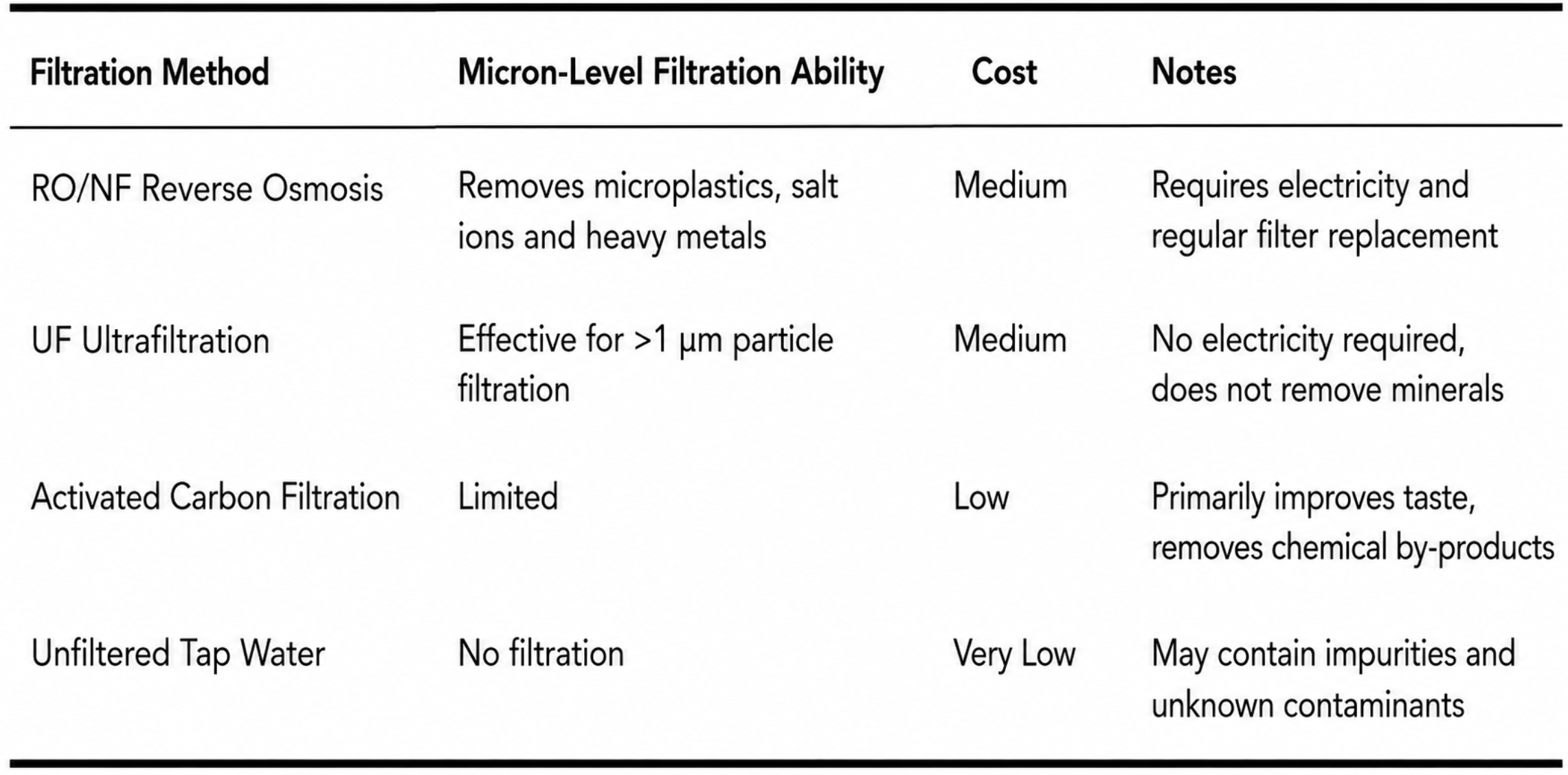
Daily practical guide:
- Install an RO or NF water filter at home.
- Bring a stainless-steel or glass bottle when going out.
- Avoid drinking bottled water that has been exposed to high heat, direct sunlight, or left in a car all day.
In fact, quite a few “old-school wellness habits” contain everyday wisdom. For example: bring a glass or stainless-steel thermos when going out, and refill it with hot water when available. Whether hot water is better than cold water is a separate topic worth discussing. But in terms of reducing microplastic intake, bringing your own cup works remarkably well.
A Special Focus Combining Priority 1 + 2: Disposable Tea Bags
Many people avoid bottled water and never microwave plastic containers, yet still brew tea every day with plastic tea bags.
And this is exactly the classic high heat + plastic scenario.
Many pyramid-shaped tea bags that look silky are actually made of nylon or PET (polyethylene terephthalate). You pour in near-boiling water, steep for 3–5 minutes, and some people even leave the tea bag in the cup until the final sip. That means plastic is continuously immersed in hot liquid, under release conditions that may be even more extreme than hot takeout food sitting in a plastic box.
In 2019, a research team from McGill University measured this directly: one plastic tea bag steeped in 95°C water for 5 minutes released about 11.6 billion microplastic particles and 3.1 billion nanoplastic particles 11.
Put that number into everyday life: if you drink three cups of tea a day brewed from plastic tea bags, that is about 16 trillion microplastic and nanoplastic particles per year — from tea alone.
If you switch to loose-leaf tea with a metal strainer, or cotton tea bags, that number gets close to zero.
What is interesting is that paper tea bags often cost less, while translucent tea bags are more likely to be positioned as “premium” or “boutique.” Partly because they look more refined, and partly because translucent bags display whole leaves and flower petals more beautifully and may allow more complete extraction (vs. opaque paper tea bags, which are more likely to contain broken tea leaves).
But simply changing how you brew tea can massively reduce microplastic intake.
Small effort, clear return.
How to do it:
- Best: loose-leaf tea + glass / ceramic teapot + stainless-steel strainer.
- Second-best: tea bags confirmed to be made of 100% cotton gauze or unbleached pure paper (without a heat-sealed plastic layer). “Corn fiber” and other biodegradable plant-based synthetic materials are often made from PLA (polylactic acid) derived from fermented corn starch, and may still carry a risk of releasing microplastics.
- Avoid: translucent, glossy, mesh-textured “premium” pyramid tea bags. They are very likely to be nylon or PET.
A simple way to judge: if the tea bag feels smoother and tougher than ordinary paper, and its edges are heat-sealed rather than stapled, it probably contains plastic.
Priority 3: Indoor Dust and Air
You spend at least 8 hours a day in your bedroom, and bedding, pajamas, carpets, and textiles are dense sources of microplastic fibers.
A 2019 simulation study by Vianello and colleagues found that one hour of sleep may lead to inhalation of about 11.3 microplastic fibers or particles 12. That may not sound like much, but multiply it by 365 days and then by decades — that is what cumulative exposure means.
Children’s rooms deserve even more attention. Infants and young children have frequent hand-to-mouth behavior, higher inhalation exposure per unit body weight, and developmental windows that are more sensitive to environmental interference.
The core practice comes down to three things: use damp cloths and wet mops instead of dry sweeping (dry sweeping resuspends settled particles into the air); place a HEPA air purifier in the bedroom; and reduce polyester carpets, fleece blankets, and synthetic-fiber curtains in the bedroom 31.
Human studies directly quantifying HEPA removal of microplastics are limited, but the engineering principle of particle capture is clear and biologically plausible. It also brings extra benefits — lower PM2.5, allergens, and dust-mite burden — which can improve both sleep quality and respiratory health.
Clothing and Home Textiles: Focus on What Touches Your Skin
For textiles that stay close to the body for long periods — underwear, pajamas, bedsheets, pillowcases — prioritize natural fibers such as cotton, linen, and silk.
The core advantage of natural fibers is not “zero shedding.” Cotton sheds fibers too. But cotton, linen, silk, and wool are not petroleum-based plastic microfibers, and the fibers they release can biodegrade 13. The risk profile is fundamentally different.
For synthetic fabrics, fiber release is highest during the first few washes, so wash new synthetic clothing separately several times before wearing regularly 14,15.
And sports quick-dry fabrics? Wear them when needed. The benefits of exercise far outweigh the potential risk from that small amount of fiber exposure.
Food: Control the Packaging Interface Before Obsessing Over the Food Itself
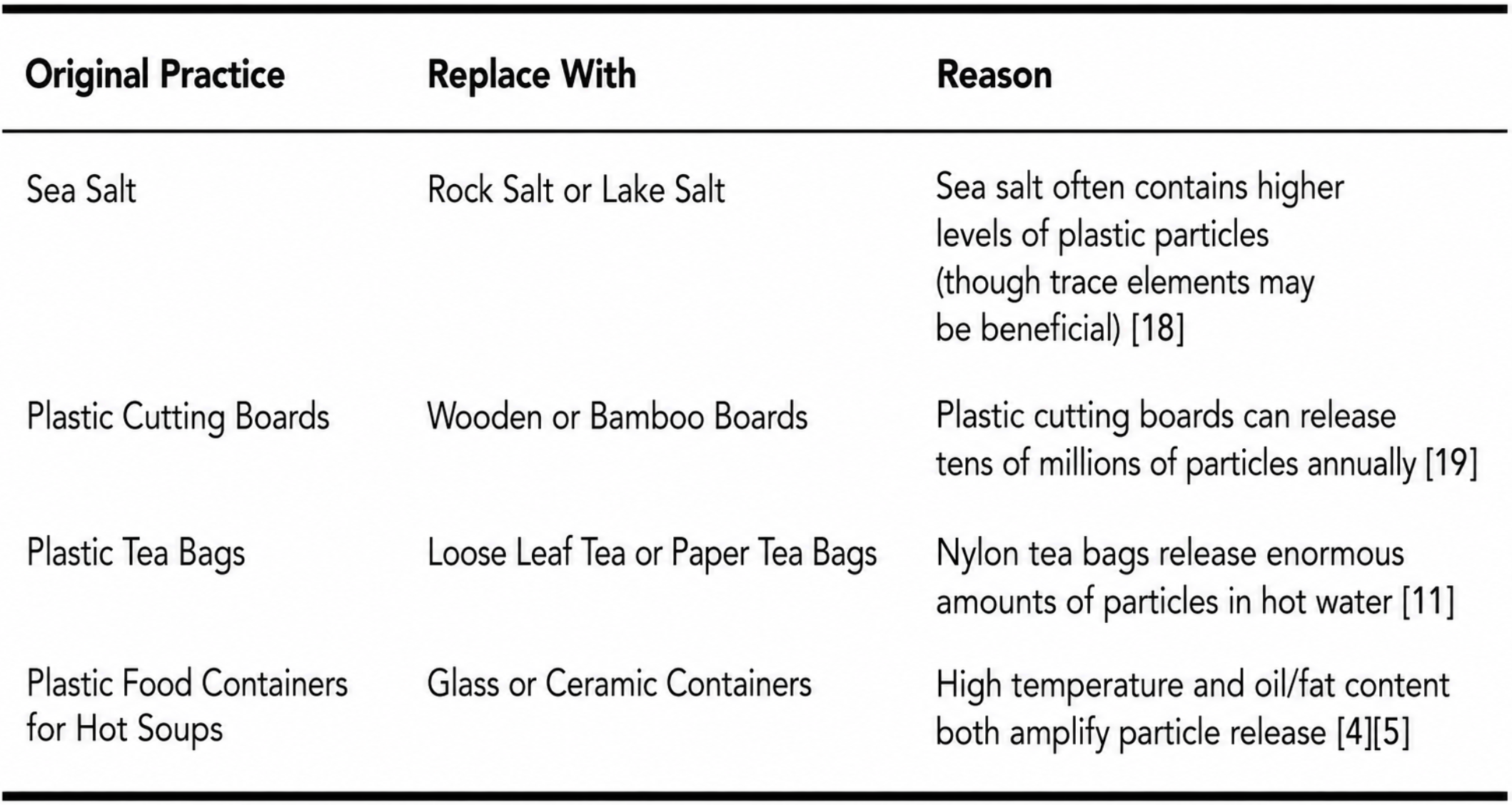
Instead of worrying about “which fish contains more microplastics” or whether “sea salt is dirtier than rock salt,” the more effective strategy is to manage the contact surface between food and plastic.
Hot food should not touch plastic, as discussed above. Avoid microwaving sealed ready-to-eat foods directly in plastic packaging.
Do not stop eating fish because of microplastics. Microplastic levels in fish muscle tissue are usually much lower than in the gastrointestinal tract (just don’t eat the fish gut), and lower than in shellfish that are eaten whole 16. The benefits of omega-3 and high-quality protein are far greater than the known risks from microplastics 17. If anxiety makes you reduce fish intake and replace it with processed meat or ultra-processed foods, the net effect will likely be worse [32–34].
A few easy swaps:
Summary
Think of reducing microplastic exposure as a low-cost habit with decades of cumulative return, not as a one-time detox.
Keep anything hot enough to burn your hand away from all plastic containers. This is the single highest-return behavior, especially for oily hot foods. If you have an infant at home, use glass bottles or let liquids cool before transferring.
Install a membrane-based water filter at home, such as RO or NF. One upfront investment reduces exposure every day. Bring a stainless-steel or glass bottle when going out, and buy less bottled water.
Use wet cleaning in the bedroom and add a HEPA air purifier. You spend 8 hours a day there, making it an extremely cost-effective intervention zone.
Prioritize natural fibers for close-to-skin clothing and bedding. Start with the layer that touches your skin while sleeping.
Do not let microplastic anxiety damage your health foundations. Keep eating fish. Keep exercising. Keep sleeping well. With those foundations intact, reduce plastic contact where it is easy to do so — and let time and compounding work for you.
Intervention recommendations are geared toward generally healthy individuals. If you have existing health conditions, always follow your doctor’s instructions.
References
[1]Leslie HA, van Velzen MJM, Brandsma SH, Vethaak AD, Garcia-Vallejo JJ, Lamoree MH. Discovery and quantification of plastic particle pollution in human blood. Environ Int. 2022 May;163:107199.
[2]Jenner LC, Rotchell JM, Bennett RT, Cowen M, Tentzeris V, Sadofsky LR. Detection of microplastics in human lung tissue using μFTIR spectroscopy. Sci Total Environ. 2022 Jul;831:154907.
[3]Campanale C, Massarelli C, Savino I, Locaputo V, Uricchio V. A detailed review study on potential effects of microplastics and additives of concern on human health. Int J Environ Res Public Health. 2020 Feb;17(4):1212.
[4]Hussain KA, Romanova S, Okur I, Zhang D, Kuebler J, Huang X, Wang B, Fernandez-Ballester L, Lu Y, Schubert M, Li Y. Assessing the Release of Microplastics and Nanoplastics from Plastic Containers and Reusable Food Pouches: Implications for Human Health. Environ Sci Technol. 2023 Jul 4;57(26):9782–9792.
[5]Fasano E, Bono-Blay F, Cirillo T, Montuori P, Lacorte S. Migration of phthalates, alkylphenols, bisphenol A and di(2-ethylhexyl)adipate from food packaging. Food Control. 2012 Sep;27(1):132–138.
[6]Li D, Shi Y, Yang L, Xiao L, Kehoe DK, Gun’ko YK, Boland JJ, Wang JJ. Microplastic release from the degradation of polypropylene feeding bottles during infant formula preparation. Nat Food. 2020 Oct;1(11):746–754.
[7]Luo Y, Gibson CT, Chuah C, Tang Y, Naidu R, Fang C. Raman imaging for the identification of Teflon microplastics and nanoplastics released from non-stick cookware. Sci Total Environ. 2022 Dec;851(Pt 1):158293.
[8]Ranjan VP, Joseph A, Goel S. Microplastics and other harmful substances released from disposable paper cups into hot water. J Hazard Mater. 2021 Feb 15;404(Pt B):124118.
[9]Qian N, Gao X, Lang Y, Lo TW, Li D, Zhu M, et al. Rapid single-particle chemical imaging of nanoplastics by SRS microscopy. Proc Natl Acad Sci U S A. 2024 Jan;121(3):e2300582121.
[10]Shen M, Song B, Zhu Y, Zeng G, Zhang Y, Yang Y, Wen X, Chen M, Yi H. Removal of microplastics via drinking water treatment: Current knowledge and future directions. Chemosphere. 2020 Jul;251:126612.
[11]Hernandez LM, Xu EG, Larsson HCE, Tahara R, Maisuria VB, Tufenkji N. Plastic teabags release billions of microparticles and nanoparticles into tea. Environ Sci Technol. 2019 Nov;53(21):12300–12310.
[12]Vianello A, Jensen RL, Liu L, Vollertsen J. Simulating human exposure to indoor airborne microplastics using a breathing thermal manikin. Sci Rep. 2019 Jun;9(1):8670.
[13]Cesa FS, Turra A, Baruque-Ramos J. Synthetic fibers as microplastics in the marine environment: A review from textile perspective with a focus on domestic washings. Sci Total Environ. 2017 Nov;598:1116–1129.
[14]De Falco F, Gullo MP, Gentile G, Di Pace E, Cocca M, Gelabert L, Brouta-Agnésa M, Rovira A, Escudero R, Villalba R, Mossotti R, Montarsolo A, Gavignano S, Tonin C, Avella M. Evaluation of microplastic release caused by textile washing processes of synthetic fabrics. Environ Pollut. 2018 Feb;236:916–925.
[15]Hernandez E, Nowack B, Mitrano DM. Polyester textiles as a source of microplastics from households: A mechanistic study to understand microfiber release during washing. Environ Sci Technol. 2017 Jun;51(12):7036–7046.
[16]Catarino AI, Macchia V, Sanderson WG, Thompson RC, Henry TB. Low levels of microplastics (MP) in wild mussels indicate that MP ingestion by humans is minimal compared to exposure via household fibres fallout during a meal. Environ Pollut. 2018 Jun;237:675–684.
[17]Mozaffarian D, Rimm EB. Fish intake, contaminants, and human health: evaluating the risks and the benefits. JAMA. 2006 Oct;296(15):1885–1899.
[18]Yang D, Shi H, Li L, Li J, Jabeen K, Kolandhasamy P. Microplastic pollution in table salts from China. Environ Sci Technol. 2015 Nov;49(22):13622–13627.
[19]Yadav H, Khan MRH, Quadir M, Rusch K, Mondal P, Orr M, Xu EG, Iskander S. Cutting boards: An overlooked source of microplastics in human food? Environ Sci Technol. 2023 Jun 6;57(22):8225–8235.
[20]Leslie HA, van Velzen MJM, Brandsma SH, Vethaak AD, Garcia-Vallejo JJ, Lamoree MH. Discovery and quantification of plastic particle pollution in human blood. Environ Int. 2022 May;163:107199.
[21]Jenner LC, Rotchell JM, Bennett RT, Cowen M, Tentzeris V, Sadofsky LR. Detection of microplastics in human lung tissue using μFTIR spectroscopy. Sci Total Environ. 2022 Jul 20;831:154907.
[22]Ragusa A, Svelato A, Santacroce C, Catalano P, Notarstefano V, Carnevali O, et al. Plasticenta: first evidence of microplastics in human placenta. Environ Int. 2021 Jan;146:106274.
[23]Danopoulos E, Twiddy M, Rotchell JM. Microplastic contamination of drinking water: a systematic review. PLoS One. 2020 Jul 31;15(7):e0236838.
[24]World Health Organization. Dietary and inhalation exposure to nano- and microplastic particles and potential implications for human health. Geneva: World Health Organization; 2022.
[25]Marfella R, Prattichizzo F, Sardu C, Fulgenzi G, Graciotti L, Spadoni T, et al. Microplastics and nanoplastics in atheromas and cardiovascular events. N Engl J Med. 2024 Mar 7;390(10):900–910.
[26]Liu Y, Zhang J, Zhao H, Zhu X, Zhang Y, Jiang L, et al. Unveiling small-sized plastic particles hidden behind large-sized ones in human excretion and their potential sources. Environ Sci Technol. 2024 Jul;58(28):12469–12479.
[27]Bouarioua N, Hamzaoui L, Rahmouni K, et al. Impact of microplastics on the human gut microbiome: a systematic review of microbial composition, diversity, and metabolic disruptions. BMC Gastroenterol. 2025;25:495.
[28]Mason SA, Welch VG, Neratko J. Synthetic polymer contamination in bottled water. Front Chem. 2018 Sep;6:407.
[29]Shen M, Song B, Zhu Y, Zeng G, Zhang Y, Yang Y, et al. Removal of microplastics via drinking water treatment: current knowledge and future directions. Chemosphere. 2020 Jul;251:126612.
[30]Cherian AG, Liu Z, McKie MJ, Almuhtaram H, Andrews RC. Microplastic removal from drinking water using point-of-use devices. Polymers (Basel). 2023 Mar 7;15(6):1331.
[31]Kumar R, Manna C, Padha S, Verma A, Sharma P, Dhar A, et al. Critical review on airborne microplastics: an indoor air contaminant of emerging concern. Sci Total Environ. 2024 Feb;912:168644.
[32]Danopoulos E, Jenner LC, Twiddy M, Rotchell JM. Microplastic contamination of seafood intended for human consumption: a systematic review and meta-analysis. Environ Health Perspect. 2020 Dec;128(12):126002.
[33]Catarino AI, Macchia V, Sanderson WG, Thompson RC, Henry TB. Low levels of microplastics (MP) in wild mussels indicate that MP ingestion by humans is minimal compared to exposure via household fibres fallout during a meal. Environ Pollut. 2018 Jun;237:675–684.
[34]Mozaffarian D, Rimm EB. Fish intake, contaminants, and human health: evaluating the risks and the benefits. JAMA. 2006 Oct 18;296(15):1885–1899.