Painted by AI
上一篇我们讲了微塑料颗粒本身的危害,证据级别中等,机制还在研究中。但我们更要重视在微塑料身上"搭便车"的那些化学物质。这层伤害的科学证据反而更扎实;而且——你这周就能让它降下来。
塑料威胁:两层伤害,优先级不同
把塑料想成一辆装载着化学品的运输车。颗粒本身是车,会进入你的血液、肝脏、甚至大脑,这是第一层伤害。但车上装的货——那些为了让塑料变软、变硬、防火、防水而添加的化学物质[1][23]——则对身体产生明确的伤害。它们有个统一的名字:PACs(塑料相关化学物质)。
这两层伤害的证据成熟度差距很大。颗粒效应目前主要靠前瞻性临床关联研究和体外研究,人体长期影响的因果链还没完全闭合。但化学物质这一层,流行病学数据、人体干预试验、剂量反应关系都已经摆在桌上 [24][25]。
如果把有限的注意力花在刀刃上,应该聚焦化学物质。而且好消息是:这些东西大多数半衰期很短,几天就能让体内浓度大幅下降。
那些塑料里的"搭便车"分子
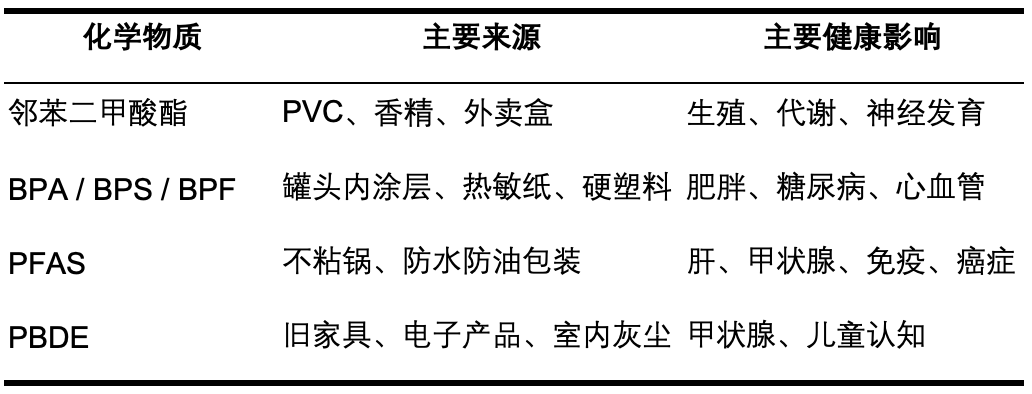
塑料生产、使用和包装过程中涉及到许多 PACs,包括邻苯二甲酸酯、双酚、PFAS、阻燃剂等。
邻苯二甲酸酯是让 PVC 变软的塑化剂,包含一大类化学物质(DEHP、DBP、DEP 等),存在于地板、香水、洗发水、外卖餐盒里。部分邻苯二甲酸酯是抗雄激素物质,会干扰男性生殖系统[2],影响代谢和神经发育。2022年发表在 Environmental Pollution 上的一项研究基于美国 NHANES 数据估计,在美国邻苯二甲酸酯暴露每年关联到 9.1 万到 10.7 万例 55-64 岁人群的过早死亡[3]。2025 年 eBioMedicine 的全球疾病负担模型估计,2018 年全球 55–64 岁成年人中,约 35.6 万例心血管死亡与 DEHP 暴露相关,占该年龄段心血管死亡的约 13.5% [26]。
而55-64 岁,这本该是健康寿命的核心阶段。
双酚类包括 BPA 以及它的"替身" BPS**、BPF**。它们让塑料变硬变透明,存在于部分硬质透明塑料水瓶和罐头内涂层内[4]。BPA 有弱雌激素活性[5],BPA 暴露与肥胖、2 型糖尿病、心血管疾病相关[6]。2023 年欧洲食品安全局做了一件震撼业内的事:把 BPA 的每日可耐受摄入量直接下调了 2 万倍 [7]!重点提醒:标着「BPA-free」的产品并不等于安全,替代物 BPS 和 BPF 内分泌干扰活性同样强[8][27]。
PFAS 被称为「永久化学品」,部分的 PFAS 在人体内半衰期长达 2 到 8 年[9]——进去了就很难出来[28]。来源是不粘锅涂层(有特氟龙等含氟不粘涂层)、防水外套、部分防油食品包装纸(披萨盒、爆米花袋、汉堡纸)[10]。PFAS和血脂异常、甲状腺异常、免疫抑制、肾癌和睾丸癌都有关联[11][29][30]。
2024 年美国 EPA 把饮用水里的 PFAS (主要是 PFOA 和 PFOS)限值定到 4 ppt[12],相当于一滴水溶在 5 个奥运泳池里——这个限值之严,说明监管机构已经把它当成顶级威胁。
PBDE 阻燃剂则藏在旧家具、旧电子产品里,主要通过家里的灰尘进入身体,干扰甲状腺功能[13],孕期或儿童期暴露与神经发育指标下降相关,可能会降低儿童 IQ [14][31]。
塑料什么时候最危险:热,油,久
塑料并不是时时刻刻都在释放化学物质。释放量取决于环境条件,关键有三个触发因素:热、油、久。
高温会显著加速塑化剂和双酚的迁移[15]——把塑料盒放进微波炉热剩饭,是最糟糕的操作之一。不仅是因为“热”,剩饭中的油脂还会把脂溶性的塑化剂从包装里"洗"出来[16],所以外卖热汤、披萨盒、薯条袋是高暴露场景[32]。
长时间接触加上紫外线老化和机械磨损(比如反复使用的塑料瓶、刮花的不粘锅),也会让释放量上升。
好消息:你这周就能看到数据下降!
这是健康干预里非常罕见的情况——你今天做出改变,一周内体内就能测到显著变化。
2026 年发表在 Nature Medicine 上的 PERTH 做了一个干净利落的实验:让受试者执行 7 天低塑料饮食。结果:尿液中 BPA 下降 59.7%,MBzP(一种邻苯二甲酸酯)下降 53.5%,DBP(另一种邻苯二甲酸酯) 下降 37.5%。一周[18]。
反过来的实验更触目惊心。2011 年 JAMA 发表的研究让受试者每天喝一份罐装汤,连续 5 天。尿 BPA 浓度暴涨 1221%[19]。连续几天的罐装汤代价,是十几倍的内分泌干扰物涌入体内。
还有一个针对青少年的 HERMOSA 研究:让女孩们换掉常用的护肤品和化妆品(去除含邻苯二甲酸酯的香精产品)。仅仅 3 天,尿液中邻苯二甲酸酯代谢物MEP 下降 27%[20]。
这些数据告诉我们一件关键的事:BPA 和大多数邻苯二甲酸酯的半衰期都很短,几小时到几天[21]。你体内现在的浓度,主要反映的是过去几天的暴露。所以正确的策略不是去做什么"排毒"——身体本来就在排毒——而是减少持续输入。关掉水龙头,水池自然就空了。
例外是 PFAS。它半衰期是按年计算的,所以对 PFAS 必须用更长远的眼光:今天减少接触的收益,要在几年后才完整兑现。越早开始越好。
减少附着塑料的化学物质的摄入,这是少数你能快速降低、且收益持续累积的健康干预——你这周开始用玻璃容器装食物,下周尿检里的指标就在变。

塑料的两层伤害,真正机制清楚、证据扎实的是第二层——附着和释放的化学物质(邻苯二甲酸酯、双酚、PFAS、PBDE)。
记住三个触发场景:热、油、长时间接触。
「BPA-free」不等于安全。替代品 BPS、BPF 内分泌干扰活性同样强。减少所有硬塑料和罐头接触。
BPA 和邻苯二甲酸酯半衰期很短,减少暴露一周内体内浓度就能大幅下降。
PFAS 是例外,它在体内能存留多年。所以越早开始减少接触越好——尤其是不粘锅和防油食品包装。
下一篇,我们会把这些原则拆成一份按 ROI 排序的具体行动清单,告诉你从哪一步开始改最划算。

参考文献
[1]Hahladakis JN, Velis CA, Weber R, Iacovidou E, Purnell P. An overview of chemical additives present in plastics: Migration, release, fate and environmental impact during their use, disposal and recycling. J Hazard Mater. 2018 Feb;344:179-199.
[2]Swan SH, Main KM, Liu F, Stewart SL, Kruse RL, Calafat AM, Mao CS, et al.; Study for Future Families Research Team. Decrease in anogenital distance among male infants with prenatal phthalate exposure. Environ Health Perspect. 2005 Aug;113(8):1056-1061.
[3]Trasande L, Liu B, Bao W. Phthalates and attributable mortality: a population-based longitudinal cohort study and cost analysis. Environ Pollut. 2022 Jan 1;292(Pt A):118021.
[4]Geens T, Aerts D, Berthot C, Bourguignon JP, Goeyens L, Lecomte P, Maghuin-Rogister G, Pironnet AM, Pussemier L, Scippo ML, Van Loco J, Covaci A. A review of dietary and non-dietary exposure to bisphenol-A. Food Chem Toxicol. 2012 Oct;50(10):3725-3740.
[5]Krishnan AV, Stathis P, Permuth SF, Tokes L, Feldman D. Bisphenol-A: an estrogenic substance is released from polycarbonate flasks during autoclaving. Endocrinology. 1993 Jun;132(6):2279-2286.
[6]Lang IA, Galloway TS, Scarlett A, Henley WE, Depledge M, Wallace RB, Melzer D. Association of urinary bisphenol A concentration with medical disorders and laboratory abnormalities in adults. JAMA. 2008 Sep;300(11):1303-1310.
[7]EFSA Panel on Food Contact Materials, Enzymes and Processing Aids (CEP); Lambré C, Barat Baviera JM, Bolognesi C, Chesson A, Cocconcelli PS, Crebelli R, et al. Re-evaluation of the risks to public health related to the presence of bisphenol A (BPA) in foodstuffs. EFSA J. 2023 Apr 19;21(4):e06857.
[8]Rochester JR, Bolden AL. Bisphenol S and F: A Systematic Review and Comparison of the Hormonal Activity of Bisphenol A Substitutes. Environ Health Perspect. 2015 Jul;123(7):643-650.
[9]Olsen GW, Burris JM, Ehresman DJ, Froehlich JW, Seacat AM, Butenhoff JL, Zobel LR. Half-life of serum elimination of perfluorooctanesulfonate, perfluorohexanesulfonate, and perfluorooctanoate in retired fluorochemical production workers. Environ Health Perspect. 2007 Sep;115(9):1298-1305.
[10]Glüge J, Scheringer M, Cousins IT, DeWitt JC, Goldenman G, Herzke D, Lohmann R, Ng CA, Trier X, Wang Z. An overview of the uses of per- and polyfluoroalkyl substances (PFAS). Environ Sci Process Impacts. 2020 Dec;22(12):2345-2373.
[11]Fenton SE, Ducatman A, Boobis A, DeWitt JC, Lau C, Ng C, Smith JS, Roberts SM. Per- and Polyfluoroalkyl Substance Toxicity and Human Health Review: Current State of Knowledge and Strategies for Informing Future Research. Environ Toxicol Chem. 2021 Mar;40(3):606-630.
[12]U.S. Environmental Protection Agency. PFAS National Primary Drinking Water Regulation. Fed Regist. 2024 Apr 26;89(82):32532-32757.
[13]Chevrier J, Harley KG, Bradman A, Gharbi M, Sjödin A, Eskenazi B. Polybrominated diphenyl ether (PBDE) flame retardants and thyroid hormone during pregnancy. Environ Health Perspect. 2010 Oct;118(10):1444-1449.
[14]Herbstman JB, Sjödin A, Kurzon M, Lederman SA, Jones RS, Rauh V, et al. Prenatal exposure to PBDEs and neurodevelopment. Environ Health Perspect. 2010 May;118(5):712-719.
[15]Le HH, Carlson EM, Chua JP, Belcher SM. Bisphenol A is released from polycarbonate drinking bottles and mimics the neurotoxic actions of estrogen in developing cerebellar neurons. Toxicol Lett. 2008 Jan;176(2):149-156.
[16]Fasano E, Bono-Blay F, Cirillo T, Montuori P, Lacorte S. Migration of phthalates, alkylphenols, bisphenol A and di(2-ethylhexyl)adipate from food packaging. Food Control. 2012 Sep;27(1):132-138.
[17]Noonan GO, Ackerman LK, Begley TH. Concentration of bisphenol A in highly consumed canned foods on the U.S. market. J Agric Food Chem. 2011 Jul;59(13):7178-7185.
[18]Harray AJ, Lucas AD, Herrmann SE, Vlaskovsky PS, Elagali A, Seewoo BJ, et al.; PERTH Trial Consortium. Low-plastic diet and urinary levels of plastic-associated phthalates and bisphenols: the randomized controlled PERTH Trial. Nat Med. 2026 Apr 21.
[19]Carwile JL, Ye X, Zhou X, Calafat AM, Michels KB. Canned soup consumption and urinary bisphenol A: a randomized crossover trial. JAMA. 2011 Nov;306(20):2218-2220.
[20]Harley KG, Kogut K, Madrigal DS, Cardenas M, Vera IA, Meza-Alfaro G, She J, Gavin Q, Zahedi R, Bradman A, Eskenazi B, Parra KL. Reducing Phthalate, Paraben, and Phenol Exposure from Personal Care Products in Adolescent Girls: Findings from the HERMOSA Intervention Study. Environ Health Perspect. 2016 Oct;124(10):1600-1607.
[21]Völkel W, Colnot T, Csanady GA, Filser JG, Dekant W. Metabolism and kinetics of bisphenol A in humans at low doses following oral administration. Chem Res Toxicol. 2002 Oct;15(10):1281-1287.
[22]Gore AC, Chappell VA, Fenton SE, Flaws JA, Nadal A, Prins GS, Toppari J, Zoeller RT. EDC-2: The Endocrine Society's Second Scientific Statement on Endocrine-Disrupting Chemicals. Endocr Rev. 2015 Dec;36(6):E1-E150.
[23]Symeonides C, Aromataris E, Mulders Y, Dizon J, Stern C, Barker TH, et al. An umbrella review of meta-analyses evaluating associations between human health and exposure to major classes of plastic-associated chemicals. Ann Glob Health. 2024 Aug 19;90(1):52.
[24]Marfella R, Prattichizzo F, Sardu C, Fulgenzi G, Graciotti L, Spadoni T, et al. Microplastics and nanoplastics in atheromas and cardiovascular events. N Engl J Med. 2024 Mar;390(10):900-910.
[25]Nihart AJ, Garcia MA, El Hayek E, Liu R, Olewine M, Kingston JD, et al. Bioaccumulation of microplastics in decedent human brains. Nat Med. 2025 Feb 3.
[26]Hyman S, Acevedo J, Giannarelli C, et al. Phthalate exposure from plastics and cardiovascular disease: global estimates of attributable mortality and years life lost. eBioMedicine. 2025;116:105730.
[27]Yang CZ, Yaniger SI, Jordan VC, Klein DJ, Bittner GD. Most plastic products release estrogenic chemicals: a potential health problem that can be solved. Environ Health Perspect. 2011 Jul;119(7):989-996.
[28]Li Y, Fletcher T, Mucs D, Scott K, Lindh CH, Tallving P, Jakobsson K. Half-lives of PFOS, PFHxS and PFOA after end of exposure to contaminated drinking water. Occup Environ Med. 2018 Jan;75(1):46-51.
[29]National Academies of Sciences, Engineering, and Medicine. Guidance on PFAS exposure, testing, and clinical follow-up. Washington (DC): National Academies Press; 2022.
[30]Li Y, Fletcher T, Mucs D, Scott K, Lindh CH, Tallving P, Jakobsson K. Half-lives of PFOS, PFHxS and PFOA after end of exposure to contaminated drinking water. Occup Environ Med. 2018 Jan;75(1):46-51.
[31]Lam J, Lanphear BP, Bellinger D, Axelrad DA, McPartland J, Sutton P, Davidson L, Daniels N, Sen S, Woodruff TJ. Developmental PBDE exposure and IQ/ADHD in childhood: a systematic review and meta-analysis. Environ Health Perspect. 2017 Aug 18;125(8):086001.
[32]Lerch M, Fengler R, Mbog G, Nguyen KH, Granby K, Beldì G, et al. What do we know about the migration of PFAS from paper based food contact materials? Food Chem. 2023 Apr 15;403:134411.