Over the last eight chapters, we’ve journeyed from the perils of high-sugar diets to foundational principles around carbs and fats. Today, we turn the spotlight onto the third macronutrient — protein.
Protein has long held center stage in the world of health and nutrition. You’ll hear advocates for low-carb and low-fat diets everywhere, but almost no one champions a low-protein approach. In common perception, high protein is practically synonymous with “nutritious” and “healthy.”
But the deeper I’ve gone in my research and personal experimentation, the more I’ve realized: managing protein intake is far more complex than managing carbs or fats. Protein is not just the structural backbone of life — it actively participates in nearly every metabolic process we associate with being alive. It’s vital, but also tricky to get right.
For carbs and fats, it’s relatively easy to distill things down to a simple baseline:
- Carbs: Avoid free sugars.
- Fats: Cut trans fats, manage your Omega-6 ratio.
Get those right, and your metabolic profile usually improves significantly.
Protein, however, is a different beast. It’s more of a dynamic balancing act, not a fixed rule. Recommendations vary based on context, individual, and purpose.
Today’s article — the first in our protein series — lays the groundwork by clarifying the fundamentals and introducing its underlying contradictions.
I. Protein: The Bricks and Beams of Life
Proteins are made of amino acids. Alongside carbon, hydrogen, and oxygen, they have a unique element — nitrogen — which sets them apart. (Carbs and fats are made only of C, H, and O. Some complex lipids contain nitrogen, but not as a defining feature.)
Proteins are everywhere in the body1:
- Structural proteins: Actin in muscles, collagen in skin, keratin in hair and nails.
- Functional proteins: Enzymes, antibodies, hormones, carrier proteins, receptors.
- Genetic expression & energy systems: DNA, RNA, and mitochondria all rely heavily on protein-based machinery for transmission, regulation, and maintenance.
Nearly every key biological function we can think of — protein plays a role.
II. Yes, Protein Can Be Burned for Energy — But It’s Costly
While carbs and fats are the body’s preferred energy sources, protein can be burned for energy in a pinch — but at a steep metabolic cost.
Here’s how it works2:
- Protein is broken down into amino acids.
- These undergo deamination, producing ammonia (NH₃) — which is toxic to the human body!
- The liver must convert ammonia into urea, which is then excreted via the kidneys.
This pathway is far messier than how the body handles carbs or fats3. It creates more physiological burden, including:
- Increased stress on liver and kidneys
- Disturbances in acid-base balance and gut microbiome (some protein metabolites are acidic)
Protein is most likely to be burned in the following scenarios4:
- Excess intake or imbalanced amino acid profile: Surplus amino acids that can’t be used get burned.
- Energy deficit: When carb/fat intake is too low (fasting, keto, fasted workouts), the body starts breaking down muscle protein for fuel.
This is a hidden danger I’ve uncovered through real-world experimentation with so-called “healthy” diet-exercise combos. Some of them inadvertently overburden metabolism or break down muscle mass — which is alarming.
Loss of muscle not only lowers disease resilience and basal metabolic rate but also raises the risk of falls and fractures. And since muscle mass naturally declines with age, accelerating that loss is the last thing we want.
In other words, this is the antithesis of Prime Life.
III. Protein Requires Precision, Not Just Abundance
So here’s the tension: too little protein and you lose muscle; too much and you strain your system.
What’s the right amount?
We often hear about “high-protein” diets. But what does “high” really mean? And more importantly, high for whom?
Assuming no underlying disease, we need to assess protein intake through at least four lenses:
- Amount
- Source
- Metabolic context
- Life stage
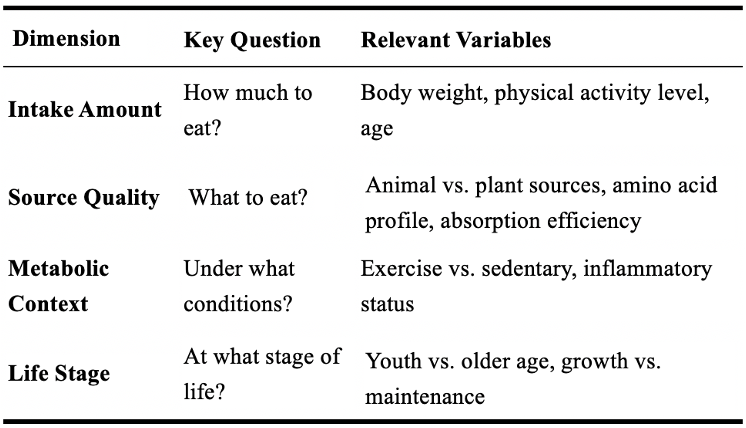
A flat rule like “eat X grams per kilogram of body weight” is too crude.
Examples:
- Muscle-building in youth, weight loss in middle age, and anti-aging in older adults all call for different protein targets.
- Protein needs and timing vary between resistance training days vs. sedentary days.
- Bioavailability varies wildly: whey protein is nearly 100% absorbed, while some plant proteins need to be combined to cover essential amino acids.
- Most subtle of all: even if two people eat the same meal, their metabolic background can lead to totally different outcomes.
Protein dosage must be nested within a dynamic, personalized system — otherwise we risk veering off-course.
IV. Growth vs. Longevity: The Paradox of Protein
When we consume protein, we’re not just feeding the body. We’re triggering the body’s growth mode.
This happens via growth-related signaling pathways like mTOR and IGF-1:
- mTOR (mechanistic Target of Rapamycin): A nutrient and energy sensor that governs protein synthesis, metabolism, and cell growth5.
- IGF-1 (Insulin-like Growth Factor 1): Stimulated by growth hormone, drives cell proliferation and metabolic activity — often through the mTOR pathway6.
These are essential for youth and development.
But past a certain age, these same growth factors start accelerating aging. Why? Because increased cell division raises the risk of hitting replication limits and promotes age-related decline, even cancer.
From a Prime Life perspective, the protein paradox looks like this:
- Too little → sarcopenia, loss of independence, higher fall and fracture risk
- Too much → burden on detox systems, faster aging, possible disease acceleration
So, we need balance. Precision. Timing.
V. A Ground-Level Guideline: Start Here
Despite all the nuance, we can still offer a safe baseline, assuming normal kidney function[7–8]:
For the average adult with a sedentary lifestyle:
- 1.0–1.2g of protein per kilogram of body weight per day
For active individuals:
- 1.4–1.8g/kg
For older adults (>60 years):
- Even without exercise, aim for 1.2–1.5g/kg to prevent muscle loss.
Example: A 60kg middle-aged woman who doesn’t work out should aim for 60–72g of protein per day. If she’s doing resistance training, that goes up to 80–90g — or more.
And yes, multiple studies confirm: for those with healthy kidneys, protein at these levels is safe. Concerns about kidney damage stem largely from pre-existing kidney disease populations and can’t be generalized.
In Summary
A solid protein strategy = balancing:
Intake amount + Source quality + Metabolic context + Life stage
This is the real equation behind “optimal protein.”
In future pieces, we’ll dive deeper into:
- Protein sources: What counts as high-quality protein? Plant vs. animal?
- Metabolism: How protein interacts with training (resistance vs. cardio), fasting, and more
- Longevity: How protein intake shapes aging and lifespan
- Precision intake: How to tailor your protein dosage using real-world variables
See you next time.
Intervention recommendations are geared toward generally healthy individuals. If you have existing health conditions, always follow your doctor’s instructions.
References8
[1] Shoulders, Matthew D., and Ronald T. Raines. “Collagen Structure and Stability.” Annual Review of Biochemistry, vol. 78, 2009, pp. 929‑958.
[2] Häberle, Johannes, et al. “Consensus Guidelines for Management of Hyper‑ammonaemia in Children Caused by Urea‑Cycle Disorders.” Nature Reviews Nephrology, vol. 13, 2017, pp. 499‑512.
[3]Knight, Eliane L., et al. “The Effect of Dietary Protein Intake on Kidney Function in Women.” Annals of Internal Medicine, vol. 138, no. 6, 2003, pp. 460‑467.
[4]Sartori, Roberta, Vanina Romanello, and Marco Sandri. “Mechanisms of Muscle Atrophy and Hypertrophy: Implications in Health and Disease.” Nature Communications, vol. 12, 2021, Article 330.
[5]Saxton, Robert A., and David M. Sabatini. “mTOR Signalling in Growth, Metabolism, and Disease.” Cell, vol. 168, no. 6, 2017, pp. 960‑976.
[6]Rommel, Christian, et al. “Multifaceted Role of Insulin‑Like Growth Factors and mTOR in Skeletal Muscle.” Endocrine Reviews, vol. 33, no. 3, 2012, pp. 349‑388.
[7]Morton, Robert W., et al. “Protein Supplementation to Augment Muscle Mass and Strength: A Systematic Review and Meta‑Analysis.” British Journal of Sports Medicine, vol. 52, no. 6, 2018, pp. 376‑384.
[8]Deutz, Nicolaas E. P., et al. “Protein Intake and Exercise for Optimal Muscle Function with Aging: Recommendations from the ESPEN Expert Group.” Clinical Nutrition, vol. 33, no. 6, 2014, pp. 929‑936.