In the last piece I wrote about retrograded resistant starch. Today I’m chasing a sibling concept: dietary fiber. Fiber is a broad family of nutrients that don’t primarily serve to supply energy or classic micronutrients (most of them are carbohydrates).
It looks like a background extra just “passing by,” yet it’s pivotal for human health.
Most nutrients work through biochemistry — the “magic.” Fiber mostly works through physics — the “martial arts” — with some biochemistry on the side. I call it a dual practice of “magic + martial.”
In this entry, I’ll walk from structure to mechanism to practice, and get to know dietary fiber properly.
I. Not Everything “Indigestible” Counts as Dietary Fiber
In the narrow sense, dietary fiber refers to non‑starch polysaccharides that resist digestion and absorption in the small intestine — think cellulose, pectin, β‑glucan. In the broader — and more useful — sense, fiber includes any carbohydrate or non‑carbohydrate component that isn’t absorbed in the small intestine but does meaningful work in the colon — like resistant starch, lignin, and functional added fibers such as resistant dextrin and polydextrose 2.
Put differently: if you eat it → your small intestine ignores it → your colonic microbes eat it (or don’t) → you still benefit, it probably belongs in the fiber family.
For clarity, I group these materials by function into three buckets: soluble fiber, insoluble fiber, and fermentable fiber. (Not a rigid taxonomy — just a practical map.)
II. Soluble Fiber: A Gentle, Fermentable Gel
As the name suggests, soluble fibers dissolve in water and form a jelly‑like gel. They punch above their weight [3–7]:
- They slow gastric emptying and dampen glucose absorption, smoothing post‑meal blood sugar.
- They bind bile acids, interrupt enterohepatic recycling, and help lower LDL‑C.
- The microbiome ferments them to short‑chain fatty acids (SCFAs), especially butyrate, which fuels the intestinal barrier and dials down chronic inflammation.
Examples: β‑glucan (oats, barley), pectin (apples, citrus), inulin (onion, garlic, leeks).
Daily target: 10–15 g.
III. Insoluble Fiber: The Gut’s Martial Artist
Insoluble fibers don’t dissolve in water. They aren’t absorbed in the small intestine, and colonic bacteria can’t really break them down either. They don’t supply calories or classic nutrients. My old impression was: a harmless passerby with no real job — what goes in looks a lot like what comes out.
I was wrong.
Their health upside is real. The twist is that while most nutrients deliver value biochemically (energy, micronutrients), insoluble fibers are martial artists — they deliver irreplaceable benefits through structure and physics [8–11]:
- Martial art #1: Increase stool bulk and water content, speed up transit, and relieve constipation.
- Martial art #2: Stimulate mucosal renewal and more protective mucus.
- Martial art #3: Adsorb environmental toxins (heavy metals, PAHs), aiding “physical detox.”
- Martial art #4: Bind bile acids, reduce cholesterol recycling, and help lower LDL‑C.
They may “have no nutrients,” but their nutritional value comes from their structure. No calories, big payoff.
Examples: cellulose (leafy greens, tofu skin), lignin (nut skins, whole grains).
Daily target: 10–15 g.
IV. Fermentable Fiber: Butyrate, the Colon’s Power Plant
Fermentable fibers are those that gut microbes metabolize into SCFAs in the colon. There’s overlap with soluble fiber, but fermentable fiber has a stronger health signature: anti‑inflammation.
The headliner here is butyrate, alongside other SCFAs [12–15]:
- The preferred fuel for colonocytes (≈70–80% of their energy).
- Activates GPR109A, inhibits HDACs, and modulates immune tone.
- Boosts regulatory T cells, lowers gut inflammation, and slows precancerous changes in the colon.
- Through the gut–brain axis, improves metabolism, tempers appetite, and nudges mood.
In short, SCFAs help architect a lower‑inflammation metabolic landscape — good news for longevity.
I mentioned this briefly when we discussed saturated fats. SCFAs are technically saturated, but unlike pro‑inflammatory long‑chain palmitic acid, the SCFA family is broadly beneficial. They mostly act locally in the gut — top‑tier fuel for the barrier and balancers of chronic inflammation. Slow‑release butyrate generated from fiber is a friend.
Examples: retrograded resistant starch (RS3; cold rice, legumes), inulin, fructooligosaccharides, onion.
You’ve probably noticed the hype around prebiotics — the favorite foods of probiotics — like inulin. Functionally, they’re highly overlapping with fermentable fibers.
This leads to a fun insight: a bowl of overnight chilled rice (retrograded RS3) can deliver benefits similar to a scoop of inulin — both feed microbes to produce butyrate, propionate, and acetate, and both pay health dividends. Before dropping serious cash on inulin, you might “DIY prebiotics” with leftovers from the fridge. 😀
One caveat: SCFA yield varies wildly by person because it depends on the microbiome. A 2023 Nature Communications study showed >4‑fold differences in SCFA production from the same fiber between individuals; a 2023 Cell Host & Microbe paper found that in some people with depleted microbial functions or diversity, butyrate didn’t rise much even with adequate fermentable fiber. Bottom line: to unlock SCFA gains, microbiome health is a prerequisite. (Probiotics are a topic for another day.) [16–18]
Daily target: 5–10 g — for example, a meal built around cold rice + inulin + onion.
V. Wait — Vegetables Aren’t That Fiber‑Dense!?
Hard numbers: 100 g of cooked broccoli has only ~3.3 g of fiber.
So to reach ~15 g of fiber:
- You might need ~500 g of cooked broccoli (about 3–4 big bowls);
- Or just ~40 g of chia seeds, or a bowl of black beans plus half a bowl of oats.
We often assume “eat vegetables = get fiber.” Not wrong — but if you care about efficiency (fiber per gram of food), vegetables aren’t always the winners.
The fiber density leaders (by dry weight) 19:
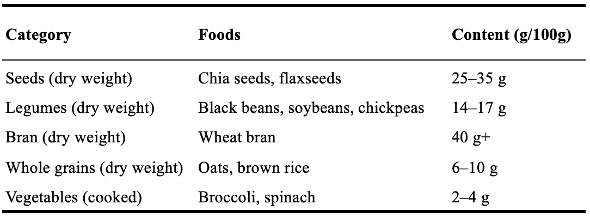
Which is why legumes are gems:
- They deliver decent, growth‑factor‑friendly plant protein;
- They’re low‑GI carbs;
- They have high‑density fiber;
- And they have endless delicious formats — soy milk, tofu, bean spreads, dried tofu — to keep things interesting.
Call them a superfood? I won’t argue.
You’ll also see functional fibers — resistant dextrin (a low‑fermentable soluble fiber) and polydextrose (a synthetic fermentable fiber) — added to zero‑sugar drinks, meal‑replacement powders, and “fiber bars.” (Heads up: maltodextrin sounds similar but is not fiber — it’s a high‑GI carb.) These add some value but don’t replace whole‑food sources. Occasional supplementation is fine; just don’t treat it as “fiber quota met.”
VI. Daily Targets and Practical Builds
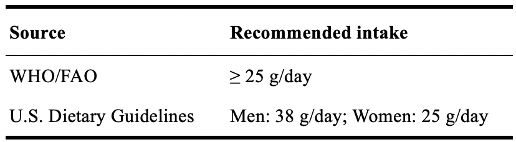
From a Prime Lab perspective, I break it down a bit finer:
- Soluble: 10–15 g
- Insoluble: 10–15 g
- Fermentable: 5–10 g
- Total: 30–35 g
Beyond mechanism‑level benefits, higher fiber intake does track with longer healthspan. In a 9‑year cohort of nearly 400,000 older Americans, those in the highest‑fiber group (>29 g/day) had 22% (men) and 19% (women) lower all‑cause mortality versus the lowest‑fiber group, with markedly lower risk of death from cardiovascular, infectious, and respiratory causes 20.
Important nuance: more isn’t always better.
For most adults, 30–35 g/day is a sweet spot. Above that, expect a higher chance of gas, borborygmi, and even reduced absorption of trace minerals like iron and zinc.
If you have IBS, be extra cautious. Many fibers — especially rapidly fermentable soluble fibers — are poorly handled in the small intestine and quickly fermented in the colon, producing gas and osmotic effects that can trigger bloating, pain, or diarrhea [21–24].
So when deciding your own intake, two rules:
- First, know your gut. If you have conditions (e.g., IBS), follow medical guidance.
- If not, still stay within a suitable range — don’t overshoot.
One more practical tip: if your diet runs high in protein, you can lean a bit higher on fiber. High‑protein low‑fiber patterns leave more unabsorbed protein to reach the colon and ferment into smelly, potentially toxic metabolites, shifting the ecosystem toward putrefactive species and away from beneficial ones. More fiber tempers this proteolytic fermentation and feeds friendlier microbes.
Sample day:
- Breakfast: chia soaked in water + oats + nuts
- Lunch: brown rice + legumes + broccoli
- Dinner: cold rice or reheated cold rice (RS3) + onion + inulin
Takeaways
Dietary fiber is a structural nutrient: through physical action and fermentation products (like butyrate), it fortifies the gut barrier, tunes metabolism, and cools inflammation.
Soluble fibers smooth sugar and lipids; insoluble fibers drive motility; fermentable fibers are anti‑inflammatory. Structure + function keep the gut ecology in shape.
The most efficient fiber sources are legumes, seeds, and whole grains — not just vegetables.
Aim for 30–35 g/day, mix the types, keep at it. The health upside can rival pricey prebiotics — without the price tag.
Intervention recommendations are geared toward generally healthy individuals. If you have existing health conditions, always follow your doctor’s instructions.
References24
[1]AI Research
[2]Questions and Answers on Dietary Fiber — FDA
[3]Ma W, et al. Intake of dietary fiber, fruits, and vegetables, and risk of diverticulitis. The American journal of gastroenterology. 2019 Sep;114(9):1531.
[4]Jesch ED, Carr TP. Food ingredients that inhibit cholesterol absorption. Preventive nutrition and food science. 2017 Jun;22(2):67.
[5]Brown L, Rosner B, Willett WW, Sacks FM. Cholesterol-lowering effects of dietary fiber: a meta-analysis. The American journal of clinical nutrition. 1999 Jan 1;69(1):30–42.
[6]Pereira MA, O’Reilly E, Augustsson K, Fraser GE, Goldbourt U, Heitmann BL, Hallmans G, Knekt P, Liu S, Pietinen P, Spiegelman D. Dietary fiber and risk of coronary heart disease: a pooled analysis of cohort studies. Archives of internal medicine. 2004 Feb 23;164(4):370–6.
[7]Acosta S, Johansson A, Drake I. Diet and lifestyle factors and risk of atherosclerotic cardiovascular disease — a prospective cohort study. Nutrients. 2021 Nov;13(11):3822.
[8]Badiali, D., et al. “Bran Treatment of Chronic Non-organic Constipation.” Gut, vol. 36, no. 3, 1995, pp. 353–358.
[9]Swain, S. M., et al. “Piezo1 Is Required for Goblet-Cell Mucus Secretion.” Cell Reports, vol. 42, 2023, 112345.
[10]He, Y., et al. “Effects of Dietary Fiber on Human Health.” Critical Reviews in Food Science and Nutrition, 2022, pp. 1–23.
[11]Jenkins, David J. A., et al. “Effect on Blood Lipids of Very High Intakes of Fiber in Diets Rich in Soluble or Insoluble Fiber.” The New England Journal of Medicine, vol. 329, no. 1, 1993, pp. 21–26.
[12]Donohoe, Dallas R., et al. “The Microbiome and Butyrate Regulate Energy Metabolism and Autophagy in the Mammalian Colon.” Cell Metabolism, vol. 13, no. 5, 2011, pp. 517–526.
[13]Singh, Nagendra, et al. “Activation of GPR109A by Niacin and Butyrate Suppresses Colonic Inflammation and Carcinogenesis.” Immunity, vol. 40, 2014, pp. 128–139.
[14]Park, Jihye, et al. “Short-Chain Fatty Acids Induce Both Effector and Regulatory T Cells.” Mucosal Immunology, vol. 8, 2015, pp. 80–93.
[15]Frost, Gary, et al. “The Short-Chain Fatty Acid Acetate Reduces Appetite via a Central Homeostatic Mechanism.” Nature Communications, vol. 5, 2014, article 3611.
[16]Ecklu-Mensah, Gertrude, et al. “Gut Microbiota and Fecal Short-Chain Fatty Acids Differ with Adiposity and Country of Origin.” Nature Communications, vol. 14, 2023, article 5160.
[17]Guo, Chuan, et al. “Deficient Butyrate-Producing Capacity in the Gut Microbiome of ME/CFS.” Cell Host & Microbe, vol. 31, 2023, pp. 1333–1348.
[18]Holmes, Zachary C., et al. “Microbiota Responses to Different Prebiotics Are Conserved but Personalised.” Microbiome, vol. 10, 2022, article 180.
[19]USDA FoodData Central
[20]Park Y, et al. Dietary fiber intake and mortality in the NIH-AARP Diet and Health Study. Arch Intern Med. 2011;171(12):1061–1068.
[21]Kim Y, Je Y. Dietary fiber intake and total mortality: a meta-analysis of prospective cohort studies. Am J Epidemiol. 2014.
[22]Zhang, Mingya, et al. “Effects of High-Fiber, Isocaloric Macronutrient Substitutions on Bloating.” Am. J. Gastroenterol., 2020, pp. 1–10.
[23]Hallberg, Lars, et al. “Iron Absorption from the Whole Diet in Men.” American Journal of Clinical Nutrition, vol. 66, 1997, pp. 347–356.
[24]Drews, Linda M., et al. “Effect of Dietary Fiber on Copper, Zinc and Magnesium Utilization.” Journal of the American Dietetic Association, vol. 75, 1979, pp. 508–512.