In a prospective observational study published in The New England Journal of Medicine in 2024, Italian researchers cut into the carotid artery plaques of 257 patients and found plastic particles in 58% of the samples. Even more unsettling: the group with plastic detected in their plaques had a 4.5-fold higher risk of subsequent heart attack or stroke compared with the group in which no plastic was detected 1.
Plastic is no longer just a story about a straw stuck in a sea turtle’s nose.
It is becoming a story about something inside your own blood vessels.
Exposure Is Already a Fact, Not a Hypothesis
Global annual plastic production has surged from 2 million tons in 1950 to more than 400 million tons in 2022, and plastics are difficult to degrade in nature 6,19,20.
And microplastics are almost certainly inside your body.
A 2022 Dutch study tested the blood of 22 healthy adults and found at least one type of plastic polymer in about 80% of them 2. Since then, researchers have detected microplastics in the placenta, breast milk, lung tissue, and even the testes 3,4,17,18.
Microplastics are plastic fragments smaller than 5 millimeters in diameter. Nanoplastics are even smaller — less than 1 micron, roughly one-tenth the diameter of a red blood cell 5. They may be able to pass directly through cell membranes into cells, where they can contribute to mitochondrial dysfunction, oxidative stress, and DNA damage responses.
The human body does have barriers, phagocytic systems, and excretion mechanisms for dealing with foreign substances. But our ability to recognize, transport, and clear microplastic particles appears limited, and the data are still insufficient 21.
The current scientific consensus is this: human exposure is real. But the true dose, whether it causes disease, and where the disease-causing threshold lies are still not well understood.
Of course, “not yet clear” does not mean “harmless.” For a synthetic material that nature cannot effectively degrade and that may enter cells, who would actually want it accumulating silently in the body over the long term?
Prime Lab’s view is that this is a potential chronic-disease risk factor where evidence is accumulating quickly while exposure continues to worsen. It belongs to the category of long-term health problems that Prime Lifers should pay attention to early.
Where Are You “Eating” the Most Plastic Every Day?
Bottled water, indoor air, and heated plastic containers are the main sources of human exposure.
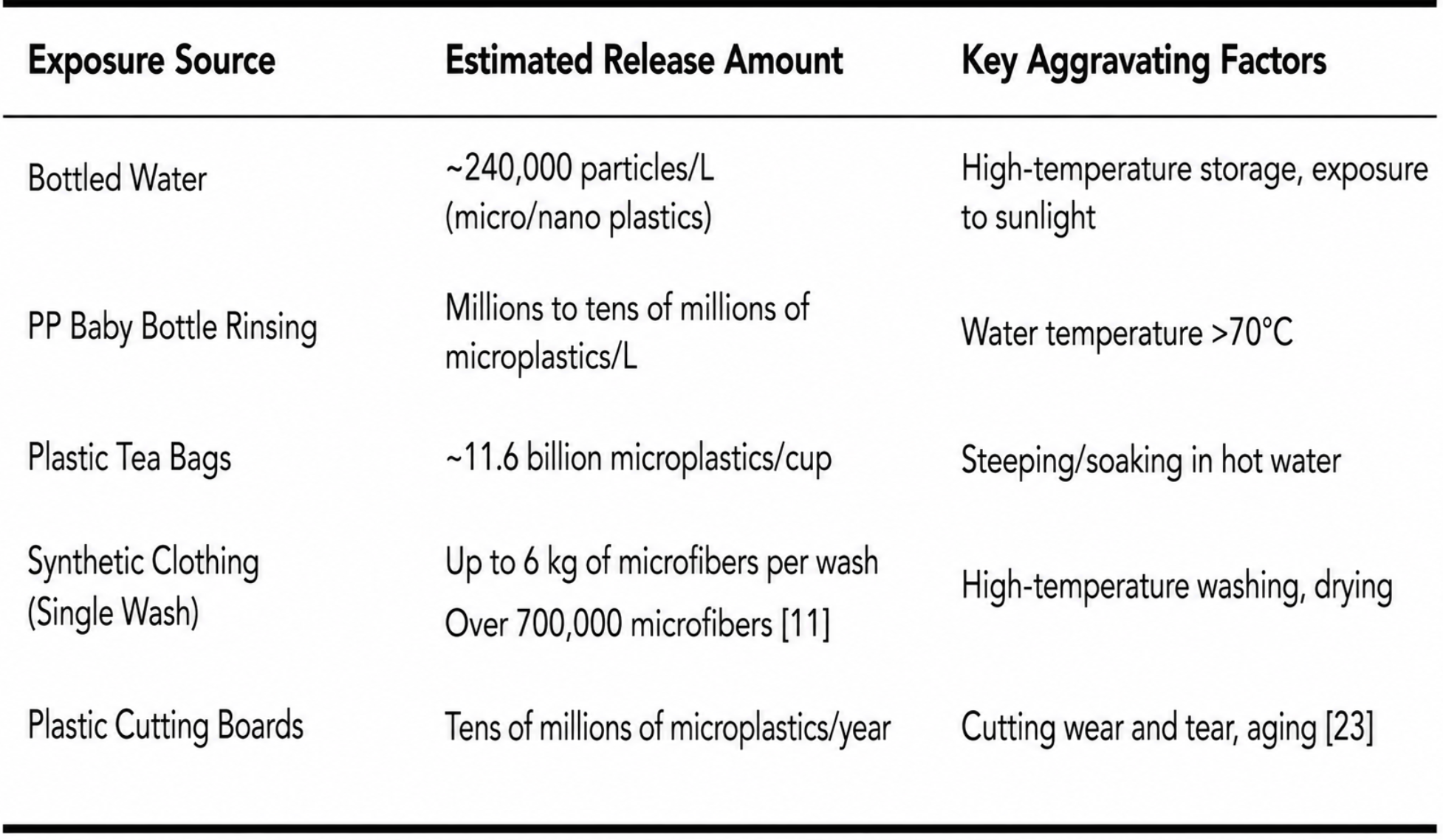
The numbers for bottled water are surprisingly high. A 2024 study published in PNAS used stimulated Raman scattering microscopy to re-examine commercially available bottled water in the United States. The researchers found roughly 110,000 to 370,000 plastic particles per liter, about 90% of which were nanoscale. Earlier detection methods simply could not see particles this small, meaning past exposure estimates were severely underestimated 7. High-temperature storage — such as leaving bottled water in a car for an afternoon in summer — can further increase the amount released 8.
Indoor air is an overlooked major source. Carpets, sofas, curtains, and synthetic-fiber clothing shed microfibers into the air every day. Inhalation exposure may be no lower than ingestion. Children may have higher exposure per unit of body weight because they crawl on the floor and put everything in their mouths 22.
Heated plastic containers are high-risk scenarios. When PP baby bottles are used to prepare formula with water above 70°C, each liter can release millions to tens of millions of particles 9. A plastic tea bag can release about 11.6 billion microplastic particles into a single cup of tea 10. Plastic cutting boards may release tens of millions of particles per year due to cutting abrasion 23.
Do not be fooled by the phrase “food-grade plastic.” Current regulation of food-contact materials mainly focuses on material compliance, additive safety, and chemical migration limits. The number, particle size, and morphology of microplastics and nanoplastics are not yet routine items on labels or in regulatory testing [24–26].
In other words, “food-grade safe” does not mean “does not release microplastics.”
After They Enter the Body, Where Do They Go?
Studies show that multiple types of microplastics can be detected in human feces 12, which means we are continuously ingesting them. In general, larger particles are believed to have more difficulty crossing the intestinal barrier and are more likely to remain in the gut lumen and be excreted with stool 21.
What truly worries researchers is nanoplastics. They are small enough to cross the intestinal barrier and enter the bloodstream, then travel from the blood to different organs. Studies have already detected microplastics or nanoplastics in human samples, including blood, placenta, and testes 2,3,4. The detection of microplastics in the testes and placenta deserves serious attention for its potential implications for reproductive health 3,27.
Can nanoplastics directly affect DNA?
In vitro and animal studies show that nanoplastics can be taken up by cells and are associated with mitochondrial dysfunction, increased ROS, inflammatory responses, and DNA damage responses. There is currently no direct evidence that they integrate into DNA sequences like viruses do. But indirect oxidative damage is already enough to raise concern 14.
The biggest unknown is this: once these particles enter tissues, how long does it take for the body to clear them?
Right now, we do not have a clear answer. It could be months. It could be decades. We cannot reliably estimate body burden based on age. The widely circulated claim that we “eat a credit card’s worth of plastic every week” has been criticized by many scholars as an oversimplification. Intake is also not the same as tissue burden, because much of what enters is excreted 13[28–30].
The most reasonable judgment is: most is excreted, some enters tissues, and part may remain for a long time. But the exact ratios and accumulation rate are still a blank map.
Possible Harms: The Strongest Lines of Evidence So Far
Animal and in vitro studies point in several directions.
Chronic inflammation and oxidative stress are the most consistent findings so far. In vitro and animal studies suggest that microplastics can activate the NF-κB signaling pathway in immune cells and promote the release of inflammatory factors such as TNF-α and IL-6 14. Nanoplastics can induce oxidative stress. And chronic low-grade inflammation happens to be one of the shared underlying mechanisms of almost all aging-related diseases.
On the cardiovascular side, beyond the NEJM study mentioned at the beginning — the one linking plastic in plaques with a 4.5-fold higher risk of cardiovascular events 1 — researchers also observed obvious inflammatory-cell infiltration and reduced collagen around plastic particles. This suggests that plaques may become more unstable and more prone to rupture. Existing research, however, is still not enough to prove that plastic particles themselves are the direct cause of plaque rupture.
In animal models, the intestinal barrier shows villus damage, increased permeability (“leaky gut”), and changes in microbiome composition 15. The gut is a central hub of the immune system. Once the barrier is damaged, the effects may ripple into metabolism, immunity, and even the brain.
Evidence involving the reproductive system is also accumulating 3. For developing fetuses and infants, extremely low-dose endocrine disruption — potentially caused by substances adsorbed onto microplastics — may create irreversible “programming effects” 31.
Another effect worth noting is the Trojan horse effect: the surface of plastic particles often adsorbs known harmful additives such as bisphenol A, phthalates, and flame retardants. The particle itself may simply be the carrier, but it can bring these chemicals deep into tissues and release them slowly at the local site 32.
But we must emphasize one important limitation: most animal experiments use doses far higher than estimated human exposure levels. Extrapolating directly from animal experiments to human health conclusions requires extreme caution.
Microplastics are no longer an environmental issue that sits far away from the human body. They are a long-term health-risk factor worth taking seriously. We already know that they are not only present in water, air, and food, but have also been detected in blood, placenta, lung tissue, and even arterial plaques 1[2–4]. In other words, the question is no longer “Can they enter the human body?” The question is: What happens after they enter, who is more vulnerable, and can they be effectively cleared?
But there is still not enough evidence to justify panic. The strongest human evidence today is still mainly association, not strict causality. Animal experiments point toward mechanisms such as inflammation, oxidative stress, endocrine disruption, and vascular injury, but many experimental doses do not match real-world exposure. The WHO’s overall position is that exposure is real, potential harm is biologically plausible, but the magnitude of human risk is still not clearly quantified 16.
For this topic, we should face it directly and do a few high-ROI things — but not dramatize it excessively. The groups that deserve more serious attention are:
- Infants, young children, and pregnant women, because developmental windows are more sensitive to low-dose interference;
- People who frequently use plastic food containers, hot takeout, or bottled water, because their exposure is more continuous and more avoidable;
- And people at high cardiovascular risk, because the most concerning human clinical signal so far happens to point toward arterial plaques and cardiovascular events 1.
In the next piece, we’ll talk about how to reduce microplastic exposure “incidentally” — without turning life upside down.
Intervention recommendations are geared toward generally healthy individuals. If you have existing health conditions, always follow your doctor’s instructions.
References
[1]Marfella R, Prattichizzo F, Sardu C, et al. Microplastics and Nanoplastics in Atheromas and Cardiovascular Events. N Engl J Med. 2024 Mar;390(10):900–910.
[2]Leslie HA, van Velzen MJM, Brandsma SH, Vethaak AD, Garcia-Vallejo JJ, Lamoree MH. Discovery and quantification of plastic particle pollution in human blood. Environ Int. 2022 May;163:107199.
[3]Ragusa A, Notarstefano V, Svelato A, Belloni A, Gioacchini G, Blondeel C, et al. Raman Microspectroscopy Detection and Characterisation of Microplastics in Human Breastmilk. Polymers (Basel). 2022;14(13):2700.
[4]Ragusa A, Svelato A, Santacroce C, et al. Plasticenta: First evidence of microplastics in human placenta. Environ Int. 2021 Jan;146:106274.
[5]Gigault J, Halle AT, Baudrimont M, et al. Current opinion: What is a nanoplastic?. Environ Pollut. 2018 Apr;235:1030–1034.
[6]Geyer R, Jambeck JR, Law KL. Production, use, and fate of all plastics ever made. Sci Adv. 2017 Jul;3(7):e1700782.
[7]Qian N, Gao X, Lang X, et al. Rapid single-particle chemical imaging of nanoplastics by SRS microscopy. Proc Natl Acad Sci U S A. 2024 Jan;121(3):e2300582121.
[8]Hussain KA, Romanova S, Okur I, Zhang D, Kuebler J, Huang X, et al. Assessing the release of microplastics and nanoplastics from plastic containers and reusable food pouches under different usage scenarios. Environ Sci Technol. 2023;57(27):9782–9792.
[9]Li D, Shi Y, Yang L, et al. Microplastic release from the degradation of polypropylene feeding bottles during infant formula preparation. Nat Food. 2020 Nov;1(11):746–754.
[10]Hernandez LM, Xu EG, Larsson HCE, Tahara R, Maisuria VB, Tufenkji N. Plastic teabags release billions of microparticles and nanoparticles into tea. Environ Sci Technol. 2019 Nov;53(21):12300–12310.
[11]Napper IE, Thompson RC. Release of synthetic microplastic plastic fibres from domestic washing machines: Effects of fabric type and washing conditions. Mar Pollut Bull. 2016 Nov;112(1–2):39–45.
[12]Schwabl P, Koppel S, Konigshofer P, et al. Detection of various microplastics in human stool: A prospective case series. Ann Intern Med. 2019 Oct;171(7):453–457.
[13]Senathirajah K, Attwood S, Bhagwat G, Carbery M, Wilson S, Palanisami T. Estimation of the mass of microplastics ingested — A pivotal first step towards human health risk assessment. J Hazard Mater. 2021;404(Pt B):124004.
[14]Hwang J, Choi D, Han S, Choi J, Hong J. An assessment of the toxicity of polypropylene microplastics in human derived cells. Sci Total Environ. 2019 Jan;684:657–669.
[15]Jin Y, Lu L, Tu W, Luo T, Fu Z. Impacts of polystyrene microplastic on the gut barrier, microbiota and metabolism of mice. Sci Total Environ. 2019 Feb;649:308–317.
[16]World Health Organization. Dietary and inhalation exposure to nano- and microplastic particles and potential implications for human health. Geneva: World Health Organization; 2022.
[17]Jenner LC, Rotchell JM, Bennett RT, Cowen M, Tentzeris V, Sadofsky LR. Detection of microplastics in human lung tissue using μFTIR spectroscopy. Sci Total Environ. 2022;831:154907.
[18]Hu CJ, Garcia MA, Nihart A, Liu R, Yin L, Adolphi N, et al. Microplastic presence in dog and human testis and its potential association with sperm count and weights of testis and epididymis. Toxicol Sci. 2024;200(2):235–240.
[19]OECD. Global Plastics Outlook: Economic Drivers, Environmental Impacts and Policy Options. Paris: OECD Publishing; 2022.
[20]United Nations Environment Programme. Everything you need to know about plastic pollution. Nairobi: UNEP; 2023.
[21]World Health Organization. Dietary and inhalation exposure to nano- and microplastic particles and potential implications for human health. Geneva: World Health Organization; 2022.
[22]Zuri G, Marrero A, Leal-Hernández O, Gutiérrez Á, Díaz C, Hardisson A, et al. Microplastics: human exposure assessment through air, water, and food. Environ Int. 2023;179:108150.
[23]Yadav H, et al. Cutting boards: An overlooked source of microplastics in human food? Environ Sci Technol. 2023;57(22):8226–8234.
[24]U.S. Food and Drug Administration. Microplastics and Nanoplastics in Foods. Silver Spring (MD): FDA; 2024.
[25]European Commission. Food contact materials legislation. Brussels: European Commission; 2024.
[26]European Food Safety Authority. Microplastics and nanoplastics in food. Parma: EFSA; 2025.
[27]Zhang C, et al. Association of mixed exposure to microplastics with sperm dysfunction: a multi-site study in China. EBioMedicine. 2024;108:105369.
[28]Mohamed Nor NH, Kooi M, Diepens NJ, Koelmans AA. Lifetime Accumulation of Microplastic in Children and Adults. Environ Sci Technol. 2021 Apr 20;55(8):5084–5096. doi: 10.1021/acs.est.0c07384. Epub 2021 Mar 16. PMID: 33724830; PMCID: PMC8154366.
[29]Cox KD, Covernton GA, Davies HL, Dower JF, Juanes F, Dudas SE. Human Consumption of Microplastics. Environ Sci Technol. 2019;53(12):7068–7074.
[30]Pletz M. Ingested microplastics: Do humans eat one credit card per week? J Hazard Mater Lett. 2022;3:100071.
[31]Gore AC, Chappell VA, Fenton SE, Flaws JA, Nadal A, Prins GS, et al. EDC-2: The Endocrine Society’s Second Scientific Statement on Endocrine-Disrupting Chemicals. Endocr Rev. 2015;36(6):E1-E150.
[32]Landrigan PJ, Raps H, Cropper M, Bald C, Brunner M, Canonizado EM, et al. The Minderoo-Monaco Commission on Plastics and Human Health. Ann Glob Health. 2023;89(1):23.