You have probably seen two kinds of short videos.
One looks futuristic: someone walks into a cryotherapy chamber cooled to well below −100°C and emerges through white vapor minutes later like the Terminator, apparently reborn.
The other is simpler: a muscular fitness enthusiast jumps into a tub of ice water, grits their teeth for a few minutes, then climbs out red-faced and declares that it feels amazing.
Ice baths and cryotherapy have acquired the aura of a secret cure-all—for burning fat, preventing dementia, and slowing aging.
To be fair, once people adapt to cold exposure, it can feel exhilarating, even addictive. Cold exposure can stimulate dopamine release, which helps explain why some people keep coming back to it.
But when Prime Lab looked closely at the evidence, an awkward fact emerged: almost every “longevity” claim rests on mouse experiments or acute physiological responses. There are no human trials measuring lifespan or mortality as an endpoint [1].
We have previously discussed whether a cold shower or a warm bath is better before bed. That article was about sleep.
This time, let us ask a different question: which benefits of cold exposure are real, and which are marketing?
A few things to know about cold exposure
First, through the mechanism of hormesis, cold exposure—like exercise and intermittent fasting—can give the body a brief, controlled stressor. With adaptation, the body may become more resilient [2]. But hard evidence for cold exposure is limited. It does not even have the equivalent of the Finnish sauna studies that followed people for two decades.
Second, cold stimulation is not the same as hypothermia. Many people assume that colder, longer, and shivering harder must be better. That is wrong. Just as prolonged overheating can lead to heatstroke or death, excessive cold can lower core temperature and cloud consciousness. That is not a stronger health stimulus; it is a medical risk [3].
Third, water conducts heat away from the body much faster than air [4]. Immersion in 12°C water is a very different dose from standing in 12°C air. Accordingly, the quality of evidence varies enormously among the three main forms of cold exposure.
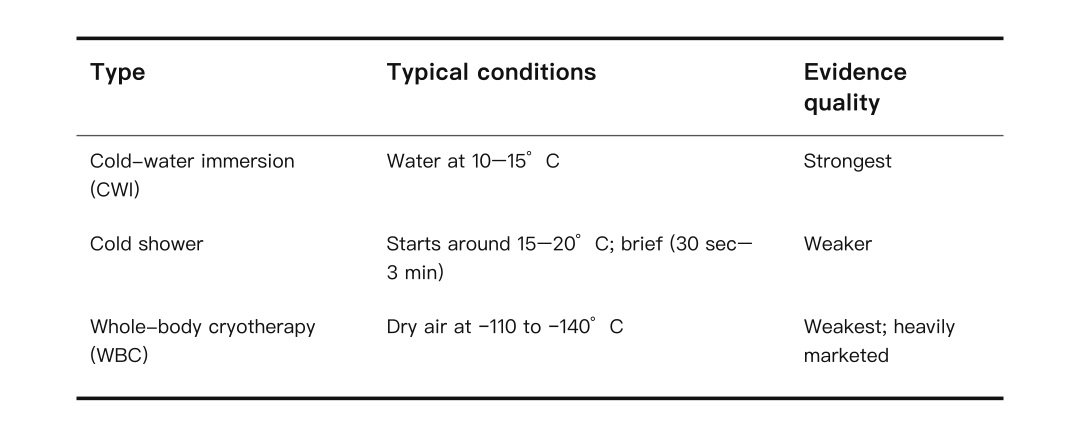
The chamber cooled below −100°C may look the most impressive and high-tech, but it has the weakest evidence [5]. The FDA has not approved any whole-body cryotherapy device to treat a specific medical condition and has emphasized the lack of evidence for its safety and effectiveness. Whole-body cryotherapy can also cause frostbite or cold burns; liquid-nitrogen equipment can pose a risk of oxygen depletion if ventilation is poor.
The main mechanisms of cold exposure
A surge in norepinephrine is one of the better-supported findings in humans. In one study, people immersed themselves in 14°C water for an hour: norepinephrine rose roughly fivefold and dopamine about 2.5-fold [6]. That helps explain the clear-headed, energized feeling afterward. The trade-off is activation of the sympathetic nervous system, which raises heart rate and blood pressure. People with heart problems need to be cautious [7]. It is also why a cold shower just before bed may be unhelpful: greater alertness can make it harder to fall asleep.
Brown-fat activation is real, but its impact is often exaggerated. Unlike white fat, which stores energy, brown fat burns fuel to generate heat and is therefore considered more metabolically beneficial [8]. Spending several hours a day for weeks in a mildly cold environment of around 17°C can increase brown-fat activity [9]. A small study in people with type 2 diabetes also observed improved insulin sensitivity [10]. In theory, strong activation of brown fat could increase energy expenditure by about 100–300 kcal per day [11]—a meaningful amount if it could be maintained over time. But that is not what a few minutes in an ice bath usually achieves. The amount of brown fat varies greatly among people and tends to decline with age and obesity [12]. Moreover, studies reporting effects generally used prolonged, repeated, mild cold exposure, not brief ice baths [13]. The more accurate conclusion is not that “brown fat does very little,” but that brown fat has metabolic potential that ordinary cold-exposure routines rarely turn into sustained, meaningful fat loss.
The cold-shock protein RBM3 is where marketing has most outrun the evidence. It is the basis for claims that ice baths prevent dementia. Yet the key evidence for neuroprotection comes mainly from animal research and is linked to a reduction in core body temperature [14]. In humans, there is no reliable evidence that an ice bath raises RBM3 in the brain and protects cognition [1]. Deliberately cooling your core to chase this unproven benefit carries far greater risks.
Less inflammation and pain versus more muscle: why athletes use ice baths and cryotherapy
Many professional athletes do use ice baths or cryotherapy. Ice tubs are common in NBA and NFL locker rooms, and athletes such as LeBron James and Cristiano Ronaldo have reportedly used cryotherapy chambers after competition. After an intense game, cold exposure can reduce pain and perceived soreness and make athletes feel more recovered in the short term [15].
But an important distinction is often lost on the rest of us: this is primarily a short-term recovery tool, not a tool for building more muscle over time.
Mild inflammation after exercise is part of the signal telling the body to repair and grow stronger. An ice bath immediately after training suppresses the inflammatory response and may also inhibit satellite-cell activity and muscle protein synthesis. In a 2015 study by Roberts and colleagues, after 12 weeks of strength training, the group that used post-exercise cold-water immersion gained less muscle mass and strength than the active-recovery group [16].
Professionals use it because they often have to choose between “being ready to compete again tomorrow” and maximizing long-term adaptation. They prioritize relief from immediate pain, swelling, and fatigue. Most recreational exercisers train far less intensely and frequently. They usually do not need to trade away a muscle-building signal for that short-term comfort.
A more useful set of rules is:
- Early after an acute injury, sprain, or impact: local icing can still be used for pain relief and swelling control, especially for symptom management in the first 24–48 hours.
- During dense competition schedules or very frequent training: an ice bath can serve as a short-term recovery tool.
- After strength training aimed at muscle growth: do not take an ice bath immediately. Wait at least 4–6 hours, or schedule cold exposure on a non-strength-training day.
A professional athlete may use the cold to get ready for the next game. If you copy that routine, you may be trading away muscle gains for the feeling of recovery.
There is a more fundamental tension here: recovery and adaptation can pull in opposite directions. Cold-water immersion can reduce delayed-onset muscle soreness (DOMS) and perceived fatigue. This is its most common use and has moderate supporting evidence [15]. But some of the relief is simply the analgesic and numbing effect of cold, not faster tissue repair [17]. Less inflammation may feel better today, while an ice bath right after training may weaken adaptation over time. Those are two sides of the same coin.
The safety line: cold really can kill
Suddenly jumping into cold water triggers the cold-shock response: an involuntary gasp, hyperventilation, and a sharp rise in heart rate and blood pressure. This happens in the first one to three minutes after entering the water [18] and can be enough to cause aspiration, drowning, or an arrhythmia. Next comes cold incapacitation: your hands and feet stop working properly [19]. Even before severe hypothermia sets in, you may be unable to swim or grip anything. People die in cold water every year; many were competent swimmers.
There is one absolute prohibition: never combine breath-holding or hyperventilation exercises with cold-water immersion. Together they greatly increase the risk of losing consciousness and drowning [20]. Breathing exercises belong on dry land, with someone else present.
Remember these rules as well:
Anyone with cardiovascular disease, uncontrolled high blood pressure, or an arrhythmia should seek a medical assessment before entering cold water.
Never immerse yourself alone in open water. People with Raynaud syndrome or cold urticaria should be cautious. Do not plunge after drinking alcohol, taking sedatives, missing sleep, or experiencing low blood sugar.
Enter gradually rather than diving in. Rewarming matters too: core temperature can continue to fall for a while after you get out, a phenomenon called afterdrop. Dry off, wrap up warmly, and have a warm drink rather than immediately taking a very hot shower or exercising vigorously [3]. Seek urgent medical care if you develop persistent violent shivering, confusion, chest pain, palpitations, or breathing difficulty.
Practical parameters
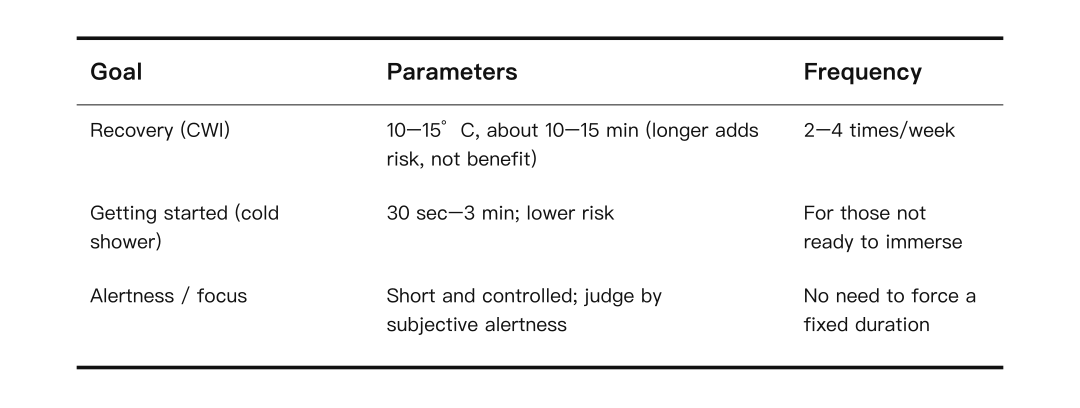
For beginners, the priority is not reaching a target number of minutes; it is maintaining steady breathing and being able to rewarm safely and predictably [4]. As for timing, remember two practical rules: do not plunge immediately after strength training if muscle growth is your goal (leave at least 4–6 hours); on competition days or during dense schedules, cold exposure may be useful for rapid recovery.

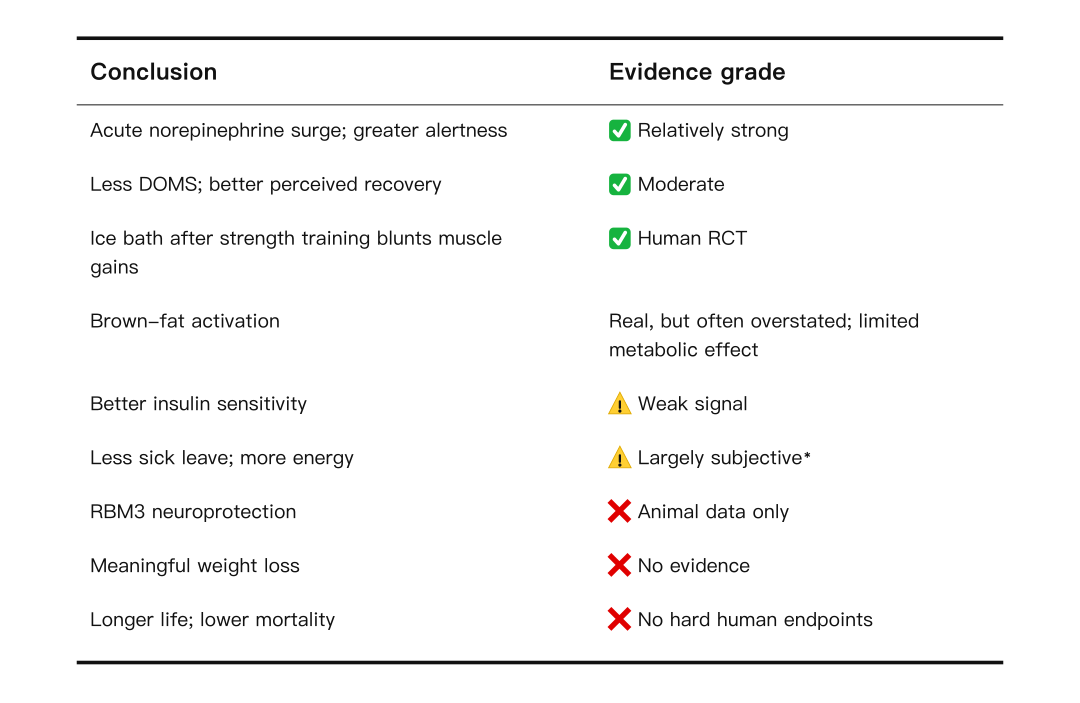
*A Dutch trial found about 29% fewer days of sickness absence among people assigned to cold showers, but no difference in the number of illness episodes. Subjective factors may account for much of the result [21].
Taken together, cold exposure has a clear place in the broader picture of long-term health. Its more credible uses are short-term state regulation and specific sports-recovery situations, not disease prevention or life extension.
References
[1]Espeland D, de Weerd L, Mercer JB. Health effects of voluntary exposure to cold water: a continuing subject of debate. Int J Circumpolar Health. 2022 Dec;81(1):2111789.
[2]Mattson MP. Hormesis defined. Ageing Res Rev. 2008 Jan;7(1):1-7.
[3]Brown DJ, Brugger H, Boyd J, Paal P. Accidental hypothermia. N Engl J Med. 2012 Nov;367(20):1930-8.
[4]Tipton MJ, Collier N, Massey H, Corbett J, Harper M. Cold water immersion: kill or cure? Exp Physiol. 2017 Nov;102(11):1335-55.
[5]Costello JT, Baker PR, Minett GM, Bieuzen F, Stewart IB, Bleakley C. Whole-body cryotherapy (extreme cold air exposure) for preventing and treating muscle soreness after exercise in adults. Cochrane Database Syst Rev. 2015 Sep;(9):CD010789.
[6]Šrámek P, Šimečková M, Janský L, Šavlíková J, Vybíral S. Human physiological responses to immersion into water of different temperatures. Eur J Appl Physiol. 2000 Mar;81(5):436-42.
[7]Shattock MJ, Tipton MJ. 'Autonomic conflict': a different way to die during cold water immersion? J Physiol. 2012 Jul;590(14):3219-30.
[8]Cannon B, Nedergaard J. Brown adipose tissue: function and physiological significance. Physiol Rev. 2004 Jan;84(1):277-359.
[9]van der Lans AA, Hoeks J, Brans B, Vijgen GH, Visser MG, Vosselman MJ, Hansen J, Jörgensen JA, Wu J, Mottaghy FM, Schrauwen P, van Marken Lichtenbelt WD. Cold acclimation recruits human brown fat and increases nonshivering thermogenesis. J Clin Invest. 2013 Aug;123(8):3395-403.
[10]Hanssen MJ, Hoeks J, Brans B, van der Lans AA, Schaart G, van den Driessche JJ, Jörgensen JA, Boekschoten MV, Hesselink MK, Havekes B, Kersten S, Mottaghy FM, van Marken Lichtenbelt WD, Schrauwen P. Short-term cold acclimation improves insulin sensitivity in patients with type 2 diabetes mellitus. Nat Med. 2015 Aug;21(8):863-5.
[11]Cypess AM, Weiner LS, Roberts-Toler C, Franquet Elía E, Kessler SH, Kahn PA, English J, Chatman K, Trauger SA, Doria A, Kolodny GM. Activation of human brown adipose tissue by a β3-adrenergic receptor agonist. Cell Metab. 2015 Jan;21(1):33-38.
[12]Cypess AM, Lehman S, Williams G, Tal I, Rodman D, Goldfine AB, Kuo FC, Palmer EL, Tseng YH, Doria A, Kolodny GM, Kahn CR. Identification and importance of brown adipose tissue in adult humans. N Engl J Med. 2009 Apr;360(15):1509-17.
[13]Yoneshiro T, Aita S, Matsushita M, Kayahara T, Kameya T, Kawai Y, Iwanaga T, Saito M. Recruited brown adipose tissue as an antiobesity agent in humans. J Clin Invest. 2013 Aug;123(8):3404-8.
[14]Peretti D, Bastide A, Radford H, Verity N, Molloy C, Martin MG, Moreno JA, Steinert JR, Smith T, Dinsdale D, Willis AE, Mallucci GR. RBM3 mediates structural plasticity and protective effects of cooling in neurodegeneration. Nature. 2015 Feb;518(7538):236-9.
[15]Machado AF, Ferreira PH, Micheletti JK, de Almeida AC, Lemes ÍR, Vanderlei FM, Netto Junior J, Pastre CM. Can water temperature and immersion time influence the effect of cold water immersion on muscle soreness? A systematic review and meta-analysis. Sports Med. 2016 Apr;46(4):503-14.
[16]Roberts LA, Raastad T, Markworth JF, Figueiredo VC, Egner IM, Shield A, Cameron-Smith D, Coombes JS, Peake JM. Post-exercise cold water immersion attenuates acute anabolic signalling and long-term adaptations in muscle to strength training. J Physiol. 2015 Sep;593(18):4285-301.
[17]Algafly AA, George KP. The effect of cryotherapy on nerve conduction velocity, pain threshold and pain tolerance. Br J Sports Med. 2007 Jun;41(6):365-9.
[18]Tipton MJ. The initial responses to cold-water immersion in man. Clin Sci (Lond). 1989 Nov;77(5):581-8.
[19]Vincent MJ, Tipton MJ. The effects of cold immersion and hand protection on grip strength. Aviat Space Environ Med. 1988 Aug;59(8):738-41.
[20]Centers for Disease Control and Prevention. Unintentional drowning deaths associated with swimming after hyperventilation--New York State, 1988-2011. MMWR Morb Mortal Wkly Rep. 2015 May;64(19):518-21.
[21]Buijze GA, Sierevelt IN, van der Heijden BCJM, Dijkgraaf MGW, Frings-Dresen MHW. The effect of cold showering on health and work: a randomized controlled trial. PLoS One. 2016 Sep;11(9):e0161749.