Exercise is a controlled form of “poisoning.” It creates oxidative stress, an energy crisis, and a rise in core temperature—and these brief, manageable stressors are precisely what signal the body to repair and upgrade itself.
This is hormesis at work in exercise: dose determines the effect, recovery determines the benefit, and excessive protection can be counterproductive.
First, a brief review of the benefits of exercise
Insight 1: The first 150 minutes of exercise each week deliver the greatest benefit
A large pooled analysis of prospective cohorts involving about 660,000 adults, followed for an average of roughly 14 years, found the following [1]:
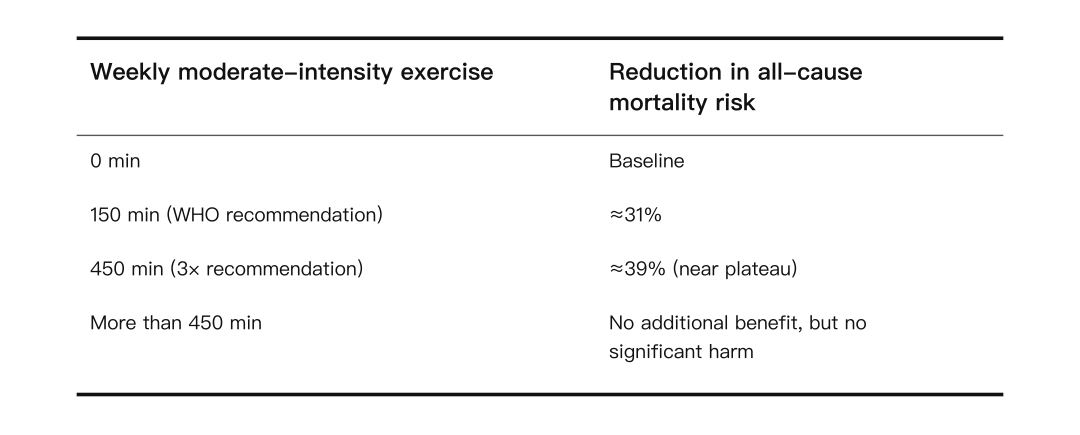
The curve has a reverse-L shape: a small amount of exercise provides substantial benefit, after which the marginal return gradually diminishes. The first 150 minutes each week deliver the greatest gain.
Insight 2: Aerobic and strength training are both important. Neither can replace the other, and combining them is far more powerful than either alone.
In a prospective cohort study of 479,856 US adults, aerobic activity alone was associated with a 29% reduction in mortality, strength training alone with an 11% reduction, and the combination with a 40% reduction [2][3].
The main mechanisms behind exercise hormesis
1. Reactive oxygen species (ROS) and mitochondrial adaptation
Muscle contraction produces reactive oxygen species, or ROS [4]. For years, we treated ROS as simply harmful—something to be eliminated with antioxidants. That view is incomplete.
At low doses, ROS are among the body’s most important adaptation signals [5]. They activate three key switches: PGC-1α, the master regulator of mitochondrial biogenesis that helps you build more mitochondria [6]; Nrf2, which prompts the body to produce its own antioxidant enzymes and strengthens endogenous antioxidant defenses through training [7]; and AMPK, the cellular energy sensor that tells the cell, “Energy is tight—we need to adapt” [8].
Mitochondrial adaptation is the combined result of low energy availability, calcium signaling, redox signaling, and mechanical stress—not a single pathway acting alone [9].
A landmark and counterintuitive experiment by Ristow in 2009 illustrated this point. Participants trained for four weeks. One group trained normally, while the other took 1,000 mg of vitamin C plus 400 IU of vitamin E every day [10].
The result: improvements in insulin sensitivity were almost entirely lost in the antioxidant group, and the upregulation of several exercise-responsive genes was blunted [10]. In other words, the “antioxidant” intervention that was expected to help may have partially canceled the benefits of exercise.
The practical implication is that there is no need to deliberately add high-dose antioxidant supplements around training—for example, more than 500 mg of vitamin C, more than 200 IU of vitamin E, NAC, or alpha-lipoic acid. Antioxidants in fruits and vegetables are delivered at lower doses and more gradually, so they are not a concern. Short-term supplementation may be a different matter if you have a genuine nutrient deficiency or are recovering from an extreme endurance event [41][42].
2. Autophagy
Beyond ROS, exercise can trigger autophagy through AMPK activation and mTOR inhibition, recycling damaged mitochondria and misfolded proteins [11]. In mice, 30 minutes of acute exercise markedly increased autophagy in skeletal muscle, cardiac muscle, the liver, and the pancreas. When autophagy was blocked, the metabolic benefit of exercise—improved glucose homeostasis—disappeared [12].
Autophagy can also be stimulated in other ways. Prolonged fasting, for example, can activate AMPK strongly enough to initiate autophagy. This is one reason some biohackers include fasting in their longevity practices. Ramadan in Islamic cultures, fasting traditions in ancient India, and the Eastern practice of bigu may all reflect, at least in part, an intuitive understanding of this pathway. Exercise, however, is a more convenient and timely way to stimulate autophagy. Prolonged fasting can place a substantial burden on the body and is difficult to integrate into everyday life.
There is another reason we recommend exercise as a way to promote autophagy: during exercise, the body shifts toward AMPK and autophagy—breakdown and cleanup. During recovery and refeeding, it shifts toward mTOR—synthesis, rebuilding, and supercompensation. Long-term health depends on establishing a balanced rhythm between AMPK and mTOR, not on keeping either pathway permanently activated. The same principle extends to life more broadly: alternating breakdown and synthesis is healthier than moving in only one direction.
3. Heat shock proteins
Prolonged, high-intensity exercise—especially in hot environments or when heat dissipation is limited—can raise core temperature by 1–2°C [13]. That rise is itself a stress signal: at high temperatures, cellular proteins are at risk of denaturing or misfolding. The body responds by activating HSF1, which in turn upregulates a family of molecular chaperones called heat shock proteins, including HSP70 and HSP90 [14][15]. These proteins help other proteins fold correctly, repair damaged proteins, and clear away material that cannot be salvaged. In essence, they form the cell’s protein quality-control system. This is another classic example of hormesis: a brief heat stress produces a more resilient system for maintaining protein homeostasis over the long term.
Interestingly, sauna bathing activates the same pathway. Finnish cohort studies have found that more frequent sauna use is associated with lower risks of both cardiovascular mortality and all-cause mortality [43][44].
4. Lactate: a wrongly accused signaling molecule
Many of us were taught that lactate causes fatigue and muscle soreness. Both charges are misplaced. Delayed-onset muscle soreness is primarily caused by microdamage to muscle fibers and the resulting inflammation [16]. According to the modern lactate shuttle theory, lactate is a fuel, a precursor for gluconeogenesis, and a signaling molecule. It is cleared rapidly after exercise and has little to do with delayed soreness [17].
Lactate’s true identity is fuel plus signal—and it is a textbook hormetic signal: a brief rise during exercise triggers adaptation, while excessive levels can be harmful. The heart, brain, and slow-twitch muscle fibers can all use lactate directly as fuel. Its signaling effects are extensive:
-
Animal studies suggest that lactate can cross the blood–brain barrier and upregulate BDNF, or brain-derived neurotrophic factor, in the hippocampus. This may be one mechanism through which HIIT affects cognitive function [18][45].
-
It promotes angiogenesis through the HIF-1α pathway [19].
-
Experimental research suggests that it can promote the “beiging” of adipocytes [20].
-
More recently, lactate has been found to influence gene expression directly through histone lactylation, elevating it from a metabolic by-product to an epigenetic signaling molecule [21].
Like ROS, lactate operates at two distinct dose levels. The chronic, low-dose stimulus of Zone 2 training, where blood lactate is around 2 mmol/L [22], and the acute, high-dose stimulus of HIIT, where it may reach 8–15 mmol/L, do not activate exactly the same downstream pathways. This helps explain why elite endurance athletes often perform best with polarized training—roughly 80% low intensity and 20% high intensity [23][24]. You need two different signals, not the average of one signal.
5. The immune system: an acute rise, a chronic decline
Exercise affects the immune system according to the same hormetic logic. A single bout of exercise causes a temporary inflammatory response and mobilizes immune cells. This is not simply an “immune decline” or “immune suppression”; it is more like a system-wide patrol and redistribution of immune cells among tissues.
People who exercise regularly over the long term tend to have lower baseline levels of CRP, or C-reactive protein, a marker of systemic inflammation, and IL-6, or interleukin-6 [28]. They also show greater natural killer cell activity and a marked slowing of immunosenescence [29]. This may be one of the key mechanisms through which exercise lowers the incidence of colorectal and breast cancer: stronger immune surveillance [30].
IL-6 has two faces. Acute IL-6 released during muscle contraction is anti-inflammatory and metabolically beneficial. Chronic IL-6 secreted over time by adipose tissue and immune cells is pro-inflammatory and disease-promoting [31]. The same molecule can have completely opposite effects depending on its source and time course—an illustration of the body’s sophisticated regulatory intelligence.
A “hormetic overdose”: overtraining
The benefits of hormesis are not unlimited. When training load exceeds the body’s capacity to recover, the effect can flip from stimulation to depletion.
As noted earlier, exercise duration alone tells us little about when exercise becomes harmful. People differ in physiology and tolerance. Those who train more often can usually tolerate longer sessions and continue to benefit from them. That is why signs and metrics—not time alone—should guide our judgment of whether we are overtraining.
Early warning signs include:
-
A sustained increase in resting heart rate of more than 5 bpm above baseline
-
A decline in heart rate variability, or HRV, across several consecutive days
-
Deteriorating sleep quality
-
Poor energy and readiness on waking
-
A drop in training performance lasting more than two weeks
It is important to distinguish two conditions. Functional overreaching—a short period of overload followed by a rebound during a deload week—can be part of a training plan. True overtraining syndrome, or OTS, may require months of recovery [32]. HRV data from wearables can be informative, but a single day’s fluctuation is not diagnostic. Look instead at the 7–14-day trend together with subjective fatigue and performance [33].
Remember: recovery—rest plus adequate nutrition—is an indispensable part of exercise.
Among recovery strategies, sleep is the irreplaceable first priority [34]. For people doing resistance training, daily protein intake should generally be maintained at 1.6–2.2 g/kg/day [35]. Another critical but often overlooked factor is energy availability. Sustained caloric restriction, particularly insufficient carbohydrate intake, can impair thyroid function, sex hormones, bone density, and immune function. This condition is known as Relative Energy Deficiency in Sport, or RED-S [36]. For people with high training volumes, carbohydrate is not merely a source of calories; it is also essential for maintaining training quality and supporting endocrine recovery [46].
What pairs with exercise: synergy or interference?
Once we understand the logic of hormesis, we gain a clear framework for deciding how exercise should be combined with other interventions:
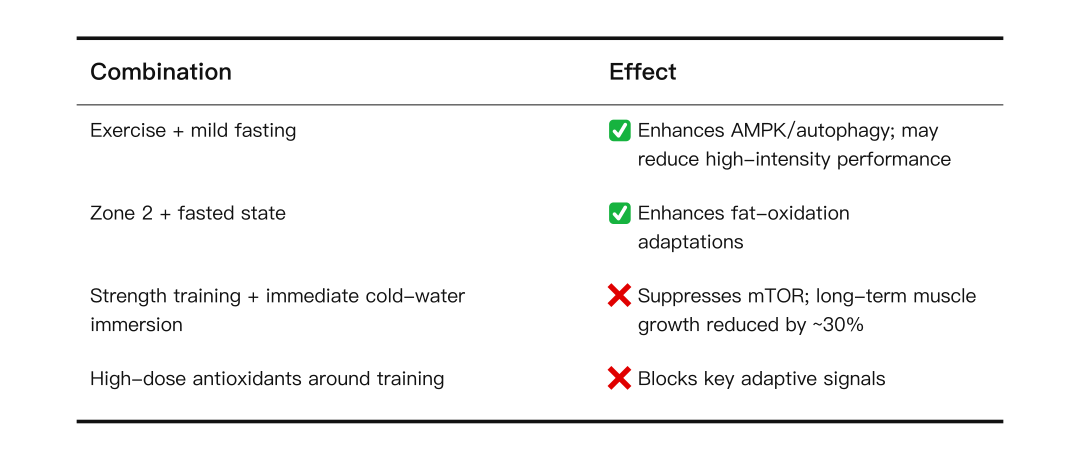
Cold exposure, another classic hormetic stressor, deserves special attention. Cold-water immersion immediately after strength training can suppress mTOR signaling and satellite-cell activation. Long-term follow-up suggests that it may reduce muscle hypertrophy by about 30% [37]. If you want to use cold exposure, separate it from strength training by at least 4–6 hours, or schedule it on a non-strength-training day. Aerobic exercise and cold exposure may work synergistically along the pathway that promotes mitochondrial biogenesis. Yet cold exposure also substantially suppresses inflammation and ROS, creating a trade-off similar to the conflict between antioxidants and aerobic training. In practice, the most relevant use of cold exposure around exercise may be after an acute sports injury, as a short-term tool for pain relief, vasoconstriction, reduced muscle blood flow, and inflammation control [47].
Otherwise, it is generally better to practice cold exposure as a separate hormetic intervention.
Fasted training also deserves a cautious assessment. It can enhance adaptations related to fat oxidation [38], but it does not necessarily produce better fat loss or performance [39]. If your goals include high-intensity performance, muscle gain, or endocrine stability—especially for women—or if you already struggle with sleep or stress, training after eating is usually the better choice.
Exercise may be the best all-in-one hormetic intervention
Viewed through the lens of hormesis, exercise is a controllable bundle of micro-stressors with built-in brakes: mechanical tension, energy stress, hypoxia followed by reoxygenation, ROS, heat stress, lactate signaling, and short pulses of inflammation. Each stressor is brief, recoverable, and capable of being translated by the body into an adaptive signal.
But more stimulation is not always better. Avoid stacking so many stressors on the same day that they exceed your recovery budget. Exercise plus sauna plus mild fasting plus inadequate sleep plus heavy work stress plus an active infection can flip hormesis into depletion and physical damage.

-
Accumulate 150–450 minutes of moderate-intensity exercise each week, plus 2–3 strength-training sessions [40]. This range captures more than 90% of the potential benefit.
-
Include both aerobic and resistance training. Neither can replace the other, and the two have synergistic effects.
-
Avoid high-dose antioxidant supplements in the 1–2 hours before and after training. Fruits and vegetables do not count—eat them normally.
-
For aerobic training, include both low-intensity Zone 2 work and high-intensity intervals. A polarized distribution of roughly 80% low intensity and 20% high intensity is smarter than doing every session at moderate intensity.
-
Sleep is the first priority for recovery, protein the second, and sufficient carbohydrate the third.
-
Avoid cold-water immersion on strength-training days, or separate it from training by at least 4–6 hours. If you want to use cold exposure, schedule it on an aerobic-training or rest day.
-
Track the ongoing trends in your HRV, resting heart rate, sleep, and mood to determine whether your training load has become excessive.

Disclaimer
This article does not constitute medical advice. It reflects personal learning, research, practice, and sharing, and is provided for reference only. For medical guidance, consult a physician or other qualified healthcare professional directly. Discussions of proactive interventions are intended primarily for healthy people; if you have an underlying medical condition, follow the advice of your clinician first.
References
[1]Arem H, Moore SC, Patel A, Hartge P, Berrington de Gonzalez A, Visvanathan K, Campbell PT, Freedman M, Weiderpass E, Adami HO, Linet MS, Lee IM, Matthews CE. Leisure time physical activity and mortality: a detailed pooled analysis of the dose-response relationship. JAMA Intern Med. 2015 Jun;175(6):959-67.
[2]Zhao M, Veeranki SP, Magnussen CG, Xi B. Recommended physical activity and all cause and cause specific mortality in US adults: prospective cohort study. BMJ. 2020 Jul;370:m2031.
[3]Gorzelitz J, Trabert B, Katki HA, et al. Independent and joint associations of weightlifting and aerobic activity with all-cause, cardiovascular disease and cancer mortality. Br J Sports Med. 2022 Nov;56(22):1277-83.
[4]Powers SK, Jackson MJ. Exercise-induced oxidative stress: cellular mechanisms and impact on muscle force production. Physiol Rev. 2008 Oct;88(4):1243-76.
[5]Powers SK, Duarte J, Kavazis AN, Talbert EE. Reactive oxygen species are signalling molecules for skeletal muscle adaptation. Exp Physiol. 2010 Jan;95(1):1-9.
[6]Wu Z, Puigserver P, Andersson U, Zhang C, Adelmant G, Mootha V, Troy A, Cinti S, Lowell B, Scarpulla RC, Spiegelman BM. Mechanisms controlling mitochondrial biogenesis and respiration through the thermogenic coactivator PGC-1. Cell. 1999 Jul;98(1):115-24.
[7]Gomez-Cabrera MC, Domenech E, Viña J. Moderate exercise is an antioxidant: upregulation of antioxidant genes by training. Free Radic Biol Med. 2008 Jan;44(2):126-31.
[8]Hardie DG, Ross FA, Hawley SA. AMPK: a nutrient and energy sensor that maintains energy homeostasis. Nat Rev Mol Cell Biol. 2012 Mar;13(4):251-62.
[9]Egan B, Zierath JR. Exercise metabolism and the molecular regulation of skeletal muscle adaptation. Cell Metab. 2013 Feb;17(2):162-84.
[10]Ristow M, Zarse K, Oberbach A, Klöting N, Birringer M, Kiehntopf M, et al. Antioxidants prevent health-promoting effects of physical exercise in humans. Proc Natl Acad Sci U S A. 2009 May;106(21):8665-70.
[11]Kim J, Kundu M, Viollet B, Guan KL. AMPK and mTOR regulate autophagy through direct phosphorylation of Ulk1. Nat Cell Biol. 2011 Feb;13(2):132-41.
[12]He C, Bassik MC, Moresi V, Sun K, Wei Y, Zou Z, An Z, Loh J, Fisher J, Sun Q, Korsmeyer S, Packer M, May HI, Hill JA, Virgin HW, Gilpin C, Xiao G, Bassel-Duby R, Scherer PE, Levine B. Exercise-induced BCL2-regulated autophagy is required for muscle glucose homeostasis. Nature. 2012 Jan;481(7382):511-5.
[13]González-Alonso J, Teller C, Andersen SL, Jensen FB, Hyldig T, Nielsen B. Influence of body temperature on the development of fatigue during prolonged exercise in the heat. J Appl Physiol (1985). 1999 Mar;86(3):1032-9.
[14]Febbraio MA, Koukoulas I. HSP72 gene expression progressively increases in human skeletal muscle during prolonged, exhaustive exercise. J Appl Physiol (1985). 2000 Sep;89(3):1055-60.
[15]Morimoto RI. Regulation of the heat shock transcriptional response: cross talk between a family of heat shock factors, molecular chaperones, and negative regulators. Genes Dev. 1998 Dec;12(24):3788-96.
[16]Cheung K, Hume P, Maxwell L. Delayed onset muscle soreness : treatment strategies and performance factors. Sports Med. 2003;33(2):145-64.
[17]Brooks GA. The Science and Translation of Lactate Shuttle Theory. Cell Metab. 2018 Apr;27(4):757-85.
[18]
El Hayek L, Khalifeh M, Zibara V, Abi Assaad R, Emmanuel N, Karnib N, et al. Lactate Mediates the Effects of Exercise on Learning and Memory Through SIRT1-Dependent Activation of Hippocampal Brain-Derived Neurotrophic Factor (BDNF). J Neurosci. 2019 Mar 27;39(13):2369-2382.
[19]Hunt TK, Aslam RS, Beckert S, Wagner S, Ghani QP, Hussain MZ, Roy S, Sen CK. Aerobically derived lactate stimulates revascularization and tissue repair via redox mechanisms. Antioxid Redox Signal. 2007 Aug;9(8):1115-24.
[20]Carrière A, Jeanson Y, Berger-Müller S, André M, Chenouard V, Arnaud E, Barreau C, Walther R, Galinier A, Wdziekonski B, Villageois P, Louche K, Collas P, Moro C, Dani C, Villarroya F, Casteilla L. Browning of white adipose cells by intermediate metabolites: an adaptive mechanism to alleviate redox pressure. Diabetes. 2014 Oct;63(10):3253-65.
[21]Zhang D, Tang Z, Huang H, Zhou G, Cui C, Weng Y, Liu W, Kim S, Lee S, Perez-Neut M, Ding J, Czyz D, Hu R, Ye Z, He M, Zheng YG, Shuman HA, Dai L, Ren B, Roeder RG, Becker L, Zhao Y. Metabolic regulation of gene expression by histone lactylation. Nature. 2019 Oct;574(7779):575-80.
[22]Kindermann W, Simon G, Keul J. The significance of the aerobic-anaerobic transition for the determination of work load intensities during endurance training. Eur J Appl Physiol Occup Physiol. 1979 Sep;42(1):25-34.
[23]Seiler KS, Kjerland GØ. Quantifying training intensity distribution in elite endurance athletes: is there evidence for an "optimal" distribution?. Scand J Med Sci Sports. 2006 Feb;16(1):49-56.
[24]Stöggl T, Sperlich B. Polarized training has greater impact on key endurance variables than threshold, high intensity, or high volume training. Front Physiol. 2014 Feb;5:33.
[25]Pedersen BK, Hoffman-Goetz L. Exercise and the immune system: regulation, integration, and adaptation. Physiol Rev. 2000 Jul;80(3):1055-81.
[26]Nieman DC. Exercise, infection, and immunity. Int J Sports Med. 1994 Oct;15 Suppl 3:S131-41.
[27]Nieman DC, Johanssen LM, Lee JW, Arabatzis K. Infectious episodes in runners before and after the Los Angeles Marathon. J Sports Med Phys Fitness. 1990 Sep;30(3):316-28.
[28]Ford ES. Does exercise reduce inflammation? Physical activity and C-reactive protein among U.S. adults. Epidemiology. 2002 Sep;13(5):561-8.
[29]Duggal NA, Niemiro G, Harridge SDR, Simpson RJ, Lord JM. Can physical activity ameliorate immunosenescence and thereby reduce age-related multi-morbidity? Nat Rev Immunol. 2019 Sep;19(9):563-72.
[30]Moore SC, Lee IM, Weiderpass E, Campbell PT, Sampson JN, Kitahara CM, et al. Association of leisure-time physical activity with risk of 26 types of cancer in 1.44 million adults. JAMA Intern Med. 2016 Jun;176(6):816-25.
[31]Pedersen BK, Febbraio MA. Muscle as an endocrine organ: focus on muscle-derived interleukin-6. Physiol Rev. 2008 Oct;88(4):1379-406.
[32]Meeusen R, Duclos M, Foster C, Fry A, Gleeson M, Nieman D, et al. Prevention, diagnosis, and treatment of the overtraining syndrome: joint consensus statement of the European College of Sport Science and the American College of Sports Medicine. Med Sci Sports Exerc. 2013 Jan;45(1):186-205.
[33]Bellenger CR, Fuller JT, Thomson RL, Davison K, Robertson EY, Buckley JD. Monitoring athletic training status through autonomic heart rate regulation: a systematic review and meta-analysis. Sports Med. 2016 Oct;46(10):1461-86.
[34]Watson AM. Sleep and athletic performance. Curr Sports Med Rep. 2017 Nov;16(6):413-8.
[35]Morton RW, Murphy KT, McKellar SR, Schoenfeld BJ, Henselmans M, Helms E, et al. A systematic review, meta-analysis and meta-regression of the effect of protein supplementation on resistance training-induced gains in muscle mass and strength in healthy adults. Br J Sports Med. 2018 Mar;52(6):376-84.
[36]Mountjoy M, Sundgot-Borgen J, Burke L, Carter S, Constantini N, Lebrun C, et al. The IOC consensus statement: beyond the Female Athlete Triad—Relative Energy Deficiency in Sport (RED-S). Br J Sports Med. 2014 Apr;48(7):491-7.
[37]Roberts LA, Raastad T, Markworth JF, Figueiredo VC, Egner IM, Shield A, et al. Post-exercise cold water immersion attenuates acute anabolic signalling and long-term adaptations in muscle to strength training. J Physiol. 2015 Sep;593(18):4285-301.
[38]
Van Proeyen K, Szlufcik K, Nielens H, Ramaekers M, Hespel P. Beneficial metabolic adaptations due to endurance exercise training in the fasted state. J Appl Physiol (1985). 2011 Jan;110(1):236-245.
[39]Schoenfeld BJ, Aragon AA, Wilborn CD, Krieger JW, Sonmez GT. Body composition changes associated with fasted versus non-fasted aerobic exercise. J Int Soc Sports Nutr. 2014 Nov;11:54.
[40]
Garber CE, Blissmer B, Deschenes MR, Franklin BA, LaMonte MJ, Lee IM, et al. American College of Sports Medicine position stand. Quantity and quality of exercise for developing and maintaining cardiorespiratory, musculoskeletal, and neuromotor fitness in apparently healthy adults: guidance for prescribing exercise. Med Sci Sports Exerc. 2011 Jul;43(7):1334-1359.
[41]Mason SA, Trewin AJ, Parker L, Wadley GD. Antioxidant supplements and endurance exercise: Current evidence and mechanistic insights. Redox Biol. 2020 Jul;35:101471.
[42]Higgins MR, Izadi A, Kaviani M. Antioxidants and exercise performance: with a focus on vitamin E and C supplementation. Int J Environ Res Public Health. 2020 Nov 23;17(22):8452.
[43]Laukkanen T, Khan H, Zaccardi F, Laukkanen JA. Association between sauna bathing and fatal cardiovascular and all-cause mortality events. JAMA Intern Med. 2015 Apr;175(4):542-548.
[44]Laukkanen JA, Laukkanen T, Kunutsor SK. Cardiovascular and other health benefits of sauna bathing: A review of the evidence. Mayo Clin Proc. 2018 Aug;93(8):1111-1121.
[45]Müller P, Duderstadt Y, Lessmann V, Müller NG. Lactate and BDNF: Key mediators of exercise induced neuroplasticity? J Clin Med. 2020 Apr 30;9(5):1136.
[46]Mountjoy M, Ackerman KE, Bailey DM, Burke LM, Constantini N, Hackney AC, Heikura IA, Melin A, Pensgaard AM, Stellingwerff T, Sundgot-Borgen JK, Torstveit MK, Jacobsen AU, Verhagen E, Budgett R, Engebretsen L, Erdener U. 2023 International Olympic Committee’s (IOC) consensus statement on Relative Energy Deficiency in Sport (REDs). Br J Sports Med. 2023 Sep;57(17):1073-1097.
[47]Petersen AC, Fyfe JJ. Post-exercise cold water immersion effects on physiological adaptations to resistance training and the underlying mechanisms in skeletal muscle: A narrative review. Front Sports Act Living. 2021 Apr 12;3:660291.