Two weeks ago, just back from an intense week of travel, I was happily on the tennis court with my coach — enjoying the sport often crowned as the “longest-living” activity.
We were rallying hard. I had just lunged to return a forehand when the next shot flew sharply to my backhand corner. I stopped on a dime, planted my foot, took a big step, twisted my torso, and swung — crack. The ball sliced cleanly across the court, landing near my opponent’s backhand baseline.
A perfect shot. I was thrilled — especially because I’ve never been great at backhands.
But before I could celebrate, a sharp pain shot up from the back of my left calf, piercing up toward my knee like a needle.
I tried walking it off. It wasn’t unbearable, but the pain lingered.
Maybe just a light pull, I told myself. I’ll shake it off. So I pushed through and played another 30 minutes.
But once I got home and sat down, it hit me — something was wrong. The pain worsened quickly, and it became almost impossible to walk normally. Any pressure sent jolts through the back of my leg.
I was injured.
I. Injury: The Second School of Movement
Before I wrap up the movement section of this series, I want to pause and talk about pain.
It was around two or three years ago when injury began to show up more often in my life.
1️⃣ First realization: I get injured more easily now.
Minor injuries started visiting me like colds — easy to catch, but slow to heal.
Both my shoulders, my elbows, my knees, Achilles tendons, and now this calf — they’ve all had their turn.
And looking back, most of these injuries coincided with the period I seriously got back into training. Not a coincidence.
The pattern is clear: injuries mostly came from training too hard, too soon, or training without enough preparation, or training without enough science.
I still remember the shoulder injury vividly. I randomly decided to challenge myself to 15 pull-ups. My back wasn’t strong enough, so other muscles compensated. I tore my rotator cuff. It was bad. I couldn’t do any upper-body workouts for half a year. Even now, two years later, I’ve never quite regained my old pull-up level.
The elbow issue — likely tennis elbow — probably came from poor kinetic chain mechanics. I wasn’t engaging my core or torso properly. My elbow was bearing all the force. Combine that with overuse (I’m right-handed), and eventually, the joint gave out.
Knees and Achilles? Running injuries. Repetitive stress on the same muscle groups, compounded by poor post-run recovery. Tiny injuries snowballed.
And this recent calf tear? A classic case of poor warm-up. I’d been traveling, training less, sleeping poorly. Muscles were stiff. I rushed onto the court without warming up — and one explosive move blew the whistle.
The older I get, the more careless movement turns into injury.
2️⃣ Second realization: recovery takes longer.
In my 20s, even moderate sprains healed after a good night’s sleep and a patch.
Now? Minor injuries take two to three weeks. A bit worse, and it’s months.
It’s not just perception — it’s biology [1–4]:
- Soft tissue elasticity and circulation decline with age
- Cellular repair slows down
- Bone and tendon healing takes longer
- Inflammatory markers linger longer, turning acute injuries into chronic ones
Muscle mass, bone density, joint stability — all start declining after age 30. And unless you intentionally intervene with training and nutrition, that slope gets steep after 40 [5–6].
So no — it’s not a lack of effort. It’s physiology.
Which means we need smarter, steadier training — not harder training.
3️⃣ Third realization: injuries disrupt everything.
The hardest part of injury isn’t just the pain — it’s the way it disrupts your rhythm.
One injury, and your regular training habit is derailed. What took months to build starts unraveling.
Your fitness regresses — muscle strength fades, and your mental motivation dulls.
Sometimes the pain fades in two weeks. But regaining your groove? That takes longer.
Even worse, it sets off a domino effect:
- Diet: You stop moving, your metabolism slows, but your eating habits don’t. You gain weight — but not muscle.
- Sleep: No exercise means less “sleep pressure.” You sleep poorly. Your schedule drifts.
- Mood: You feel frustrated, sluggish, and stuck in a low-energy cycle.
Injury doesn’t just hurt your muscle — it throws your entire life system out of balance.
It may look like a localized issue, but it knocks out the entire energy rhythm of your life. That’s the real damage.
For exercise to extend healthspan, it must not injure you. And rushed, unprepared exercise? That’s how you get injured.
❓What Does It Mean to Be “Unprepared”?
Let me break it down with my own mistakes — you might find some familiar patterns in here:
- Not doing targeted strength work for weak areas
- Skipping dynamic warm-ups — like this tennis session that led to my calf injury
- Not stretching post-exercise — old knee and Achilles issues stem from this
- Faulty movement patterns — doing complex lifts without activating core muscles, causing shoulder overcompensation and injury
- Pushing beyond current capacity — high intensity and frequency without enough recovery
- Monotonous training — daily runs may seem healthy, but in reality they overload certain joints and muscle groups
- Forcing workouts despite poor sleep or fatigue — like this time, jumping into tennis after a long business trip without recovery
If you’re serious about making exercise part of your Prime Life Protocol, then injury prevention and training readiness aren’t optional — they’re part of the discipline.
A stable training rhythm and professional guidance go hand in hand.
And targeted strength training itself? It’s the single most powerful tool for injury prevention.
Studies show that strength training and neuromuscular training can reduce overall injury risk by up to 68% [7–8].
Second best? A structured warm-up system like FIFA 11+, which can cut injury risk by 30% 9:
FIFA 11+ was developed by FIFA’s medical research center (F-MARC) in collaboration with the University of Zurich. It’s a systematic warm-up protocol designed specifically to reduce injury risk. It started with football players, but has since been widely adopted by runners, tennis players, basketball players — even everyday fitness enthusiasts.
With the right coaching, injury prevention can be embedded into your training system:
- Periodized strength training (core/hip/knee/ankle chains) →
- Structured dynamic warm-ups (like FIFA 11+) →
- Load management (adjust intensity appropriately) →
- Optimized movement patterns (reduce compensations) →
- Cross-training (avoid repetitive stress) →
- Post-training stretching & joint mobility work →
- Sleep & nutrition
This is why hiring a professional coach or consultant is not a luxury — it’s not just an investment in “training efficiency,” but also in “injury insurance.”
Painted by AI
Part II: The Rehab Experience
Once you’re injured, the focus shifts from prevention to repair.
In serious cases, you might need a trip to the ER. I was lucky this time — a skilled rehab specialist was enough.
Diagnosis: mild strain of the left gastrocnemius — in plain English, a partial tear of the calf muscle.
This muscle powers explosive movements — sprinting, jumping, sudden directional shifts. But in midlife, tendons lose elasticity and recovery slows down. One unexpected burst of force can easily become the “final straw” [10–11].
⚠️ Releasing Adhesions
My rehab specialist started with manual therapy to release the fascia, then used compression sleeves to reduce swelling.
I asked, “What if I just rest it and let the pain subside naturally in a few weeks?”
He replied, “Then the muscle fibers may heal improperly — forming scar tissue or misaligned collagen fibers. You might stop feeling pain, but flexibility and performance won’t come back. That’s why so many people keep dealing with the same chronic injuries.”
It reminded me of a hamstring injury from years ago. The pain disappeared long ago, but every time I stretch that area, I still feel like it’s on the verge of tearing. That muscle group never regained its full flexibility.
Clearly, “no pain” does not mean “recovered.” True recovery is when a muscle regains its original function — not just when it stops hurting.
♻️ The Unexpected Experience of Rehab Training
Just after the manual therapy, my rehab coach said, “Let’s get to training.”
That completely contradicted my past experience. I used to think injuries meant at least two or three weeks of total rest. Maybe then you could start slowly rebuilding. And even then — only train other body parts.
But he told me: “Rehab is not the same as rest.”
“Muscles are brutally honest. Use them — they get stronger. Stop using them — they waste away.”
If you pause completely during rehab, the muscles that normally support or coordinate with the injured area will also begin to deteriorate. In the end, the injury might heal, but the rest of your system will have weakened.
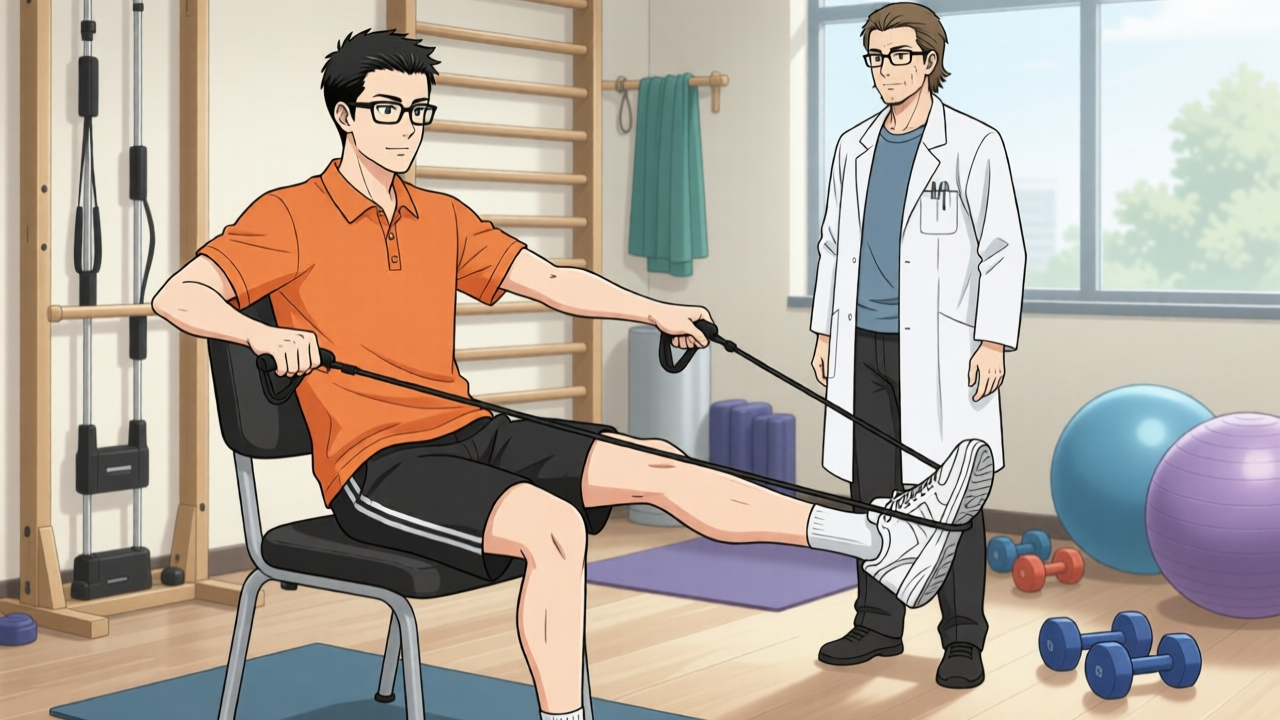
So we entered Phase One of rehab: Avoid the injured area, and activate the surrounding muscles to prevent overall regression.
I was skeptical: “I can barely walk properly — what can I even train?”
He explained: The gastrocnemius mainly drives the pushing motion during leg extension. But the quads, hip flexors, and even glute medius don’t rely on it directly. So we could train the anterior chain of the legs without touching the injured posterior chain.
This was real expertise.
If I had been on my own, I never would’ve dared train legs while recovering from a leg injury. But with a clear understanding of anatomy and muscle isolation, we did it.
Incredibly, just one week after the injury, I was already doing leg training: fast squats, glute bridges, Bulgarian split squats, crab walks — all focused, all avoiding danger zones.
The weights were light. The perceived intensity was lower. But the total volume and training duration? On par with my normal sessions.
And perhaps more importantly: I kept my training rhythm. That alone was a huge win.
🗒 Recovery Can Be Systematic, Too
In week two, the pain noticeably eased. So we moved to Phase Two of rehab: gently reactivating the calf muscle. This included slow, tempo-controlled calf raises and static foot presses.
By week three, the pain was nearly gone. We entered Phase Three: light box jumps, slow loaded calf presses, all designed to rebuild explosive strength. My rehab coach said next week we could try light jogging — helping the calf reintegrate under dynamic conditions.
The biggest takeaway?
Recovery can be part of your training system.
If done properly, your diet, sleep, and workout rhythm don’t have to fall apart. An injury doesn’t have to set you back — it can be an opportunity for structural recalibration.
So my advice is simple:
What to do after an injury?
See a doctor. See a rehab specialist. Don’t tough it out on your own.
What matters more than rest is a structured and scientific reactivation.
In Summary
How to avoid injury:
- Strength training is your #1 defense
- Warm up thoroughly
- Use correct movement patterns — avoid compensations
- Don’t push high intensity beyond your level
- Vary your movement — don’t overdo one pattern
- Stretch and recover after training
- Manage workload — give your body time to repair
- Never ignore sleep and nutrition
- Work with a coach — especially after 40
Already injured?
- Get an early and accurate diagnosis
- Seek professional rehab — don’t “tough it out”
- Recover in structured phases, not blindly
- Stay active — rehab is also training
- Prevent the entire system from going “offline”
One More Thing: Injury Teaches, Too
Training isn’t just about reps, sweat, or personal records.
There’s wisdom in injury — and opportunity in recovery.
We need both the foresight to prevent pain and the structure to bounce back smartly.
Not reckless effort, but intelligent training.
Not passive rest, but strategic healing.
Use science and systems to bring recovery into your Prime Life Protocol.
Because the only thing worse than getting injured — is letting that injury push you further away from the healthy rhythm you worked so hard to build.
The smarter way?
Let injury recalibrate your system.
And come back better.
Intervention recommendations are geared toward generally healthy individuals. If you have existing health conditions, always follow your doctor’s instructions.
References
[1]Kwan KYC, Ng KWK, Rao Y, Zhu C, Qi S, Tuan RS, Ker DFE, Wang DM. Effect of Aging on Tendon Biology, Biomechanics and Implications for Treatment Approaches. Int J Mol Sci. 2023 Oct 14;24(20):15183.
[2]Svensson RB, Heinemeier KM, Couppé C, Kjaer M, Magnusson SP. Effect of aging and exercise on the tendon. J Appl Physiol (1985). 2016 Dec 1;121(6):1237–1246.
[3]Clark D, Nakamura M, Miclau T, Marcucio R. Effects of Aging on Fracture Healing. Curr Osteoporos Rep. 2017 Dec;15(6):601–608.
[4]Sendama W. The effect of ageing on the resolution of inflammation. Ageing Res Rev. 2020 Jan;57:101000.
[5]Keller K, Engelhardt M. Strength and muscle mass loss with aging process. Age and strength loss. Muscles Ligaments Tendons J. 2014 Feb 24;3(4):346–50.
[6]Watts NB, Adler RA, Bilezikian JP, Drake MT, Eastell R, Orwoll ES, Finkelstein JS; Endocrine Society. Osteoporosis in men: an Endocrine Society clinical practice guideline. J Clin Endocrinol Metab. 2012 Jun;97(6):1802–22.
[7]Lauersen JB, Bertelsen DM, Andersen LB. The effectiveness of exercise interventions to prevent sports injuries: a systematic review and meta-analysis of randomised controlled trials. Br J Sports Med. 2014 Jun;48(11):871–7.
[8]Lauersen JB, Andersen TE, Andersen LB. Strength training as superior, dose-dependent and safe prevention of acute and overuse sports injuries: a systematic review, qualitative analysis and meta-analysis. Br J Sports Med. 2018 Dec;52(24):1557–1563.
[9]Sadigursky, D., Braid, J.A., De Lira, D.N.L. et al. The FIFA 11+ injury prevention program for soccer players: a systematic review. BMC Sports Sci Med Rehabil 9, 18 (2017).
[10]Hamner SR, Seth A, Delp SL. Muscle contributions to propulsion and support during running. J Biomech. 2010 Oct 19;43(14):2709–16.
[11]Green B, Pizzari T. Calf muscle strain injuries in sport: a systematic review of risk factors for injury. Br J Sports Med. 2017 Aug;51(16):1189–1194.