52. Comprehensive Assessment of Physical Capacity (Part 2) — Strength, Functionality, Symmetry, and Body Composition
Painted by AI
In the previous entry, we dove into the first section of movement capacity testing — the CPET test — which helps us understand mitochondrial efficiency, our cardiovascular ceiling, and how to tailor our Zone 2 and HIIT training goals.
Today, let’s explore the second half of this five-part test report, which includes:
- Volume: Isotonic muscle strength
- Functionality: Practical movement performance
- Symmetry: Postural and movement symmetry
- Body Composition: Muscle, fat, and metabolic metrics
The first three modules map directly to the three pillars of muscle training: volume, functionality, and symmetry.
What’s especially useful is this: even if you don’t have access to a professional testing lab, understanding the rationale behind these movements and metrics will allow you to conduct a quality self-assessment — at home or in the gym.
Volume: Isotonic Strength — Your Muscular “Savings Account”
Isotonic strength refers to a muscle’s ability to generate force through movement — producing stable power while pushing, pulling, or lifting under a constant external load. Think bench press, squats, pull-ups: all classic examples of isotonic exertion 1,2.
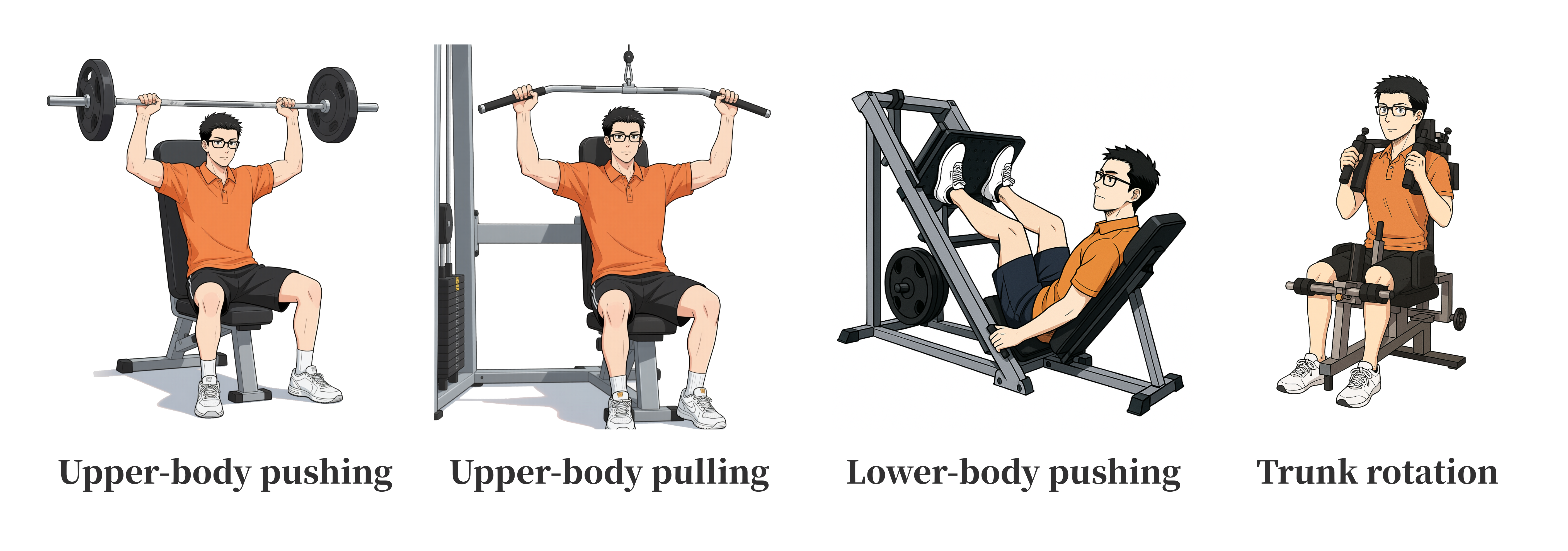
The test evaluates four core movement patterns:
- Upper-body pushing: Engages the deltoids, pectoralis major, and triceps — used in pushing doors, bracing the ground, or lifting a child.
- Upper-body pulling: Relies on the lats, rhomboids, and biceps — without them, pull-ups are merely wishful thinking.
- Lower-body pushing: Driven by the quadriceps, glutes, and calves — whether you sprint or shuffle depends on their teamwork.
- Trunk rotation: Involves the internal/external obliques, erector spinae, and quadratus lumborum — not flashy, but essential. Rotation is critical in all open-skill sports, from tennis to basketball.
Painted by AI
Training rotational power strengthens the oblique chain and activates both the diaphragm and QL muscles, promoting better breathing efficiency and coordination of energy pathways 3,4.
My results showed decent performance in the first three areas, but a clear deficiency in trunk rotation.
And this lack of rotational capacity is common. Long hours of sitting and low activity levels weaken the core, stiffen the hips, and reduce spinal control. That’s how we end up throwing out our backs with a simple twist or tweak — it’s the body’s protest against long-neglected deficits.
This gives me a clear training direction: don’t just chase heavier lifts; rebuild dynamic rotational power and core stability.
Functionality: Are Your Muscles Actually Useful?
This section tests the real-world performance of your muscles:
- Grip strength: Considered a surrogate marker of total body strength — and a mortality predictor. “Each 5 kg drop in grip strength is linked to a 16% increase in all-cause mortality” 5.
- Back pull strength: Assesses the posterior chain and core stability.
- Vertical jump: Measures lower-body explosiveness and neuromuscular activation 6.
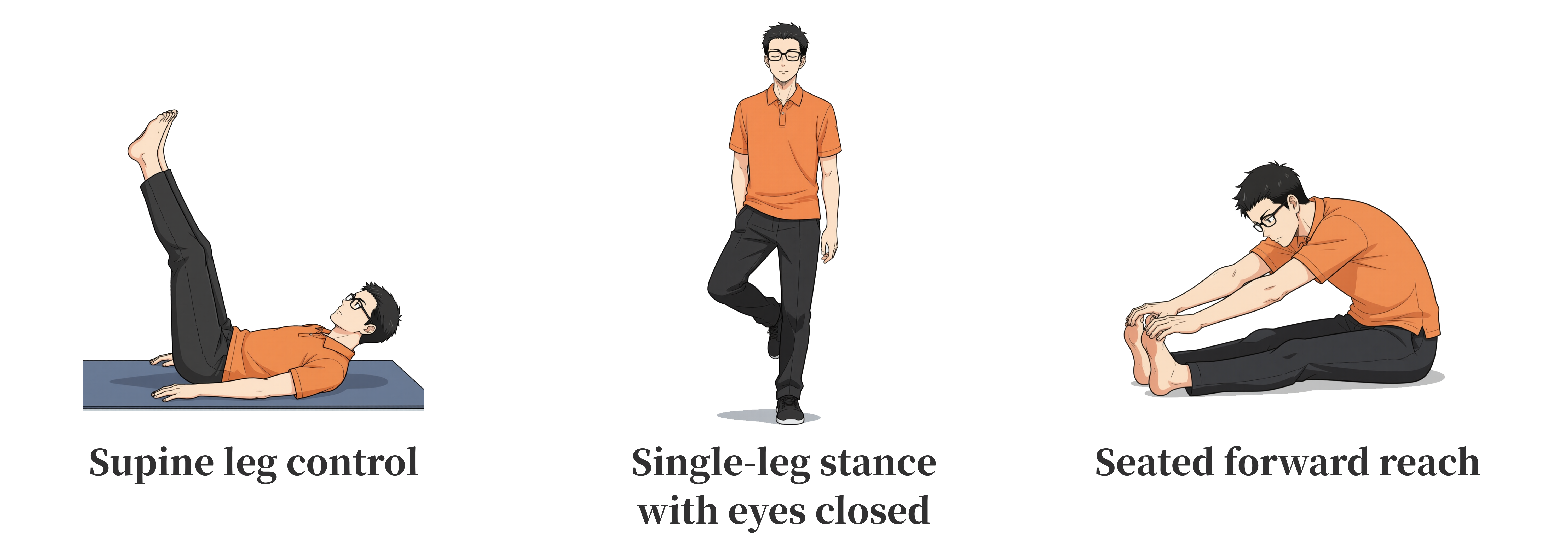
- Supine leg control: Tests not just the abs, but overall core integration.
- Single-leg stance with eyes closed: A key static balance test.
- Seated forward reach: Evaluates posterior-chain flexibility and trunk mobility.
- 1-minute push-up test: For upper-body endurance and stability.
- Reaction time: A practical indicator of neuromuscular reactivity and real-world RFD (Rate of Force Development) 7.
Painted by AI
Together, these assess three dimensions of movement functionality:
- Balance & Core Stability: Balance is your first line of defense against aging.
- Neuromuscular Reactivity: Faster reactions mean fewer falls.
- Strength Endurance & Symmetry: Sustained and stable movements equal quality execution.
My results revealed an imbalance in grip strength (weaker left side) and poor single-leg stance performance with eyes closed — pointing to weaknesses in core stability and balance. Both are critical in preventing falls, maintaining mobility, and delaying disability as we age.
Symmetry: Posture and Balance — The Habitual “Tilt”
This section evaluates:
- Natural standing posture: Detects subtle shifts in the spine, shoulders, and pelvis.
- Forward bend, backward extension, side bends, and trunk rotation: Reveal range of motion, flexibility, and sticking points.
- Arm raise, squat, stand-up patterns: Reflect upper-lower body coordination.
- Single-leg knee lift stance: Tests integration between the gluteus medius and core.
My result? A textbook case of “mid-career office worker” syndrome:
Forward head posture + thoracic rigidity + restricted hip mobility + lumbar compensation + weak core control.
This wasn’t a one-off misalignment; it was the result of years of desk work and prolonged sitting.
“The way you sit over long periods is closely associated with postural issues such as anterior pelvic tilt, inhibited core activation, and limited hip extension.” [8–10].
Fixing this won’t happen with a few stretches. It requires sustained postural awareness, balanced strength training, and — most importantly — a fundamental change in how we sit throughout the day.
Body Composition: The Visible Output of Your Muscle, Fat, and Metabolism
Finally, we come to a more familiar assessment: body composition.
We used an InBody scanner — the same kind seen in gyms and clinics. Its core method:
“Multi-frequency Bioelectrical Impedance Analysis (BIA), which estimates body water and lean mass using different current frequencies, then infers skeletal muscle and fat distribution” [11–12].
While not as precise as MRI or DEXA, it’s highly reliable for trend tracking and repeat testing (often r ≈ 0.9) 13.
Here were my InBody results:
- Body fat percentage: 3–5% above ideal
- Muscle mass: 2 kg below target
- Visceral fat level: Normal
- Muscle symmetry: Slight left-right imbalance
- Overall score: 80 / 100
Elite athletes can exceed 100 on this scale. But that’s not our benchmark. A healthy and sustainable Prime Life target would be:
- Body fat: 12–15%, with even lower visceral fat
- Balanced muscle distribution
- BMI: 22–23
- InBody score: 85–100
From a Prime Life perspective, extremely low body fat or excessively high muscle mass may not be optimal. Higher is not always better.
“According to ACSM and the Chinese Association for Science and Technology, a healthy body fat range is approximately 10–20% for men and 20–30% for women” [14–16].
What we want is a sustainable, low-injury, metabolically active, and structurally balanced body.
Self-Assessment & Training Priorities
After this assessment, I created my own “problem checklist”:
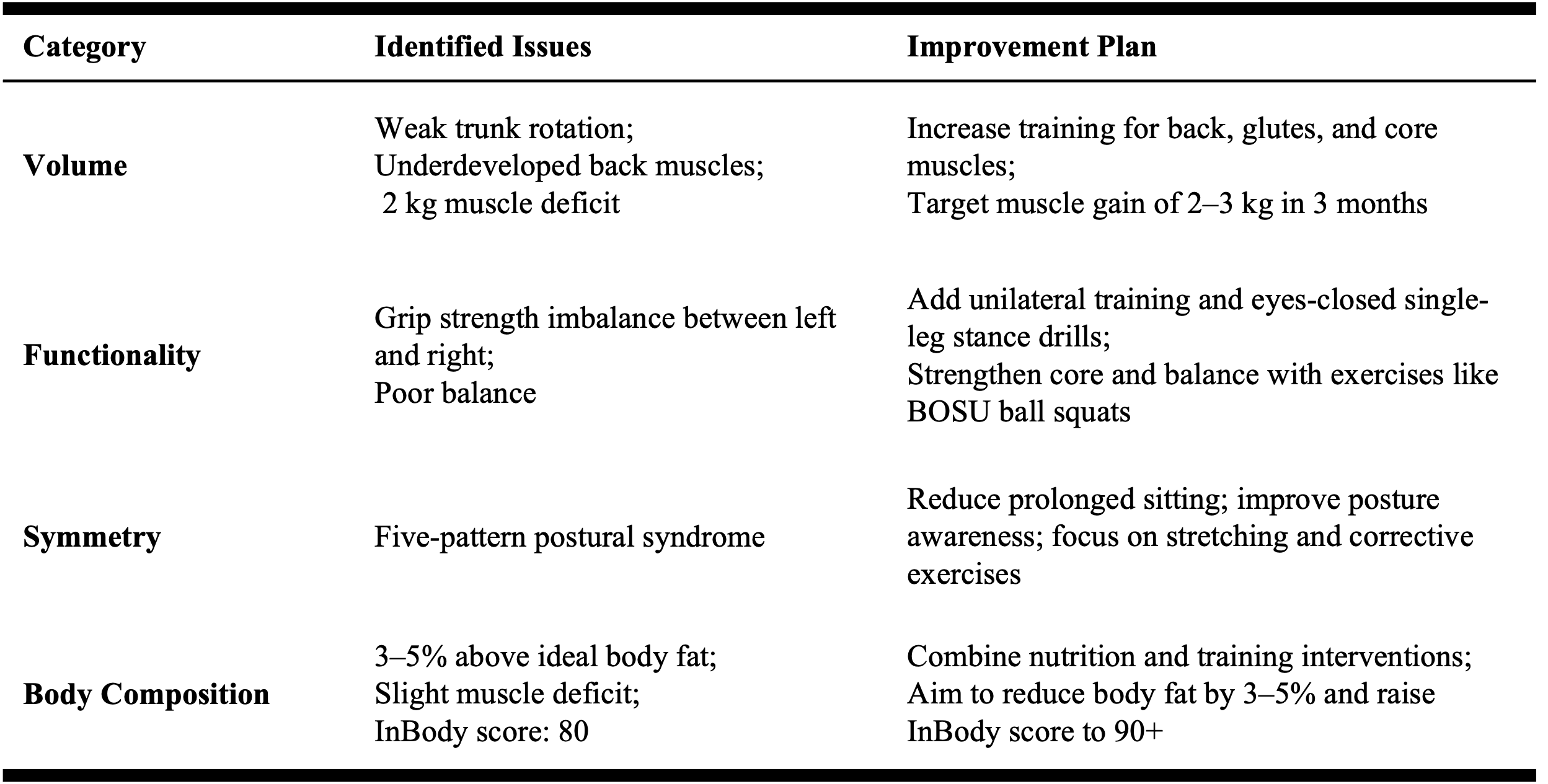
Practically speaking, a middle-aged male can naturally gain 0.5–1 kg of muscle per month, assuming sufficient protein intake and resistance training 17,18.
But if you get injured or stop training, you’ll need to adapt. Healthy training is a long game — not a quick hack.
Among all modules, I found the most challenging to be the long-term improvement of posture and symmetry. That can’t be solved by 60–90 minutes of daily exercise alone. It’s about how you live — your posture throughout the entire 24-hour day.
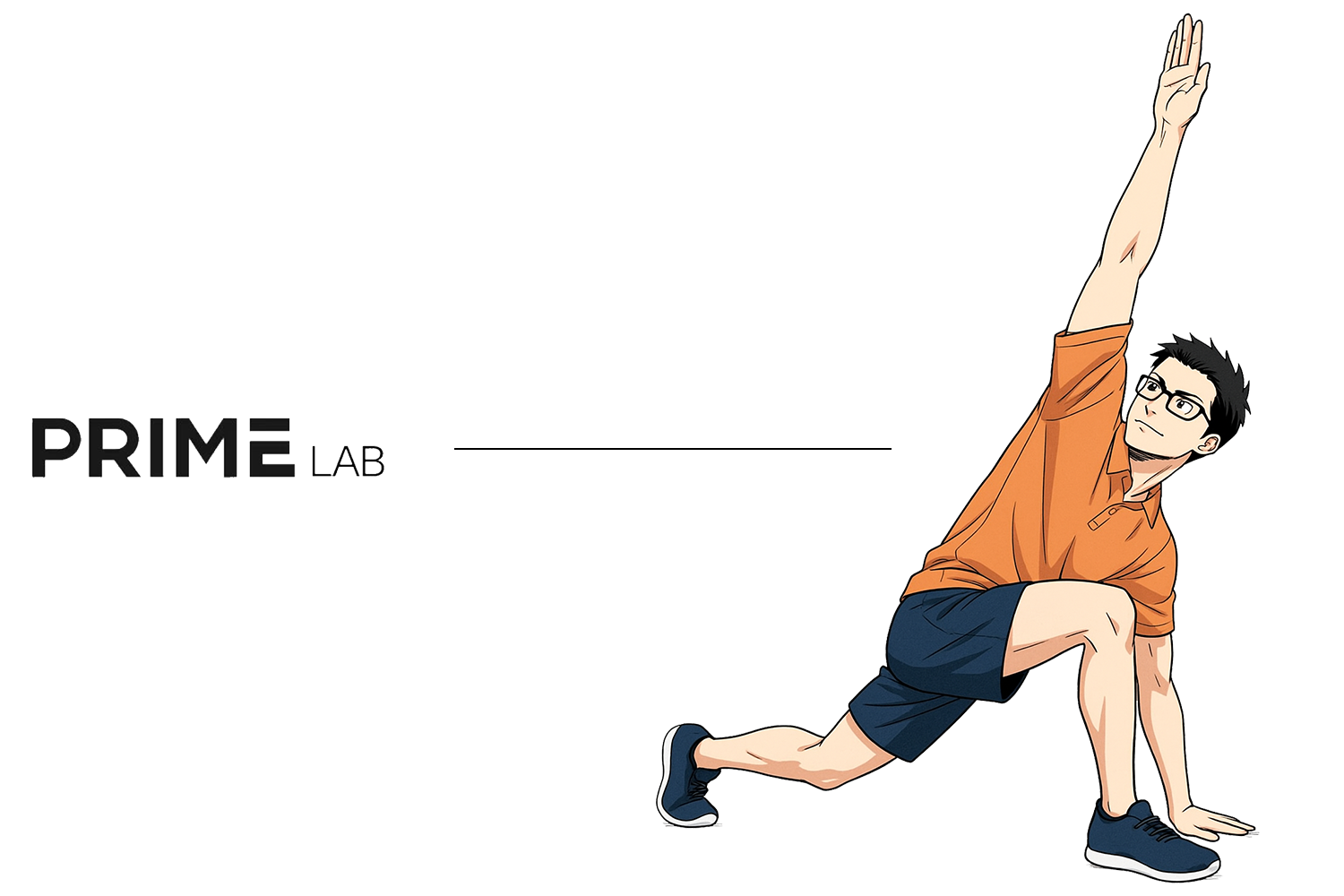
That said, even small changes can yield major benefits. Just a few rounds a day of the “World’s Greatest Stretch” can help unlock the thoracic spine and hips, significantly easing compensation patterns from prolonged sitting 19,20.

World’s Greatest Stretch (Painted by AI)
While comprehensive testing like this isn’t something we can do often, once you understand your weak points, you can make targeted improvements through daily training and movement.
In six months, I plan to retest myself. I expect to see real changes.
If you’ve made it this far — congratulations. You’ve just taken another powerful step in understanding and taking ownership of your own body.
Let’s keep going.
In knowledge, and in practice.
Intervention recommendations are geared toward generally healthy individuals. If you have existing health conditions, always follow your doctor’s instructions.
References
[1]Gash, Michael C., and J. K. Huntoon. “Physiology, Muscle Contraction.” StatPearls, 2023. NCBI Bookshelf.
[2]Widodo, A. F., et al. “Isotonic and Isometric Exercise Interventions Improve the Hamstring Muscle Pathology.” Healthcare, vol. 10, no. 5, 2022.
[3]Rodríguez-Perea Á, et al. Core training and performance: a systematic review with meta-analysis. Biol Sport. 2023 Oct;40(4):975–992.
[4]Sannasi R, et al. Diaphragm and core stabilization exercises in low back pain: A narrative review. J Bodyw Mov Ther. 2023 Oct;36:221–227.
[5]Leong DP, et al. Prognostic value of grip strength: findings from the Prospective Urban Rural Epidemiology (PURE) study. Lancet. 2015 Jul 18;386(9990):266–73.
[6]Caseiro-Filho, L.C., Girasol, C.E., Rinaldi, M.L. et al. Analysis of the accuracy and reliability of vertical jump evaluation using a low-cost acquisition system. BMC Sports Sci Med Rehabil 15, 107 (2023).
[7]Maffiuletti NA, Aagaard P, Blazevich AJ, Folland J, Tillin N, Duchateau J. Rate of force development: physiological and methodological considerations. Eur J Appl Physiol. 2016 Jun;116(6):1091–116.
[8]González-de-la-Flor, Á., Cotteret, C., García-Pérez-de-Sevilla, G. et al. Comparison of two different stretching strategies to improve hip extension mobility in healthy and active adults: a crossover clinical trial. BMC Musculoskelet Disord 25, 853 (2024).
[9]Jung KS, Jung JH, In TS. The Effects of Cross-Legged Sitting on the Trunk and Pelvic Angles and Gluteal Pressure in People with and without Low Back Pain. Int J Environ Res Public Health. 2020 Jun 27;17(13):4621.
[10]Boukabache A, Preece SJ, Brookes N. Prolonged sitting and physical inactivity are associated with limited hip extension: A cross-sectional study. Musculoskelet Sci Pract. 2021 Feb;51:102282.
[11]Ward LC. Bioelectrical impedance analysis for body composition assessment: reflections on accuracy, clinical utility, and standardisation. Eur J Clin Nutr. 2019 Feb;73(2):194–199.
[12]Shiose K, Yamada Y, Motonaga K, Sagayama H, Higaki Y, Tanaka H, Takahashi H. Segmental extracellular and intracellular water distribution and muscle glycogen after 72-h carbohydrate loading using spectroscopic techniques. J Appl Physiol (1985). 2016 Jul 1;121(1):205–11.
[13]Potter, A.W., Ward, L.C., Chapman, C.L. et al. Real-world assessment of Multi-Frequency Bioelectrical Impedance Analysis (MFBIA) for measuring body composition in healthy physically active populations. Eur J Clin Nutr (2025).
[14]Grodner, Michele, Sara Long, and Colleen J. DeYoung. Nutritional Foundations and Clinical Applications: A Nursing Approach. 5th ed., Mosby/Elsevier, 2012.
[15]Turocy, Patricia S., et al. “National Athletic Trainers’ Association Position Statement: Safe Weight Loss and Maintenance Practices in Sport and Exercise.” Journal of Athletic Training, vol. 46, no. 3, 2011, pp. 322–36.
[16]Thompson, Walter R., Neil F. Gordon, and Linda S. Pescatello, editors. ACSM’s Guidelines for Exercise Testing and Prescription. 8th ed., Lippincott Williams & Wilkins, 2010, p. 71.
[17]Benito, Pedro J., et al. “A Systematic Review with Meta-Analysis of the Effect of Resistance Training on Whole-Body Muscle Growth in Healthy Adult Males.” International Journal of Environmental Research and Public Health, 17(4), 2020, 1285.
[18]Kapsis, Dimitrios P., et al. “Changes in Body Composition and Strength after 12 Weeks of High-Intensity Functional Training with Low vs Moderate Loads.” Sports, 10(1), 2022, 7.
[19]Albulescu P, Macsinga I, Rusu A, Sulea C, Bodnaru A, Tulbure BT. “Give me a break!” A systematic review and meta-analysis on the efficacy of micro-breaks for increasing well-being and performance. PLoS One. 2022 Aug 31;17(8):e0272460.
[20]Tunwattanapong P, Kongkasuwan R, Kuptniratsaikul V. The effectiveness of a neck and shoulder stretching exercise program among office workers with neck pain: a randomized controlled trial. Clin Rehabil. 2016 Jan;30(1):64–72.