Painted by AI
KeyTakeaways:
-
运动是“最好的综合毒物效应”
-
运动适量,恢复充分时,ROS、自噬、热应激和免疫调节都会变成身体升级的信号。
-
是否“过度训练”要结合心率、HRV、睡眠质量和运动感受来确定,不能光看运动总时长。
-
运动和冷暴露、大剂量服用抗氧化剂等其他实践可能有冲突,需谨慎选择。
运动是一种受控的"中毒"。它制造氧化压力、能量危机、核心温度升高——所有这些短暂的小麻烦和小压力,恰恰是身体启动修复和升级的信号。
这就是 Hormesis(毒物效应)在运动中的体现:剂量决定一切,恢复决定收益,过度保护反而有害。
先回顾一下之前深入分享过的运动收益
Insight 1:每周前 150 分钟运动收益最大
一项纳入约 66 万名成人、平均随访约 14 年的大型前瞻性队列合并分析显示 [1]:
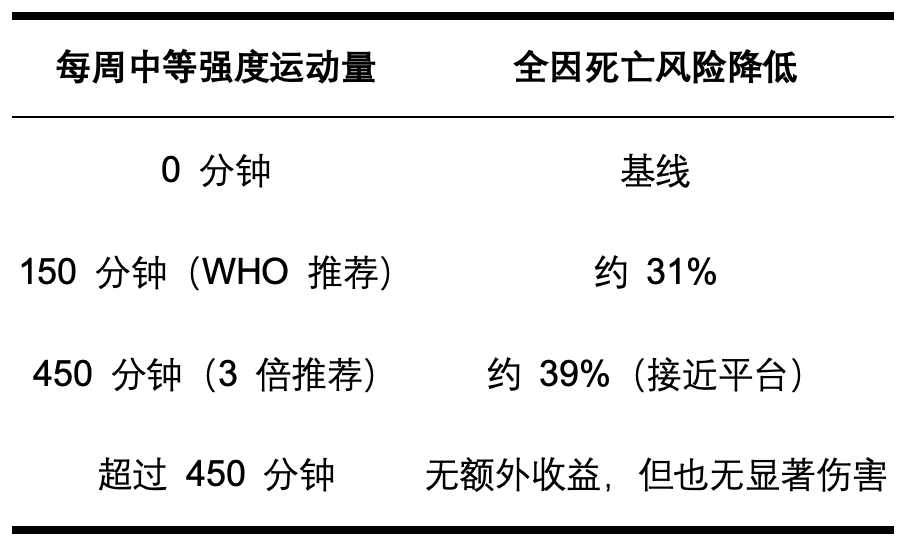
这是一条"反向 L 型"曲线——少量运动收益巨大,越往后边际递减。每周前 150 分钟的运动,受益最大。
Insight 2:有氧和力量训练都很重要,彼此不能替代,且联合效果远超单项。
在一项基于 479,856 名美国成年人的前瞻性队列研究中,只做有氧死亡率降 29%,只做力量降 11%,两者结合降到 40% [2][3]。
运动"毒物效应"的主要机制
1. 活性氧(ROS)和线粒体适应
肌肉收缩时会产生活性氧(ROS)[4]。过去我们一直把 ROS 简化成坏东西,要靠各种抗氧化剂清除它。这个观念是不全面的。
低剂量 ROS 是身体最重要的"升级信号"之一 [5]。它会激活三个关键的开关:PGC-1α(线粒体生物合成的总开关,让你长出更多新线粒体)[6]、Nrf2(让身体自己生产抗氧化酶,促进机体内源性抗氧化防御系统上调,让身体通过训练形成更强的内源性防御能力)[7]、AMPK(能量感受器,告诉细胞"现在很紧张,得想办法")[8]。
线粒体适应是能量下降、钙信号、氧化还原信号、机械应力一起投票的结果,并非单一路径 [9]。
2009 年 Ristow 一个经典的颠覆性实验,正好印证了这个观点:受试者训练四周,一组正常训练,一组每天补 1000mg 维生素 C 加 400IU 维生素 E [10]。
结果:抗氧化剂组的胰岛素敏感性改善基本消失,多项训练相关基因上调被削弱 [10]。这说明原本被认为有价值的"抗氧化",可能会部分抵消运动带来的收益。
这给我们的启示是:训练前后不必刻意叠加高剂量抗氧化补剂(比如维生素 C 超过 500mg、维生素 E 超过 200IU、NAC、α-硫辛酸等)。蔬果里的抗氧化剂剂量低、释放慢,无需担心。当然,如果你本身就缺乏某种营养素,或在极端赛事后的恢复期,短期补充另当别论 [41][42]。
2. 自噬
除了 ROS,运动还通过 AMPK 激活和 mTOR 抑制触发自噬,把破损的线粒体和错误折叠的蛋白质回收掉 [11]。小鼠急性运动 30 分钟,骨骼肌、心肌、肝脏、胰腺的自噬全部显著上升;如果阻断自噬,运动的代谢好处(改善葡萄糖稳态)就消失了 [12]。
自噬也可以通过其他方式激发,比如长时间断食一样可以激活 AMPK 达到足以启动自噬的水平。这也是为什么有些极客把断食作为长寿实践之一(不论是伊斯兰文明的斋月、古印度的断食,还是东方的辟谷,这些流传至今的智慧可能都暗含了这条长寿路径)。但通过运动来激发自噬,更方便和及时;长期断食给人体带来的负担也很大,且较难融入日常生活。
我们推荐以运动来促进自噬还有另一个原因:运动时偏 AMPK/自噬(分解、清理),恢复进食时偏 mTOR(合成、重建,超量恢复)。长期健康在于在 AMPK 与 mTOR 之间形成平衡节律,而非一直踩其中一边。这条原则可以延展到整个生活——分解和合成轮流来,比单方向更健康。
3. 热休克蛋白
长时间,尤其是炎热或散热受限环境下,高强度运动会让核心体温上升 1-2°C [13]。这个升温本身就是一种压力信号——细胞内的蛋白质在高温下有变性、错误折叠的风险。身体的应对是激活 HSF1,进而上调一组叫"热休克蛋白"(HSP70、HSP90)的分子伴侣 [14][15]。它们帮助其他蛋白正确折叠、修复受损蛋白、清理无法挽救的垃圾,本质上是细胞内的蛋白质质量控制系统。这又是一次典型的 Hormesis:短暂的热应激威胁,换来长期更强的蛋白质稳态能力。
有意思的是,桑拿激活的是同一条通路。芬兰队列研究发现,更高频率桑拿与较低心血管死亡也和全因死亡风险相关[43][44]。
4. 乳酸:被冤枉的信号分子
我们从小被教育乳酸是疲劳和酸痛的元凶。两个都是冤案。延迟性酸痛真正的元凶是肌纤维的微损伤和炎症 [16],现代乳酸穿梭理论认为,乳酸既是燃料,也是糖异生前体和信号分子。乳酸在运动后很快就会清除,跟它关系不大[17]。
乳酸的真实身份是燃料 + 信号分子,而且是一个标准的 Hormesis 信号:运动中短暂飙升触发适应,过量才有害。心脏、大脑、慢肌纤维都能直接烧它。它的信号功能强大:
-
动物研究显示,跨过血脑屏障,上调海马区的 BDNF(脑源性神经营养因子)——这可能是 HIIT 影响认知功能的机制之一 [18][45]
-
通过 HIF-1α 通路促进血管新生 [19]
-
在实验研究中可促进脂肪细胞米色化 [20]
-
近年来还发现它通过"组蛋白乳酰化"直接影响基因表达,从代谢产物升级为表观遗传信号分子 [21]
和 ROS 一样,乳酸有"双层剂量":Zone 2 训练(血乳酸约 2 mmol/L)的慢性低剂量刺激 [22],和 HIIT(8-15 mmol/L)的急性高剂量刺激,下游通路并不完全重叠。这就是为什么精英耐力运动员用"80% 低强度 + 20% 高强度"的极化训练效果更好 [23][24]——你需要的是两种不同的信号,而不是一种信号的平均值。
5. 免疫系统:急性升、慢性降
运动对免疫系统的影响,也符合 Hormesis 的逻辑:单次运动会造成短暂的炎症和免疫细胞动员,这不是简单的“免疫下降”或“免疫抑制”,而更像是一次系统巡逻和免疫细胞的组织再分配。
长期规律运动的人,基线 CRP(C 反应蛋白,反映全身炎症水平)、IL-6(白介素 6)都低于平均水平 [28],NK 细胞活性更高,免疫衰老明显延缓 [29]。这也是运动降低结直肠癌、乳腺癌发病率的核心机制之一 —— 免疫监视能力更强 [30]。
IL-6 有双面性:肌肉收缩时释放的急性 IL-6 是抗炎、促代谢的"好分子";脂肪组织和免疫细胞长期分泌的慢性 IL-6 是促炎、致病的"坏分子" [31]。同一个分子,根据来源和时程产生完全相反的效应。这体现了身体深刻的调控智慧。
"毒物超剂量":过度训练
“毒物效应”的收益当然不是无限的。如果训练负荷超过恢复能力,身体会从"刺激"翻转为"消耗"。
前文已经提过,如果单纯看运动时间,很难说更长的运动时间会带来身体负面效应。每个人的体质和耐受不一样:越是多运动的人,越能耐受更长时间的运动且获得收益。所以,我们要通过信号指标来判断自己是不是"过度训练"了。
过度训练的早期信号包括:
-
静息心率持续升高超过 5 bpm
-
心率变异性(HRV)连续多日下降
-
睡眠质量恶化
-
晨起精神状态差
-
训练表现连续两周以上下滑
但要区分两种状态:短期超量后通过减量周(deload)反弹的 functional overreaching 是计划的一部分;真正的过度训练综合征(OTS)则可能需要数月恢复 [32]。可穿戴设备的 HRV 有参考价值,但单日波动不能下诊断,要看 7-14 天的趋势加上主观疲劳和表现 [33]。
记住,恢复(休息和补充营养)是运动不可或缺的组成部分。
恢复策略里,睡眠是无可替代的第一变量 [34];而蛋白质需按 1.6-2.2 g/kg/day 在抗阻训练后补充 [35]。除此之外还有一个常被忽视的关键——能量可用性。长期热量不足,尤其是碳水不足,会拖垮甲状腺、性激素、骨密度和免疫功能(学名叫 RED-S,运动相对能量不足)[36]。对训练量大的人来说,碳水不只是热量,更是维持训练质量和内分泌恢复的关键变量[46]。
运动"搭子":合力还是抵消?
理解了 Hormesis 的逻辑,运动和其他干预的搭配就有了清晰的判断框架:
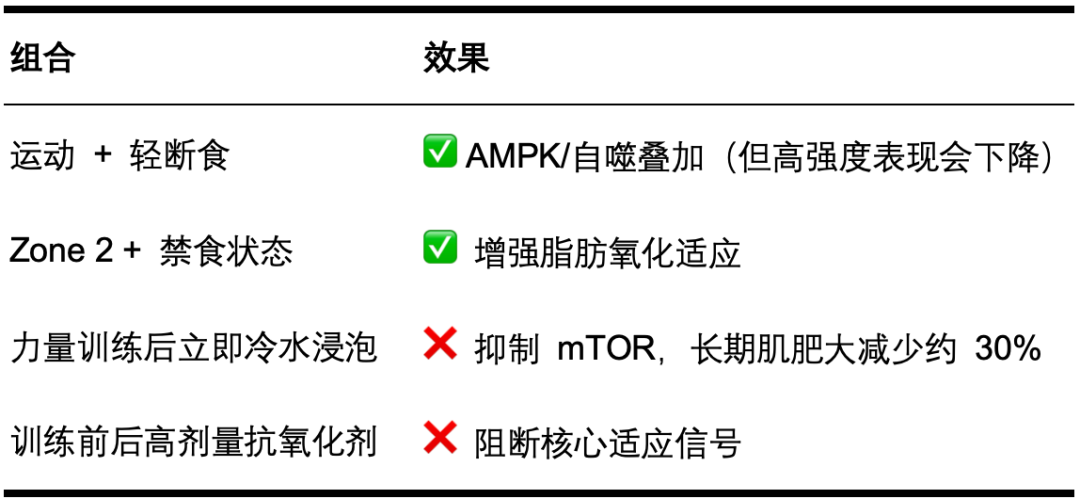
冷暴露(另一种经典 Hormesis)这件事值得特别聊聊:力量训练后立刻冷水浸泡会抑制 mTOR 和卫星细胞激活,长期跟踪显示肌肉肥大减少约 30% [37]。如果你想用冷暴露,至少和力量训练间隔 4-6 小时,或者放在非力量训练日。有氧训练和冷暴露在激活线粒体合成这条通路上可能有协同效应,但冷暴露会显著抑制炎症/ROS,类似于抗氧化剂和有氧训练的矛盾。所以冷暴露和运动最多的相关应用,反而是运动急性损伤之后,作为镇痛、血管肌肉收缩和抗炎的疗愈手段[47]。
除此之外,冷暴露最好还是作为独立的 Hormesis 来实践。
禁食也要谨慎看待。它确实能增强脂肪氧化相关的适应 [38],但不一定带来更好的减脂效果或表现 [39]。如果你的目标是高强度表现、增肌、内分泌稳定(尤其女性),或者已经有睡眠/压力问题,吃饱了再训练通常更好。
运动是"最好的综合毒物效应"
从毒物效应的视角看,运动是一组自带刹车的,可控的微应激组合:机械张力、能量压力、缺氧再氧合、ROS、热应激、乳酸信号、炎症短脉冲。每一种压力都短暂、可恢复、能被身体翻译成适应信号。
但也不是刺激越多越好,要避免多个应激源在同一天叠加超过恢复预算。运动 + 桑拿 + 轻断食 + 睡眠不足 + 工作压力大 + 感染期,这种叠加会让 Hormesis 翻转成消耗,导致身体损伤。

- 每周累计 150-450 分钟中等强度运动,加 2-3 次力量训练 [40]。这个范围覆盖了 90% 以上的收益区间。
- 有氧和抗阻都要有,不可互相替代且有协同效应。
- 训练前后 1-2 小时内不吃高剂量抗氧化补剂。蔬果不算,正常吃。
- 有氧:低强度(Zone 2)和高强度(HIIT)都要有。80% 低 + 20% 高的极化分布比所有训练都中等强度更聪明。
- 睡眠是恢复的第一变量,蛋白质是第二,足够的碳水是第三。
- 力量训练日不要做冷水浸泡,至少错开 4-6 小时。冷暴露想做,放在有氧日或休息日。
- 留意自己的 HRV、静息心率、睡眠和情绪的连续趋势,来确定是否运动过量。

Disclaimer :该文不代表医学建议,为个人学习、研究、实践和分享,仅供参考。如需获取医学指导,请直接咨询医生或专业医疗从业者。关于主动干预的分享,主要针对健康人群;有基础病的朋友,请优先遵循医嘱。
向上滑动阅览 Reference:
[1]Arem H, Moore SC, Patel A, Hartge P, Berrington de Gonzalez A, Visvanathan K, Campbell PT, Freedman M, Weiderpass E, Adami HO, Linet MS, Lee IM, Matthews CE. Leisure time physical activity and mortality: a detailed pooled analysis of the dose-response relationship. JAMA Intern Med. 2015 Jun;175(6):959-67.
[2]Zhao M, Veeranki SP, Magnussen CG, Xi B. Recommended physical activity and all cause and cause specific mortality in US adults: prospective cohort study. BMJ. 2020 Jul;370:m2031.
[3]Gorzelitz J, Trabert B, Katki HA, et al. Independent and joint associations of weightlifting and aerobic activity with all-cause, cardiovascular disease and cancer mortality. Br J Sports Med. 2022 Nov;56(22):1277-83.
[4]Powers SK, Jackson MJ. Exercise-induced oxidative stress: cellular mechanisms and impact on muscle force production. Physiol Rev. 2008 Oct;88(4):1243-76.
[5]Powers SK, Duarte J, Kavazis AN, Talbert EE. Reactive oxygen species are signalling molecules for skeletal muscle adaptation. Exp Physiol. 2010 Jan;95(1):1-9.
[6]Wu Z, Puigserver P, Andersson U, Zhang C, Adelmant G, Mootha V, Troy A, Cinti S, Lowell B, Scarpulla RC, Spiegelman BM. Mechanisms controlling mitochondrial biogenesis and respiration through the thermogenic coactivator PGC-1. Cell. 1999 Jul;98(1):115-24.
[7]Gomez-Cabrera MC, Domenech E, Viña J. Moderate exercise is an antioxidant: upregulation of antioxidant genes by training. Free Radic Biol Med. 2008 Jan;44(2):126-31.
[8]Hardie DG, Ross FA, Hawley SA. AMPK: a nutrient and energy sensor that maintains energy homeostasis. Nat Rev Mol Cell Biol. 2012 Mar;13(4):251-62.
[9]Egan B, Zierath JR. Exercise metabolism and the molecular regulation of skeletal muscle adaptation. Cell Metab. 2013 Feb;17(2):162-84.
[10]Ristow M, Zarse K, Oberbach A, Klöting N, Birringer M, Kiehntopf M, et al. Antioxidants prevent health-promoting effects of physical exercise in humans. Proc Natl Acad Sci U S A. 2009 May;106(21):8665-70.
[11]Kim J, Kundu M, Viollet B, Guan KL. AMPK and mTOR regulate autophagy through direct phosphorylation of Ulk1. Nat Cell Biol. 2011 Feb;13(2):132-41.
[12]He C, Bassik MC, Moresi V, Sun K, Wei Y, Zou Z, An Z, Loh J, Fisher J, Sun Q, Korsmeyer S, Packer M, May HI, Hill JA, Virgin HW, Gilpin C, Xiao G, Bassel-Duby R, Scherer PE, Levine B. Exercise-induced BCL2-regulated autophagy is required for muscle glucose homeostasis. Nature. 2012 Jan;481(7382):511-5.
[13]González-Alonso J, Teller C, Andersen SL, Jensen FB, Hyldig T, Nielsen B. Influence of body temperature on the development of fatigue during prolonged exercise in the heat. J Appl Physiol (1985). 1999 Mar;86(3):1032-9.
[14]Febbraio MA, Koukoulas I. HSP72 gene expression progressively increases in human skeletal muscle during prolonged, exhaustive exercise. J Appl Physiol (1985). 2000 Sep;89(3):1055-60.
[15]Morimoto RI. Regulation of the heat shock transcriptional response: cross talk between a family of heat shock factors, molecular chaperones, and negative regulators. Genes Dev. 1998 Dec;12(24):3788-96.
[16]Cheung K, Hume P, Maxwell L. Delayed onset muscle soreness : treatment strategies and performance factors. Sports Med. 2003;33(2):145-64.
[17]Brooks GA. The Science and Translation of Lactate Shuttle Theory. Cell Metab. 2018 Apr;27(4):757-85.
[18]
El Hayek L, Khalifeh M, Zibara V, Abi Assaad R, Emmanuel N, Karnib N, et al. Lactate Mediates the Effects of Exercise on Learning and Memory Through SIRT1-Dependent Activation of Hippocampal Brain-Derived Neurotrophic Factor (BDNF). J Neurosci. 2019 Mar 27;39(13):2369-2382.
[19]Hunt TK, Aslam RS, Beckert S, Wagner S, Ghani QP, Hussain MZ, Roy S, Sen CK. Aerobically derived lactate stimulates revascularization and tissue repair via redox mechanisms. Antioxid Redox Signal. 2007 Aug;9(8):1115-24.
[20]Carrière A, Jeanson Y, Berger-Müller S, André M, Chenouard V, Arnaud E, Barreau C, Walther R, Galinier A, Wdziekonski B, Villageois P, Louche K, Collas P, Moro C, Dani C, Villarroya F, Casteilla L. Browning of white adipose cells by intermediate metabolites: an adaptive mechanism to alleviate redox pressure. Diabetes. 2014 Oct;63(10):3253-65.
[21]Zhang D, Tang Z, Huang H, Zhou G, Cui C, Weng Y, Liu W, Kim S, Lee S, Perez-Neut M, Ding J, Czyz D, Hu R, Ye Z, He M, Zheng YG, Shuman HA, Dai L, Ren B, Roeder RG, Becker L, Zhao Y. Metabolic regulation of gene expression by histone lactylation. Nature. 2019 Oct;574(7779):575-80.
[22]Kindermann W, Simon G, Keul J. The significance of the aerobic-anaerobic transition for the determination of work load intensities during endurance training. Eur J Appl Physiol Occup Physiol. 1979 Sep;42(1):25-34.
[23]Seiler KS, Kjerland GØ. Quantifying training intensity distribution in elite endurance athletes: is there evidence for an "optimal" distribution?. Scand J Med Sci Sports. 2006 Feb;16(1):49-56.
[24]Stöggl T, Sperlich B. Polarized training has greater impact on key endurance variables than threshold, high intensity, or high volume training. Front Physiol. 2014 Feb;5:33.
[25]Pedersen BK, Hoffman-Goetz L. Exercise and the immune system: regulation, integration, and adaptation. Physiol Rev. 2000 Jul;80(3):1055-81.
[26]Nieman DC. Exercise, infection, and immunity. Int J Sports Med. 1994 Oct;15 Suppl 3:S131-41.
[27]Nieman DC, Johanssen LM, Lee JW, Arabatzis K. Infectious episodes in runners before and after the Los Angeles Marathon. J Sports Med Phys Fitness. 1990 Sep;30(3):316-28.
[28]Ford ES. Does exercise reduce inflammation? Physical activity and C-reactive protein among U.S. adults. Epidemiology. 2002 Sep;13(5):561-8.
[29]Duggal NA, Niemiro G, Harridge SDR, Simpson RJ, Lord JM. Can physical activity ameliorate immunosenescence and thereby reduce age-related multi-morbidity? Nat Rev Immunol. 2019 Sep;19(9):563-72.
[30]Moore SC, Lee IM, Weiderpass E, Campbell PT, Sampson JN, Kitahara CM, et al. Association of leisure-time physical activity with risk of 26 types of cancer in 1.44 million adults. JAMA Intern Med. 2016 Jun;176(6):816-25.
[31]Pedersen BK, Febbraio MA. Muscle as an endocrine organ: focus on muscle-derived interleukin-6. Physiol Rev. 2008 Oct;88(4):1379-406.
[32]Meeusen R, Duclos M, Foster C, Fry A, Gleeson M, Nieman D, et al. Prevention, diagnosis, and treatment of the overtraining syndrome: joint consensus statement of the European College of Sport Science and the American College of Sports Medicine. Med Sci Sports Exerc. 2013 Jan;45(1):186-205.
[33]Bellenger CR, Fuller JT, Thomson RL, Davison K, Robertson EY, Buckley JD. Monitoring athletic training status through autonomic heart rate regulation: a systematic review and meta-analysis. Sports Med. 2016 Oct;46(10):1461-86.
[34]Watson AM. Sleep and athletic performance. Curr Sports Med Rep. 2017 Nov;16(6):413-8.
[35]Morton RW, Murphy KT, McKellar SR, Schoenfeld BJ, Henselmans M, Helms E, et al. A systematic review, meta-analysis and meta-regression of the effect of protein supplementation on resistance training-induced gains in muscle mass and strength in healthy adults. Br J Sports Med. 2018 Mar;52(6):376-84.
[36]Mountjoy M, Sundgot-Borgen J, Burke L, Carter S, Constantini N, Lebrun C, et al. The IOC consensus statement: beyond the Female Athlete Triad—Relative Energy Deficiency in Sport (RED-S). Br J Sports Med. 2014 Apr;48(7):491-7.
[37]Roberts LA, Raastad T, Markworth JF, Figueiredo VC, Egner IM, Shield A, et al. Post-exercise cold water immersion attenuates acute anabolic signalling and long-term adaptations in muscle to strength training. J Physiol. 2015 Sep;593(18):4285-301.
[38]
Van Proeyen K, Szlufcik K, Nielens H, Ramaekers M, Hespel P. Beneficial metabolic adaptations due to endurance exercise training in the fasted state. J Appl Physiol (1985). 2011 Jan;110(1):236-245.
[39]Schoenfeld BJ, Aragon AA, Wilborn CD, Krieger JW, Sonmez GT. Body composition changes associated with fasted versus non-fasted aerobic exercise. J Int Soc Sports Nutr. 2014 Nov;11:54.
[40]
Garber CE, Blissmer B, Deschenes MR, Franklin BA, LaMonte MJ, Lee IM, et al. American College of Sports Medicine position stand. Quantity and quality of exercise for developing and maintaining cardiorespiratory, musculoskeletal, and neuromotor fitness in apparently healthy adults: guidance for prescribing exercise. Med Sci Sports Exerc. 2011 Jul;43(7):1334-1359.
[41]Mason SA, Trewin AJ, Parker L, Wadley GD. Antioxidant supplements and endurance exercise: Current evidence and mechanistic insights. Redox Biol. 2020 Jul;35:101471.
[42]Higgins MR, Izadi A, Kaviani M. Antioxidants and exercise performance: with a focus on vitamin E and C supplementation. Int J Environ Res Public Health. 2020 Nov 23;17(22):8452.
[43]Laukkanen T, Khan H, Zaccardi F, Laukkanen JA. Association between sauna bathing and fatal cardiovascular and all-cause mortality events. JAMA Intern Med. 2015 Apr;175(4):542-548.
[44]Laukkanen JA, Laukkanen T, Kunutsor SK. Cardiovascular and other health benefits of sauna bathing: A review of the evidence. Mayo Clin Proc. 2018 Aug;93(8):1111-1121.
[45]Müller P, Duderstadt Y, Lessmann V, Müller NG. Lactate and BDNF: Key mediators of exercise induced neuroplasticity? J Clin Med. 2020 Apr 30;9(5):1136.
[46]Mountjoy M, Ackerman KE, Bailey DM, Burke LM, Constantini N, Hackney AC, Heikura IA, Melin A, Pensgaard AM, Stellingwerff T, Sundgot-Borgen JK, Torstveit MK, Jacobsen AU, Verhagen E, Budgett R, Engebretsen L, Erdener U. 2023 International Olympic Committee’s (IOC) consensus statement on Relative Energy Deficiency in Sport (REDs). Br J Sports Med. 2023 Sep;57(17):1073-1097.
[47]Petersen AC, Fyfe JJ. Post-exercise cold water immersion effects on physiological adaptations to resistance training and the underlying mechanisms in skeletal muscle: A narrative review. Front Sports Act Living. 2021 Apr 12;3:660291.