In my last post, we talked about saturated fats (SFA). Today, let’s move on to unsaturated fats (UFA) — which, at room temperature, are typically in liquid form. That’s what we usually refer to as “oil.”
If you’re like me, you probably grew up hearing that vegetable oils are healthier. But is that actually true?
Some vegetable oils do deserve their health halo. But unfortunately, the ones most commonly used in everyday cooking are the very ones that pose the greatest risks.
So in this piece, I want to walk you through how to actually choose the right oil — grounded in science, but practical for real kitchens.
🧠 Quick Recap: The Core Facts on Fats
Let’s start with the basics.
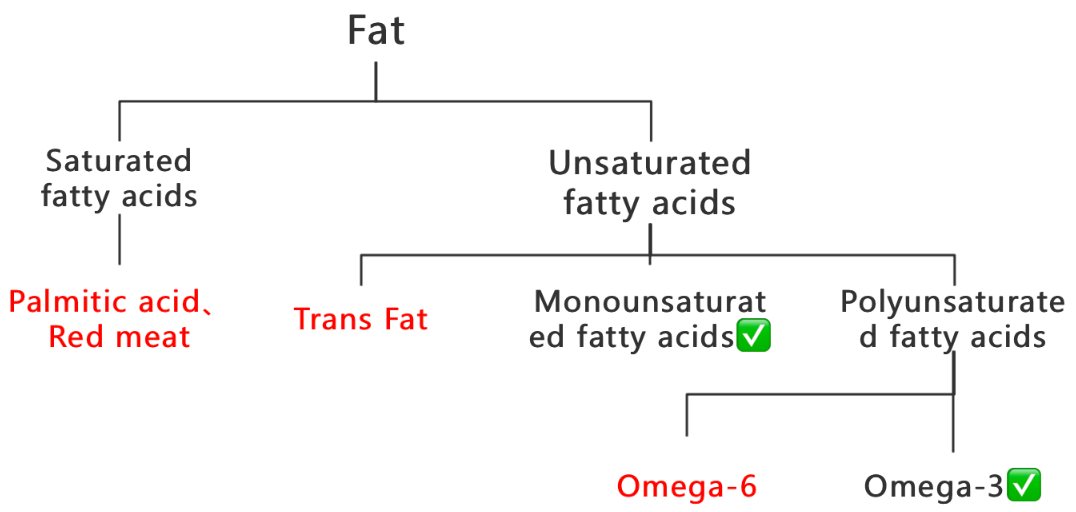
Fat isn’t bad in and of itself. But some types deserve caution:
- Trans fats — industrial hydrogenated fats that should be strictly avoided
- Palmitic acid / Myristic acid — pro-inflammatory saturated fats
- Omega-6 fatty acids — essential in small amounts, but typically overconsumed in modern diets, especially when not balanced with Omega-3s
On the flip side, other fats are neutral — or even health-promoting:
- MUFA (monounsaturated fats) — anti-inflammatory and stable; the “golden trio” here is olive oil, avocado oil, and camellia oil
- Omega-3 — potent anti-inflammatory fats found in deep-sea fish oil and flaxseed oil
- Other SFAs — such as butyric acid and stearic acid, which may even offer protective benefits
These principles form the framework for how we evaluate whether an oil is a good choice.
🔍 How Do You Judge If an Oil Is “Good” or Not?
Two big factors:
- Does it promote inflammation? → Depends on its fatty acid structure
- Is it stable under heat? → Depends on its PUFA content
Let’s break these down.
1. Inflammation: Check the Fatty Acid Composition
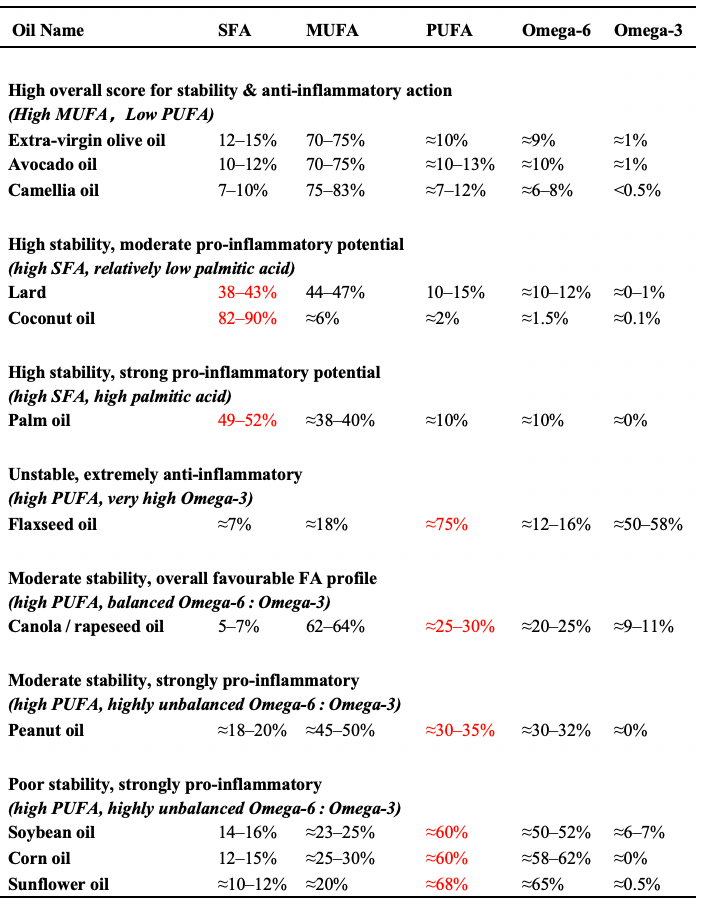
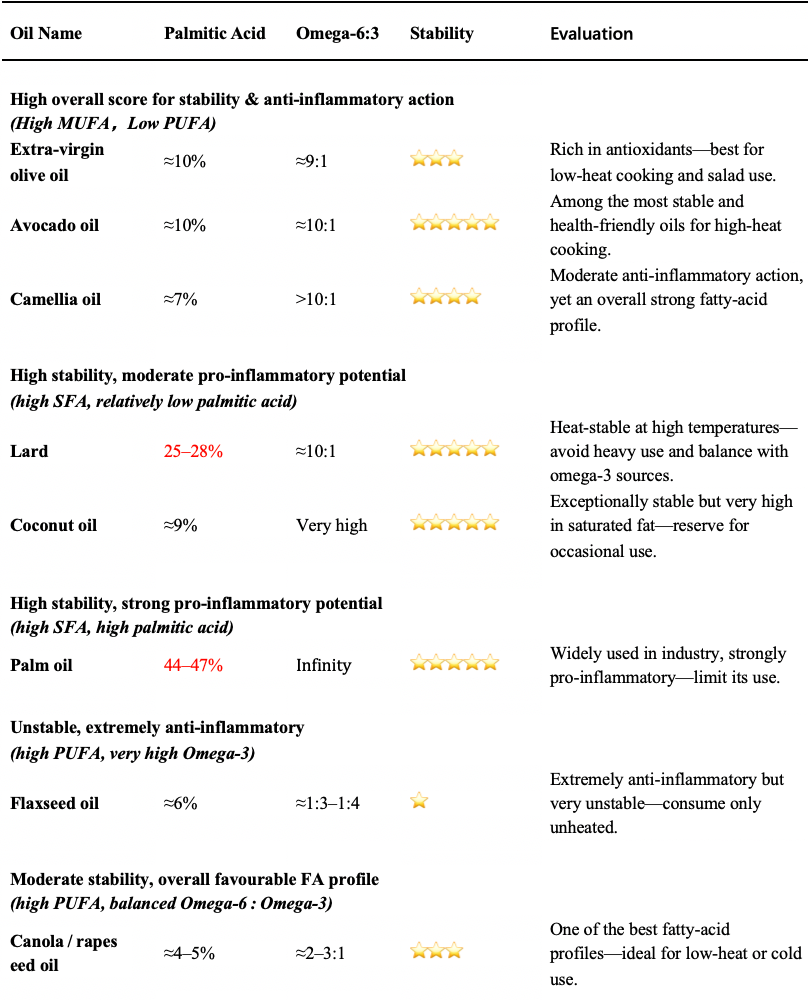
Oils that are high in palmitic acid or have wildly unbalanced Omega-6 to Omega-3 ratios are pro-inflammatory.
Oils that are MUFA-dominant or have a balanced 6:3 ratio tend to be neutral or anti-inflammatory.
Omega-6 and Omega-3 share the same metabolic pathways. When your diet has a 6:3 ratio of 15:1, 20:1, or even 40:1 — compared to the 1:1 of our ancestors — you’re creating the perfect storm for chronic low-grade inflammation.
Why does that matter?
Because this kind of inflammation is silent, but insidious. Over time, it:
- damages blood vessels,
- reduces insulin sensitivity,
- disrupts mitochondria,
- and sets the stage for heart disease, diabetes, fatty liver, and more.
2. Stability: Check the PUFA Load
PUFAs (polyunsaturated fats) are chemically unstable, especially when heated. High-PUFA oils degrade into harmful compounds:
- Aldehydes — like acrolein, linked to lung cancer
- Free radicals — damage cells and accelerate aging
- PM2.5 particles — especially during high-heat stir-frying, as in Chinese cooking
📖 In fact, a Lancet study found that exposure to kitchen oil fumes is a key reason for high rates of lung cancer among non-smoking women in Chinese cities.
🍳 So… What Are We Actually Using Every Day?
Let’s look at some global consumption data:
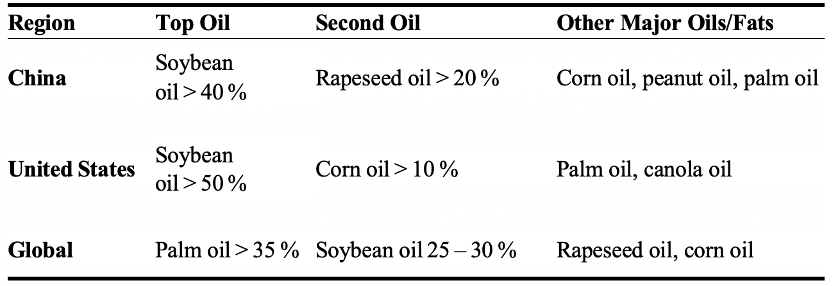
🔍 The takeaway is simple but sobering: the most commonly used oils are often the most harmful.
🚨 The “Pro-Inflammatory Trio” of Cooking Oils
- Palm Oil
- Dominated by palmitic acid
- Highly stable but highly pro-inflammatory
- Common in snacks, fast food, and blended oils
2. Soybean Oil
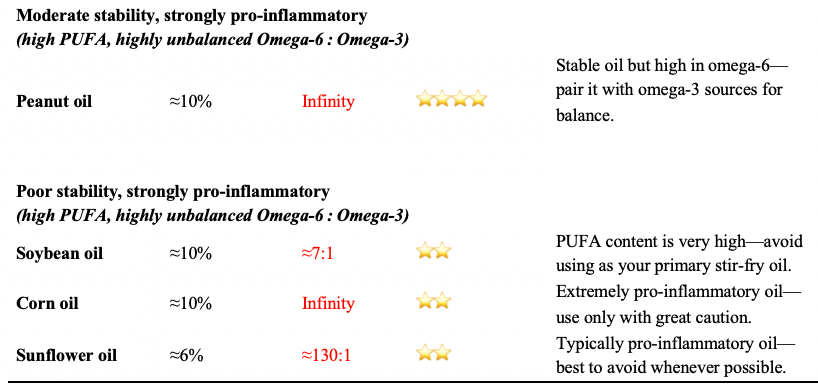
- 52% Omega-6, <7% Omega-3 → an 8:1 ratio
- High in PUFA, highly unstable, prone to oxidation and toxic byproducts
3. Corn Oil
- Up to 60% Omega-6, virtually no Omega-3
- Even more unstable than soybean oil
- Ubiquitous in commercial kitchens, takeout, and processed foods
Together, these three are a structural part of modern restaurant and industrial cooking — chosen for cost, smoke point, and taste familiarity. But they quietly underpin a chronic-inflammation epidemic that shortens our healthspan day by day.
🌱 What About Canola Oil?
Surprisingly, another commonly used cooking oil — canola oil (especially “double-low” varieties with low erucic acid and glucosinolates) has an excellent fatty acid profile:
- ~60% MUFA
- Omega-6 to 3 ratio of ~2:1 to 3:1 — nearly ideal
- Fits our recommended Prime Diet model very well
So if canola oil is your household staple, you’re in a pretty good place.
⚠️ Caveat: It still contains 30–35% PUFA, so not ideal for prolonged high-heat cooking. Better for cold dishes or light sautéing.
🏷️ So What Oils Should You Actually Use? Four Categories to Guide You
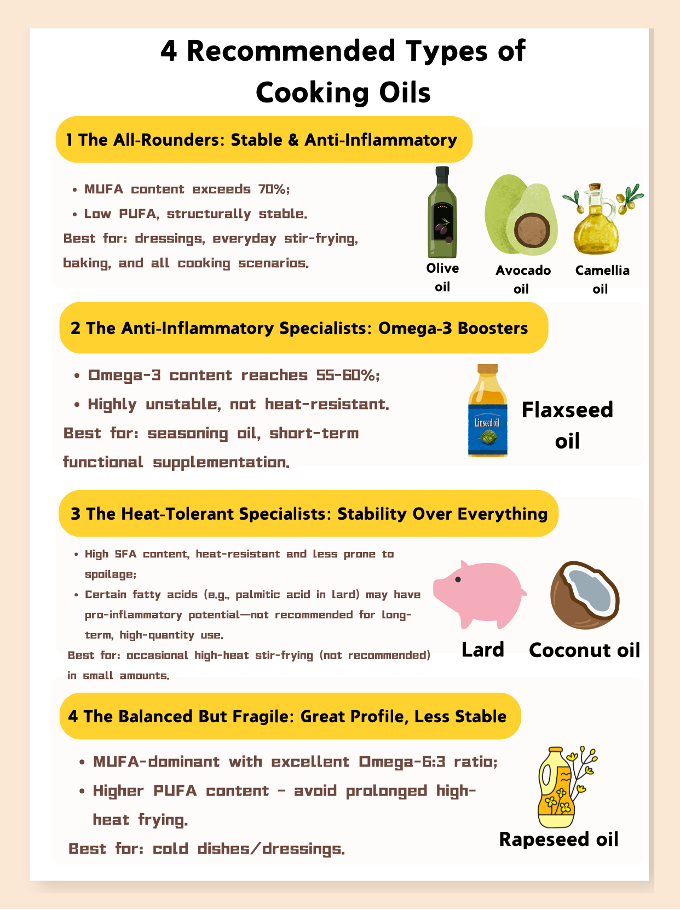
✅ The All-Rounders: Stable & Anti-Inflammatory
- Examples: Olive oil, avocado oil, camellia oil
- 70%+ MUFA, low PUFA
- Decent 6:3 ratio, total Omega-6 load is low
- Best for: Stir-frying, dressings, baking — basically everything
🔬 The Anti-Inflammatory Specialists: Omega-3 Boosters
- Example: Flaxseed oil
- Extremely high in Omega-3 (55–60%), great for correcting 6:3 imbalance
- But extremely unstable — never heat it
- Best for: Cold use only (e.g., drizzling or short-term supplementation)
Reminder: This is a functional oil, not a mainstay. Like chia seeds or fish oil, its role is to rebalance internal ratios — not to be your default cooking oil.
🔥 The Heat-Tolerant Specialists: Stability Over Everything
- Examples: Lard, coconut oil
- High in saturated fats, great for high-heat applications
- Some palmitic acid → potential pro-inflammatory effect at high doses
- Use occasionally for deep-frying or high-heat searing
Reminder: If you can reduce your reliance on high-heat cooking, you may not need these at all. Olive oil is often good enough.
⚖️ The Balanced But Fragile: Great Profile, Less Stable
- Example: Canola oil
- MUFA-dominant, excellent 6:3 ratio
- PUFA load still relatively high
- Best for: Medium-heat or cold applications
Reminder: Unless you particularly love the taste, you don’t have to use canola oil —even for cold dishes, there are many good oil options (like the all-rounders golden trio).
📌 The Simplest Kitchen Oil Strategy
- Use the “Golden Trio” — Olive, avocado, camellia oil — as your default for both hot and cold cooking
- Supplement Omega-3s — through flaxseed oil, chia seeds, fish oil, or deep-sea fish
- Avoid high-heat stir-frying as much as you can
This is the simplest oil strategy I know that’s both grounded in science and practical for real-world home cooking.
🧭 Final Thoughts: How to Avoid the Oil Trap?
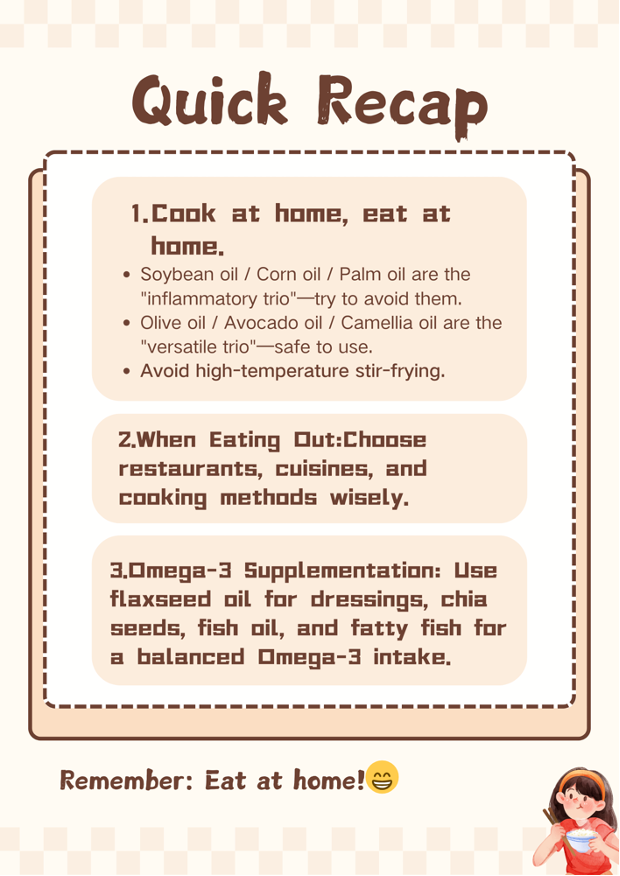
- Cook more at home
- When you control ingredients and oils, you control your health.
2. When eating out, choose cuisines and dishes wisely:
- Hot pot, coconut chicken, and shabu-shabu: ingredients and broth are more DIY
- Salads, grain bowls and yogurt bowls: cleaner oil profiles
- Japanese steamed egg (chawanmushi), sashimi: naturally low-oil
- Choose broth-based hot pot and skip chili oil dips
- Prefer steamed, baked, or braised dishes in most cuisines
- Avoid pan-fried or deep-fried items; request olive oil and vinegar instead of default dressings
3. When all else fails? Bring out the “Regret Antidote”
- Long-term fish oil supplementation
- Regular intake of flaxseed oil, chia seeds, or oily fish
- These help rebalance your Omega-6:3 ratio, mitigating harm
Intervention recommendations are geared toward generally healthy individuals. If you have existing health conditions, always follow your doctor’s instructions.
References18
[1] A few exceptions exist, such as coconut oil and palm kernel oil, which are primarily SFA-based yet remain liquid. Conversely, trans fatty acids — also UFAs — are solid.
[2] Korbecki, Jacek, and Katarzyna Bajdak-Rusinek. “Palmitic Acid and Its Role in Inflammatory Signalling via TLR4/NF-κB.” Frontiers in Physiology, vol. 12, 2021, Art. 656391
[3] Visentin, Gianluca, et al. “Monounsaturated Fatty Acids in Obesity-Related Inflammation.” Nutrients, vol. 13, 2021, Art. 3063.
[4] Burdge, Graham C., and Sheila J. Calder. “Omega-3 Versus Omega-6 Polyunsaturated Fatty Acids in the Context of Inflammation.” Proceedings of the Nutrition Society, vol. 79, 2020, pp. 1–10.
[5] Hotamisligil, Gökhan S. “Inflammation and Metabolic Disorders.” Nature, vol. 444, 2006, pp. 860–867.
[6] Lin, J., et al. “Assessment of Acrolein Development during Frying and Its Relation to Acrylamide Formation.” Journal of Food Chemistry, 2024.
[7] Shahidi, F. & Zhong, Y. “Potential Adverse Public-Health Effects Afforded by the Ingestion of Thermally Oxidized Fats and Oils.” Critical Reviews in Food Science and Nutrition, 2023.
[8] Li, Y., et al. “Characteristics of PM₂.₅ Emissions from Six Types of Commercial Chinese Cooking.” Environmental Pollution, 2022.
[9] Yu, I-T. S., et al. “Dose–Response Relationship between Cooking-Fume Exposure and Lung Cancer among Chinese Non-Smoking Women.” The Lancet Oncology, 2006.
[10] USDA Foreign Agricultural Service. Oilseeds and Products Annual — Beijing (CH2025–0055). 28 Mar 2025.
[11] USDA Economic Research Service. Oil Crops Outlook: February 2025 (OCS-25b). 13 Feb 2025.
[12] OECD&FAO. OECD-FAO Agricultural Outlook 2017–2026 (Commodity Snapshot: Vegetable Oil). Paris: OECD Publishing, 2017. p. 105.
[13] The term “pro-inflammatory” used here refers to the impact of these oils on chronic inflammatory pathways under typical modern dietary conditions (severe Omega-3 deficiency + repeated high-heat cooking), and does not imply these oils possess inherent toxicity.
[14] Chabni, A., et al. “Oxidative Stability via Rancimat of Phenolic-Rich Olive Oils.” Frontiers in Nutrition, 2024;
[15] Martínez-González, M. A., et al. “Effects of a Mediterranean Diet Supplemented with Olive Oils on Inflammatory Biomarkers.” Nutrition Reviews, 2025.
[16] Dey, S. & Przybylski, R. “Flaxseed: A Rich Source of ALA.” International Journal of Food Science, 2024.
[17] Neufeld, L., et al. “Coconut Oil Consumption Significantly Increases LDL-Cholesterol: Meta-Analysis.” Circulation, 2020.
[18]“Rapeseed Oil: A Comprehensive Review of Health-Benefiting Components.” Frontiers in Nutrition, 2023.