Anyone who’s dabbled in the world of spiritual practice knows the story well: the path to enlightenment is paved with stillness.
You retreat into silence, practice mindful breathing, meditate for years — sometimes decades — gradually ascending through deeper states of awareness. If you’re lucky, you’ll reach inner peace. If you’re truly exceptional, perhaps even transcendence.
Some say with enough stillness, you might just escape the bounds of aging altogether — become ageless, awakened, eternally young.
That, of course, is me being half-serious and half-mystical.
But the idea persists: in many cultures, stillness and longevity are deeply intertwined.
And exercise? We say it’s good for us. “Life is movement,” after all. But deep down, many of us aren’t so sure.
- Does exercise deplete vitality?
- Why do we keep hearing about people who suddenly die after intense workouts?
- Why does exercise leave us gasping for air, our hearts pounding? Doesn’t that mean our body is suffering?
- Why do so many elite athletes’ health decline so sharply after retirement?
- If exercise boosts metabolism and increases oxidation, wouldn’t that accelerate aging?
- And if cells can only divide a limited number of times, aren’t we just spending life faster by exercising?
Both cultural tradition and bodily sensations subtly reinforce the same message: exercise might be risky. Better to move with caution.
So: stillness or motion — which truly extends life?
To kick off our new exploration into lifestyle interventions, let’s start here.
This article focuses on “stillness.” In the next one, we’ll turn to “movement.”
Stillness: Sleep Saves Lives. Sitting Kills.
Stillness comes in two distinct forms: asleep vs. awake.
Sleeping Stillness: The Essential Kind
Let’s start with sleep. On this front, the science is clear: quality sleep is foundational to longevity.
Large-scale cohort studies have shown that sleeping 7–9 hours a night is associated with the lowest all-cause mortality, as well as the lowest cardiovascular and metabolic disease risk. Too little sleep (<7 hours) or too much (>10 hours) both correlate with a shorter lifespan. In other words: that one-third of your life spent sleeping matters, and quality matters even more [1–3].
Waking Stillness: Sedentary Living Is a Silent Killer
The real problem lies in being still while awake — in other words, being sedentary.
“Sedentary behavior” is defined as waking time spent sitting or lying down with energy expenditure ≤ 1.5 METs (Metabolic Equivalents of Task). For context:
· Sitting/Lying: ≤ 1.5 METs
· Slow walking: 2–3 METs
· Jogging: 7–8.5 METs
· High-Intensity Interval Training (HIIT): >10 METs
And no — this is not a minor issue. Sedentary behavior is an independent risk factor for death. Here’s what the science says:
- Immediate harm from extreme inactivity: Just 1–2 weeks of bed rest or extreme sitting can trigger measurable insulin resistance, muscle atrophy, and reduced VO₂Max (maximal oxygen uptake) 6.
- The longer you sit, the higher your risk: In a meta-analysis of over 220,000 people, those who sat ≥11 hours per day had a 55% higher risk of death from all causes 7,19.
- Prolonged unbroken sitting is especially dangerous: According to a 2017 study in Annals of Internal Medicine, even if total sitting time is the same, those who break it up with movement have significantly lower mortality rates than those who sit uninterrupted 8.
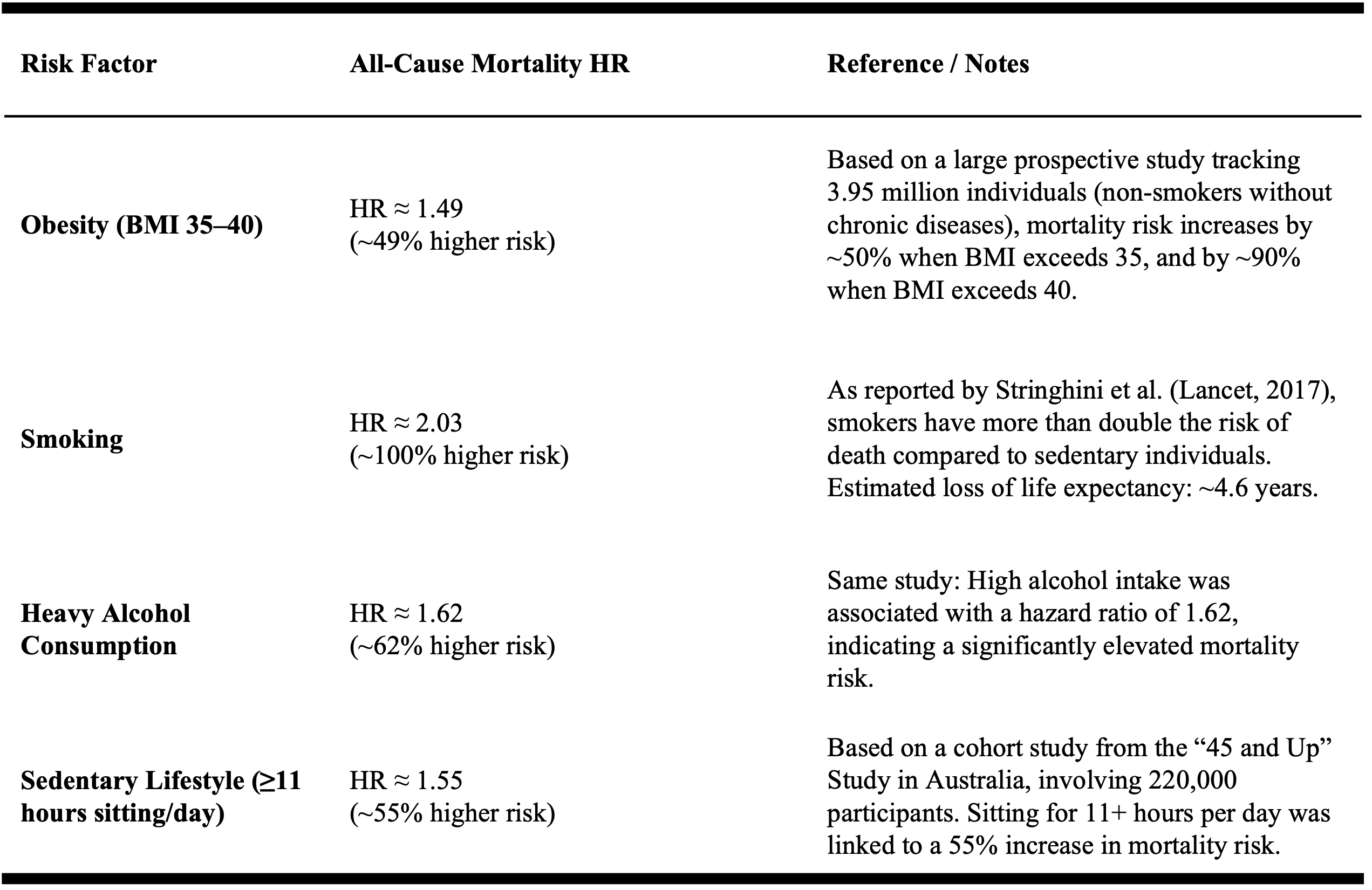
To put it in perspective, the risk from prolonged sitting is on par with smoking or heavy drinking.
People who sit for prolonged periods daily face a mortality risk comparable to that of smokers or heavy drinkers19.
See: All-Cause Mortality Hazard Ratios (HR) Chart
Why Sitting Shortens Your Life: The Physiology
The root problem of sitting too much? When your skeletal muscle pump shuts down, it sets off a chain reaction.
1. Your Muscles Are Your Metabolic Engine
Skeletal muscles account for 40% of body mass and are your largest metabolic organ. Each contraction not only burns glucose and fatty acids but also releases signaling molecules called myokines — which communicate with your liver, brain, and heart. But when you sit still, your muscles stop contracting. It’s like turning off the engine. Energy use plummets. Internal signals go quiet [10–12].
2. The Domino Effect of Metabolic Breakdown
When your muscle pump shuts off 11,13:
- Glucose isn’t absorbed → Blood sugar spikes → Insulin resistance begins.
- Reduced fatty acid utilization → Accumulation of free fatty acids in the bloodstream → Lipotoxicity and inflammation follow.
- Energy burn decreases → Basal metabolic rate drops → Fat begins to accumulate.
3. Your Blood Flow Slows Like a Broken Pump
The return flow of blood from your legs relies on muscle contraction. No contraction = no pump. Blood starts pooling in the legs. Blood pressure rises. The risk of blood clots and cardiovascular events shoots up. Worse still, reduced shear stress on blood vessels weakens endothelial function — accelerating arterial hardening 14,15.
4. Mitochondria Decline, Inflammation Rises
Active muscles keep your mitochondria — the powerhouses of your cells — functioning via a pathway called PGC-1α. Sedentary behavior shuts this pathway down. Mitochondria degrade. Meanwhile, fat accumulates, immune cells invade, and inflammation pathways like NF-κB and NLRP3 flare up. The result: chronic low-grade inflammation, or inflammaging (Primarily based on human-associated, animal, or in vitro studies) 16.
5. The Brain Gets Bored
Prolonged sitting usually comes with low-quality stimulation (e.g., mindless scrolling or watching TV). Cognitive function starts to decline. By contrast, exercise triggers the release of BDNF (brain-derived neurotrophic factor), which promotes neural growth and synaptic plasticity — both vital for long-term brain health [17,18].
In short: sitting too much doesn’t just mean “not moving.” It means you’re systematically turning off systems that keep you alive.
So… Stillness or Movement?
Here’s a more nuanced way to frame it:
Let sleep time belong to stillness. Let waking hours belong to movement.
And no, “movement” doesn’t mean HIIT every hour. Even just standing up, stretching, walking to the restroom — these small breaks help disrupt prolonged sitting and have real physiological value.
Sleep well, move often — that’s the strategy.
How Long Is TOO LONG? The Quantified Risk of Sitting
So, what’s the tipping point? How much sitting is too much?
Longitudinal cohort studies give us a fairly clear threshold:
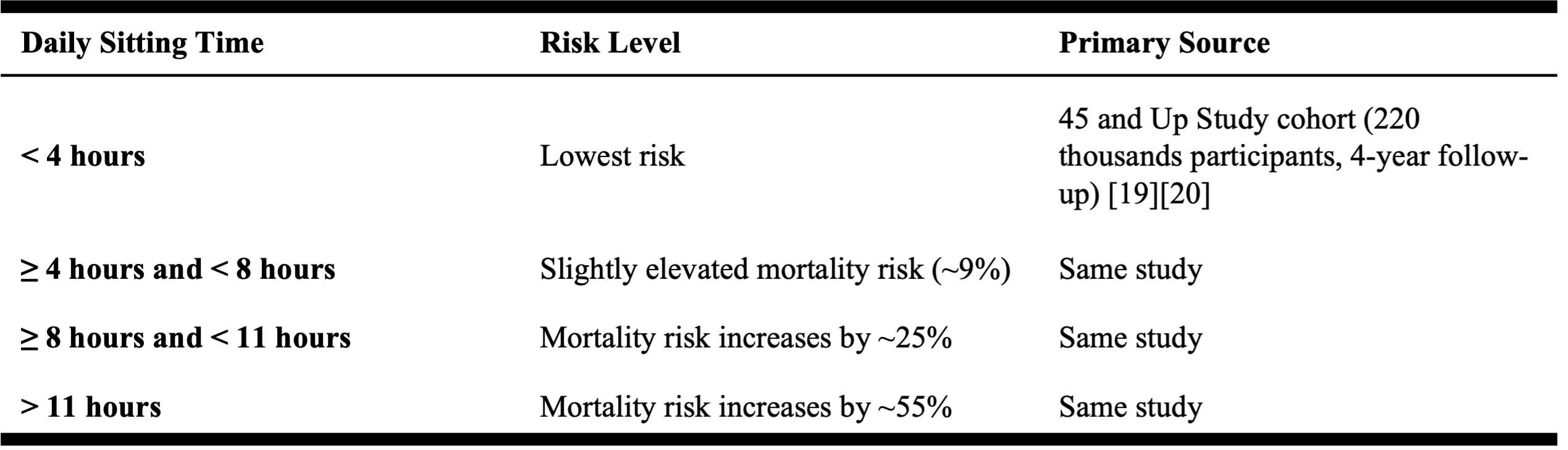
Risk remains low when sitting less than 4 hours per day. But once daily sitting exceeds 8 hours, the risk curve rises sharply.
And while sedentary practices like meditation and breathwork have proven benefits — enhancing mood and hormonal balance — research shows that 20–30 minutes a day is enough. Beyond that, their benefits may be outweighed by the accumulating harm of prolonged stillness.
How to Offset the Harm of Sitting
Let’s face it — most modern jobs make it nearly impossible to sit less than four hours a day. So the solution isn’t to eliminate sitting altogether, but to interrupt it intentionally.
1. Break the Sitting Cycle: Small Moves, Big Wins 22
- Standing up and walking for 2–5 minutes every 30 minutes significantly reduces blood sugar and blood pressure.
- Even walking for 1 minute every hour shows measurable blood pressure benefits.
- Important: Standing ≠ Moving. Simply standing still doesn’t increase energy expenditure much. What works best is a mini combo of stand-walk-stretch-squat.
2. The “Umbrella Effect” of Cardio
- A 2019 BMJ meta-analysis found that 30–40 minutes of moderate-to-vigorous physical activity (MVPA) per day can almost completely cancel out the mortality risk of sitting 10–11 hours a day 23.
- In the REGARDS cohort study, replacing 30 minutes of sitting with:Light physical activity → 17% lower mortality risk; MVPA → 35% lower mortality risk 24
MVPA typically corresponds to 60–80% of your max heart rate — what we commonly refer to as Zone 2 to Zone 3 cardio.
Put another way: sitting may be unavoidable. But movement can counteract the damage.
Life is 50% Stillness, 50% Motion
Here’s a poetic little equation for you:
- Optimal sleep: 8 hours
- Low-risk sitting time: 4 hours
Total: 12 hours — exactly 50% of your day.
So the answer, both scientific and symbolic, is this:
Life is half stillness, half movement. Health emerges from their integration.
Stillness and motion are like the inhale and exhale of life — each incomplete without the other, rhythmically entwined in the pulse of being.
Reserve your sleeping hours for rest. Give your waking hours to movement.
Let’s not allow late nights to rob us of sleep. Let’s not let sitting silently chip away at our life.
Coming up next:
What happens when we fully embrace motion during our waking hours
“Life lies in movement”
Stay tuned.
Intervention recommendations are geared toward generally healthy individuals. If you have existing health conditions, always follow your doctor’s instructions.
References25
[1]Wang, Yu-Hao, et al. “Association of Longitudinal Patterns of Habitual Sleep Duration with Risk of Cardiovascular Events and All-Cause Mortality.” JAMA Network Open, vol. 3, no. 5, 2020, e205246.
[2]Huang, Yu-Ming, et al. “Sleep Duration and Risk of Cardio-Cerebrovascular Disease: A Dose-Response Meta-Analysis of Prospective Cohort Studies.” Frontiers in Cardiovascular Medicine, 2022, 907990.
[3]Gu, Jian, et al. “Association of Sleep Duration with Risk of All-Cause and Cardiovascular Mortality: A Meta-Analysis of Prospective Cohort Studies.” Frontiers in Public Health, 2024.
[4]Bull, Fiona C., et al. “World Health Organization 2020 Guidelines on Physical Activity and Sedentary Behaviour.” British Journal of Sports Medicine, vol. 54, no. 24, 2020, pp. 1451–1462.
[5]Tremblay, Mark S., et al. “Sedentary Behavior Research Network (SBRN) — Terminology Consensus Project.” International Journal of Behavioral Nutrition and Physical Activity, vol. 14, 2017, p. 75.
[6]Krogh-Madsen, R., et al. “A 2-Week Reduction of Ambulant Activity Attenuates Peripheral Insulin Sensitivity.” Journal of Applied Physiology, vol. 108, no. 5, 2010, pp. 1034–1040.
[7]Ekelund, Ulf, et al. “Does Physical Activity Attenuate, or Even Eliminate, the Detrimental Association of Sitting Time with Mortality?” The Lancet, vol. 388, no. 10051, 2016, pp. 1302–1310.
[8]Diaz, Keith M., et al. “Patterns of Sedentary Behavior and Mortality in U.S. Middle-Aged and Older Adults.” Annals of Internal Medicine, vol. 167, no. 7, 2017, pp. 465–475.
[9]Stringhini, Silvia, et al. “Socioeconomic Status and the 25 × 25 Risk Factors as Determinants of Premature Mortality.” The Lancet, vol. 389, no. 10075, 2017, pp. 1229–1237.
[10]Pedersen, Bente K., and Mark A. Febbraio. “Muscles, Exercise and Obesity: Skeletal Muscle as a Secretory Organ.” Nature Reviews Endocrinology, vol. 8, 2012, pp. 457–465.
[11]Hamilton, M. T., et al. “Too Little Exercise and Too Much Sitting: Inactivity Physiology.” Curr Cardiovasc Risk Rep, 2008
[12]Bey, Lauren, and Marc T. Hamilton. “Suppression of Skeletal Muscle Lipoprotein Lipase Activity During Physical Inactivity.” Journal of Applied Physiology, vol. 94, 2003, pp. 2396–2403.
[13]Booth, Frank W., et al. “Lack of Exercise Is a Major Cause of Chronic Diseases.” Comprehensive Physiology, 2012, pp. 1143–1211.
[14]Morishima, Takuma, et al. “Prolonged Sitting–Induced Leg Endothelial Dysfunction Is Prevented by Fidgeting.” AJP–Heart and Circulatory Physiology, 2016.
[15]Restaino, Robert M., et al. “Endothelial Dysfunction following Prolonged Sitting Is Mediated by Reduced Shear Stress.” American Journal of Physiology–Heart and Circulatory Physiology, 2016.
[16]Handschin, Christoph, and Bruce M. Spiegelman. “The Role of Exercise and PGC-1α in Inflammation and Chronic Disease.” Nature, vol. 454, 2008, pp. 463–469.
[17]Erickson, Kirk I., et al. “Exercise Training Increases Size of Hippocampus and Improves Memory.” PNAS, vol. 108, no. 7, 2011, pp. 3017–3022.
[18]Dinoff, Alexander, et al. “The Effect of Acute Exercise on Blood BDNF in Healthy Adults: A Meta-Analysis.” European Journal of Neuroscience, vol. 46, no. 1, 2017, pp. 1635–1646.
[19]van der Ploeg, Hidde P., et al. “Sitting Time and All-Cause Mortality Risk in 222,497 Australian Adults.” Archives of Internal Medicine, vol. 172, no. 6, 2012, pp. 494–500
[20]Patterson, Richard, et al. “Sedentary Behaviour and Risk of All-Cause, Cardiovascular and Cancer Mortality, and Incident Type 2 Diabetes: A Systematic Review and Dose-Response Meta-Analysis.” European Journal of Epidemiology, vol. 33, 2018, pp. 811–829.
[21]Nguyen, Samson, et al. “Prospective Associations of Accelerometer-Measured Machine-Learned Sedentary Behavior with Death Among Older Women: The OPACH Study.” Journal of the American Heart Association, 2024.
[22]Diaz, Keith M., et al. “Effects of Within-Day Activity Breaks on Cardiometabolic Risk: A Randomized Trial.” JAMA Network Open, vol. 7, no. 4, 2024, e249909.
[23]Ekelund, Ulf, et al. “Dose-Response Associations between Accelerometry Measured Physical Activity, Sedentary Time and All-Cause Mortality.” BMJ, 2019, l4570.
[24]Diaz, Keith M., et al. “Prognostic Associations of Sedentary Time and Physical Activity with Mortality in REGARDS: Isotemporal Substitution Analyses.” American Journal of Epidemiology, vol. 187, no. 8, 2018, pp. 1813–1822.
[25]Global BMI Mortality Collaboration et al. “Body-mass index and all-cause mortality: individual-participant-data meta-analysis of 239 prospective studies in four continents.” Lancet