36. Stillness or Movement: Which One Truly Sustains Life? (Part II) — To Move in Our Waking Hours

Painted by AI
As we discussed in the previous piece:
Life is half stillness, half movement. Health emerges from their integration.
Stillness and motion are like the inhale and exhale of life — each incomplete without the other, rhythmically entwined in the pulse of being.
Reserve your sleeping hours for rest. Give your waking hours to movement.
Because in our waking state, life NEEDS movement.
First, let’s get one thing straight: Movement doesn’t shorten your life. Inactivity does.
There’s a popular misconception that sounds deceptively logical:
“Exercise accelerates cell division → burns through your life force.” “Exercise increases metabolism and oxidation → speeds up aging.”
These arguments sound intuitive, maybe even scientific — but they’re fundamentally wrong.
Misconception #1: “Exercise accelerates cell division → consumes life force.”
Let’s break this down.
1.Exercise doesn’t meaningfully increase cell division1,2.
Physical adaptation from exercise is driven less by new cells dividing, and more by optimizing the function of existing cells — more mitochondria, new capillaries, stronger muscle fibers. Yes, muscle satellite cells (muscle stem cells) are recruited for repair. But this is a necessary and healthy process, not a premature overdraw of your biological account.
2.Exercise reduces harmful cell proliferation. What actually drives abnormal and dangerous cell division (like in cancer)? Chronic inflammation, obesity, and high-sugar diets3.
Regular exercise improves insulin sensitivity, enhances autophagy and DNA repair, reduces inflammation, and helps prevent mutations from piling up3,4.
Telomere research backs this up. People who exercise regularly have longer telomeres in their white blood cells — effectively turning back their biological clocks by 7 to 10 years. Twin studies confirm this effect5.
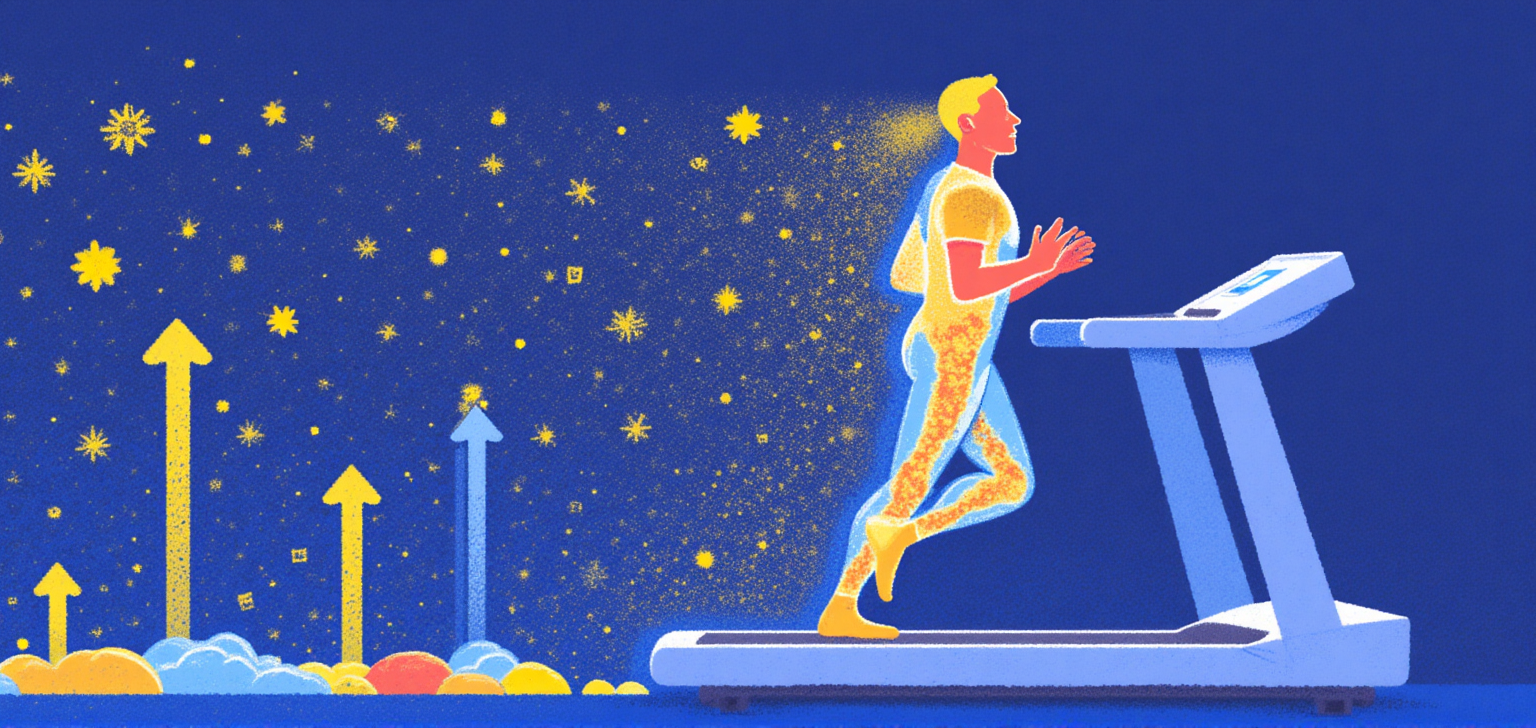
3. “Burning the candle faster” is the wrong analogy. A candle passively burns out. But exercise is a system upgrade: more mitochondria, stronger heart and lungs, better metabolic control6.
Consistent exercise is strongly correlated with longer healthspan and lifespan. Regular exercisers reduce their all-cause mortality risk by over 30% — hardly the definition of “burning out”6,7.
Painted by AI
Misconception #2: “Exercise increases oxidation → accelerates aging.”
This confusion stems from a simplistic view of Reactive Oxygen Species (ROS).
ROS (Reactive Oxygen Species) refers to a broad family of oxidative molecules derived from molecular oxygen. It includes both free radicals and non-radical oxidants, and plays roles in various cellular signaling pathways. However, in excess, ROS can cause oxidative damage, lipid peroxidation, protein carbonylation, and DNA damage — stress responses that are closely linked to aging and multiple diseases.
Yes, exercise does generate more ROS temporarily. And yes, excess ROS can cause oxidative damage — lipid peroxidation, protein carbonylation, DNA mutations.
But here’s the key: Not all stress is bad.
In fact, small, controlled doses of stress are necessary for growth. This is the principle of hormesis.
When your body encounters mild stress from exercise, it doesn’t break down — it adapts. It upregulates antioxidant enzymes like SOD and GPx1, strengthens internal defenses, and becomes more resilient overall8,9.
Without these micro-stresses? The system weakens. Chronic oxidative pressure builds, unchecked.
Let me offer a metaphor:
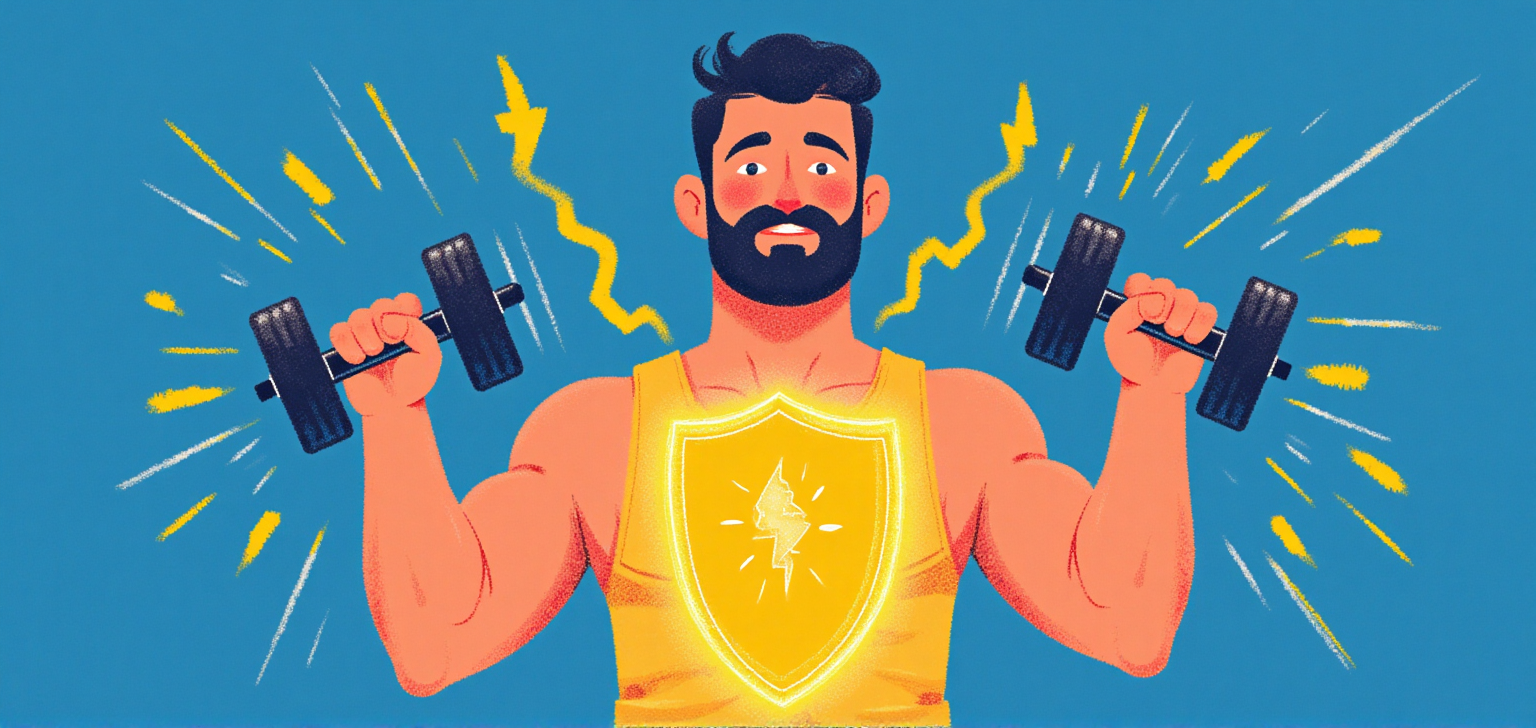
The free radicals generated by exercise are like controlled fires during a drill — they activate your internal firefighters. Over time, your fire response system (antioxidant capacity) becomes faster, smarter, stronger.
As a result, your city (body) becomes more fire-resistant. Less likely to be devastated by uncontrolled wildfires (chronic diseases and aging).
This logic applies across many proven longevity mechanisms:
- Caloric restriction and fasting promote autophagy.
- Exercise activates AMPK.
- Polyphenols, despite being mildly toxic, trigger protective responses.
- Cold exposure stimulates brown fat development.
- Hypoxia enhances cardiopulmonary resilience.
The underlying truth? Only through stress, do we grow stronger.
If the human body were a self-upgrading factory, then these micro-stresses — like exercise — serve as critical signals. They drive repair, feedback, and optimization. They tell the system where to send resources, how to rebuild, and what to reinforce.
Painted by AI
👉 So no, “exercise = more oxidation = faster aging” doesn’t hold up.
The truth is: Moderate exercise → stronger antioxidant defenses → slower aging.
What’s common across these myths is a static, mechanistic worldview. A reductionist lens trying to interpret a dynamic, adaptive system.
But the human body is not a closed machine. It is an open, dissipative system — constantly exchanging matter and energy with its environment to maintain order and structure.
Stop the exchange, and the system dies.
Exercise is one of the most fundamental, everyday forms of this exchange. It creates purposeful disturbances:
- During exercise: energy demand and metabolic pressure spike.
- During recovery: the body upgrades systems to cope better next time.
This cycle — of disruption and recovery — is what enables us to rebuild, rewire, and perform better. It slows decay. It sustains peak performance for longer.
Exercise: The Most Powerful Anti-Aging Drug We Know
If there’s one intervention we know that can target all major hallmarks of aging, it’s exercise.
The Hallmarks of Aging were first introduced in Cell in 2013, and expanded in 2023 to a comprehensive 14-point framework. These hallmarks describe the key biological processes driving aging — from genomic instability to chronic inflammation.
And movement affects all of them[16–30].

One hallmark worth highlighting: Mitochondrial adaptation.
Mitochondria are the power plants of our cells. Their health determines how much energy you feel, how quickly you recover, and how alive you feel, day to day.
This is why mitochondria are sometimes called the “barometers of aging.”
And guess what stimulates them most directly? Exercise.
- It increases mitochondrial quantity and distribution.
- It improves energy efficiency and stability.
- It makes mitochondria more robust under stress.
That’s why regular exercisers often feel sharper, steadier, more energized.
On a cellular level, it’s their mitochondria lighting up.
Exercise Is the Most Accessible Longevity Drug
Let’s bust another myth while we’re here:
Exercise doesn’t have to mean gasping for air, dripping sweat, or waking up sore. That’s not the bar.
Modern research shows: even light movement — like standing up, walking around, or doing chores — significantly lowers mortality risk.
It makes sense when you think about it.
We already know prolonged sitting is a silent killer. But the “safe zone” for sedentary time is less than four hours a day — far less than what modern life demands of most people.
Here’s the good news: You don’t need to work out. You just need to break the sitting.
And that alone, done regularly, already reverses much of the damage10,11:
- Standing up and walking for just 3–5 minutes every 30 minutes significantly reduces blood glucose spikes and lowers blood pressure.
- In the CARDIA cohort, people who walked 7,000+ steps a day reduced all-cause mortality by 30%–50%.
- Even one minute of walking per hour beats staying seated the whole time.
So don’t overthink it. Don’t get paralyzed wondering which exercise is best, or how long you should go.
Every kind of movement has its value.
Start with what you enjoy. Build the habit. Optimize later.
Painted by AI
A Framework for Movement
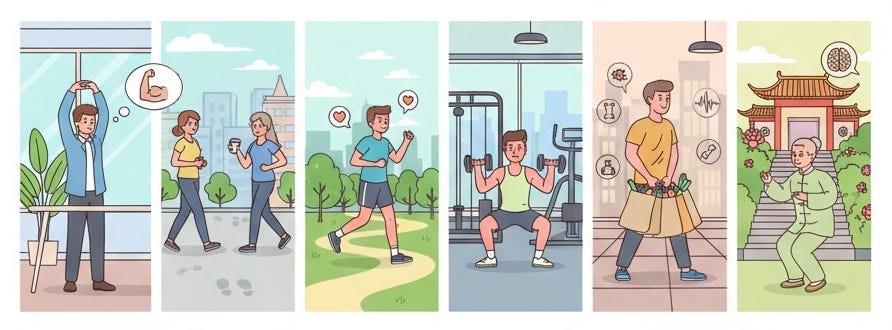
Tier 0: Just stand up.
Stretch. Walk to the bathroom. Break the sitting.
Standing up every 30 minutes for 5 minutes can reduce post-meal blood sugar by ~58% and lower blood pressure by 4–5 mmHg. Even walking for just 1 minute per hour shows benefits10,12.
Tier 1: Everyday Movement (Walking)
Walking is massively underrated.
The sweet spot seems to be 6,000–10,000 steps/day, especially for sedentary individuals.
Even pacing around while taking calls counts. These small choices quietly bend your health trajectory upward.
Tier 2: Foundational Aerobic Training (Zone 2 / MICT)
Zone 2 = Heart rate around 100–130 bpm (for most middle-aged people). Think brisk walking or slow jogging — where you can talk but not sing.
150–300 minutes per week significantly improves mitochondrial health, cardio fitness, and longevity. This is the base of any good movement routine.
Tier 3: Strength & Resistance Training
Muscle is your biggest metabolic organ. And strength is a major predictor of longevity.
2–3 sessions per week help maintain muscle and bone density, reduce fall risk, and improve insulin sensitivity.
Grip strength alone is one of the most powerful mortality predictors we have.
Tier 4: High-Intensity Bursts (HIIT / VILPA)
HIIT = High-Intensity Interval Training, great for VO₂max and time efficiency.
VILPA = Vigorous Intermittent Lifestyle Physical Activity — like sprinting to catch a bus or carrying heavy groceries upstairs.
These “microbursts” of intensity, even in daily life, are linked to significantly lower mortality risk.
Tier 5: Functional Movement (Balance, Flexibility, Neuromuscular Control)
Think yoga, Pilates, tai chi. These practices boost flexibility and balance — crucial for fall prevention in older adults.
Because the goal of longevity isn’t just living long — it’s living steady.
Among these five tiers, only Tier 4 (HIIT/VILPA) involves any heavy breathing — and even then, only a little is needed.
For example, UK Biobank wearable data shows that just ~4.4 minutes per day of VILPA (less than 31 minutes per week!) was associated with14,15:
- 26–30% reduction in all-cause and cancer mortality
- 32–34% reduction in cardiovascular mortality
From a Prime Life perspective, the majority of movement’s benefits come from low to moderate activity. You don’t need to exhaust yourself to unlock massive health gains.
The Three Mental Shifts That Change Everything
If you want to rethink exercise, start with these truths:
- The bar is low. Just standing and moving counts.
- All movement matters. Don’t obsess over type or duration. Start anywhere.
- It doesn’t have to hurt. Most of the benefit comes from low or moderate intensity.
In Summary
Life, in our waking hours, is movement.
And movement isn’t depletion. It’s restoration. It’s not burnout. It’s upgrade.
From mitochondria to mind, muscles to social bonds — movement is the central artery that connects body and longevity.
So don’t think of exercise as a monk-like ordeal. It’s more like collecting daily deposits into your longevity account.
Every time you get up, take a walk, or move with intention, you’re stepping closer to your Prime Life.

Painted by AI
Intervention recommendations are geared toward generally healthy individuals. If you have existing health conditions, always follow your doctor’s instructions.
References30
[1]Handschin, Christoph, and Bruce M. Spiegelman. “The Role of Exercise and PGC-1α in Skeletal Muscle Plasticity and Adaptation.” Nature, vol. 454, 2008, pp. 463–469.
[2]Joyner, Michael J., and Andrew J. Coyle. “Endurance Exercise Performance: The Physiology of Champions.” The Journal of Physiology, vol. 586, no. 1, 2008, pp. 35–44.
[3]World Cancer Research Fund/AICR. Diet, Nutrition, Physical Activity and Cancer: a Global Perspective, Continuous Update Project, 2018/updated.
[4]International Agency for Research on Cancer. IARC Handbooks of Cancer Prevention: Physical Activity, 2018–2019.
[5]He, Chao, et al. “Exercise-Induced BCL2-Regulated Autophagy Is Required for Muscle Glucose Homeostasis.” Nature, vol. 481, 2012, pp. 511–515.
[6]Arem, Hannah, et al. “Leisure Time Physical Activity and Mortality: A Detailed Pooled Analysis of the Dose-Response Relationship.” JAMA Internal Medicine, vol. 175, no. 6, 2015, pp. 959–967.
[7]World Health Organization. WHO Guidelines on Physical Activity and Sedentary Behaviour, 2020.
[8]Powers, Scott K., et al. “Exercise-Induced Oxidative Stress: Friend or Foe?” Journal of Sport and Health Science, vol. 9, no. 5, 2020, pp. 415–425.
[9]Ristow, Michael, et al. “Antioxidants Prevent Health-Promoting Effects of Physical Exercise in Humans.” PNAS, vol. 106, no. 21, 2009, pp. 8665–8670.
[10]Duran, Andrea T., et al. “Breaking Up Prolonged Sitting to Improve Cardiometabolic Risk: Dose-Response Analysis of a Randomized Crossover Trial.” Medicine & Science in Sports & Exercise, 2023.
[11]Paluch, Amanda E., et al. “Steps per Day and All-Cause Mortality in Middle-Aged Adults in the CARDIA Study.” JAMA Network Open, vol. 4, no. 9, 2021, e2124516.
[12]Columbia University Irving Medical Center. “Rx for Prolonged Sitting: A Five-Minute Stroll Every Half Hour.” News Release, 12 Jan. 2023
[13]Stamatakis, Emmanuel, et al. “Association of Wearable Device-Measured Vigorous Intermittent Lifestyle Physical Activity with Mortality.” Nature Medicine, 2022.
[14]Ahmadi, Matthew N., et al. “Brief Bouts of Device-Measured Intermittent Lifestyle Physical Activity and Major Cardiovascular Events and Mortality among Non-Exercisers.” The Lancet Public Health, 2023.
[15]Stamatakis, Emmanuel, et al. “Device-Measured Vigorous Intermittent Lifestyle Physical Activity and Cardiovascular Outcomes.” British Journal of Sports Medicine, 2025.
[16]Kroemer, Guido et al. “From geroscience to precision geromedicine: Understanding and managing aging.” Cell vol. 188,8 (2025): 2043–2062.
[17]Tryfidou, D. V., et al. “DNA Damage Following Acute Aerobic Exercise: A Systematic Review and Meta-analysis.” Sports Medicine, vol. 50, 2020, pp. 103–127.
[18]Werner, C., et al. “Physical Exercise Prevents Cellular Senescence in Circulating Leukocytes and Increases Telomerase Activity.” Circulation, 2009.
[19]Ammous, F., et al. “Physical Activity Is Associated with Decreased Epigenetic Age Acceleration.” International Journal of Epidemiology, 2025.
[20]Kampinga, H. H., and E. A. Craig. “The HSP70 Chaperone Machinery: J Proteins as Drivers of Functional Specificity.” Nature Reviews Molecular Cell Biology, 2010
[21]Laker, R. C., et al. “AMPK Phosphorylation of ULK1 Is Required for Targeting of Mitochondria by Autophagy in Response to Exercise.” Nature Communications, 2017.
[22]Egan, B., and J. R. Zierath. “Exercise Metabolism and the Molecular Regulation of Skeletal Muscle Adaptation.” Cell Metabolism, 2013.
[23]Arany, Z. “PGC-1 Coactivators and Skeletal Muscle Adaptations in Health and Disease.” Trends in Endocrinology & Metabolism, 2008.
[24]Khalafi, M., et al. “Influence of Different Modes of Exercise Training on Systemic Inflammatory Markers in Older Adults: A Systematic Review and Meta-analysis.” Experimental Gerontology, 2023.
[25]Snijders, T., et al. “Satellite Cells in Human Skeletal Muscle Plasticity with Resistance Training.” Journal of Physiology, 2015.
[26]Pedersen, B. K., and M. A. Febbraio. “Muscles, Exercise and Obesity: Skeletal Muscle as a Secretory Organ.” Nature Reviews Endocrinology, 2012.
[27]Wang, Y.-H., et al. “Long-Term Exercise Training and Inflammatory Biomarkers: A Meta-analysis.” Frontiers in Psychology, 2023.
[28]Allen, J. M., et al. “Exercise Alters Gut Microbiota Composition and Function in Lean and Obese Adults.” Medicine & Science in Sports & Exercise, 2018.
[29]Kjaer, M. “Role of Extracellular Matrix in Adaptation of Tendon and Skeletal Muscle to Mechanical Loading.” Physiological Reviews, 2004.
[30]Dinoff, A., et al. “Effect of Acute and Chronic Exercise on BDNF Concentrations in Humans: A Meta-analysis.” European Journal of Neuroscience, 2017.