Peter Attia shared a story in Outlive that he says he still can’t let go of 1.
It was at a funeral. He was there to mourn Sophie, the mother of a friend. She had once been the embodiment of vitality — nimble, energetic, passionate about gardening, a fluid, powerful golfer. Attia had shared dinner with her once in her perfectly manicured garden.
She was the kind of person you’d expect to live to 100 — and live well.
But everything changed after what seemed like a minor fall. That fall tore the rotator cuff in her shoulder. Chronic pain followed. She could no longer garden, golf, or travel. Her world shrank, little by little, until all that remained was a couch, a TV, and four walls.
Years later, cognitive decline set in. Eventually, at 83, she died from a respiratory infection.
Attia writes:
“…I reflected on the fact that she had spent the last decade of her life being unable to participate in any of the activities that had given her pleasure. Instead, she had been in considerable pain. Nobody mentioned that. We were gathered to mourn Sophie’s biological death, but it saddened me even more deeply that she had been robbed of the joy of her final years.”
He uses this story to distinguish between lifespan (how long you live) and healthspan (how well you live). We talked about that in Prime Lab Entry 1.
But to me, Sophie’s story revealed something even more chilling:
Everything fell apart because of a single fall.
For older adults, falling is rarely just a fall. It’s often the prelude to decline, disorder, and — eventually — death.
I. Falling: The Most Dangerous “Accident” in Old Age
According to data from the World Health Organization, approximately 680,000 people die each year directly from falls, making it the second leading cause of unintentional injury deaths worldwide. When you include indirect deaths from complications like fractures, disability, and infections, the total number may reach over one million — comparable to global traffic fatalities, which claim about 1.2 million lives annually and rank as the number one cause of unintentional injury deaths [2–4].
But here’s the difference:
- Two-thirds of traffic deaths occur in young and middle-aged adults (18–59).
- The vast majority of fatal falls occur in those over 60.
More grim numbers:
- In 2019 alone, there were 11 to 18 million new cases of hip fractures globally 5.
- Among adults over 50, the 1-year mortality rate after a hip fracture is 22% 6.
- Over 50% of older adults can't fully regain their pre-fracture mobility or independence in a year23.
- And globally, fall-related death rates in the elderly are still rising 5.
In other words, for many older adults, it’s not the fracture that kills — it’s the cascade:
Fall → Fracture → Bed rest → Muscle loss → Infection or disability → Rapid health decline
Falls often steal the final chapter of life. Sophie’s story is a textbook case of this unraveling.
II. Fighting Falls with Muscle
When you’re young, a fall means a bruise and a laugh.
When you’re older, it can mean the end of independence.
And often, it’s not the floor that causes the fall — it’s the body that fails to respond in time.
Muscle is the key variable in this equation.
💪🏻 Muscle helps prevent falls in 4 crucial ways:
- Stability: Core and lower-body strength keep you steady while standing or walking.
- Speed: The ability to generate force quickly — Rate of Force Development (RFD) — determines whether you can take that one crucial step within 50–200 milliseconds to catch yourself 7.
- Coordination: Your neuromuscular system needs to fire in sync to help you dodge or stabilize quickly.
- Protection: Muscle cushions bones and organs, reducing impact damage when you do fall.
Fall prevention = Muscle strength + Reaction speed + Balance + Muscular protection
So preventing falls isn’t about bench pressing 100 kg. It’s about whether you can stay upright when a subway train suddenly brakes.
That’s why High-Velocity Resistance Training (HVRT) is superior to slow, heavy lifting for older adults. HVRT better improves explosive power, dynamic balance, and neuromuscular coordination — all essential to staying on your feet 8,9.
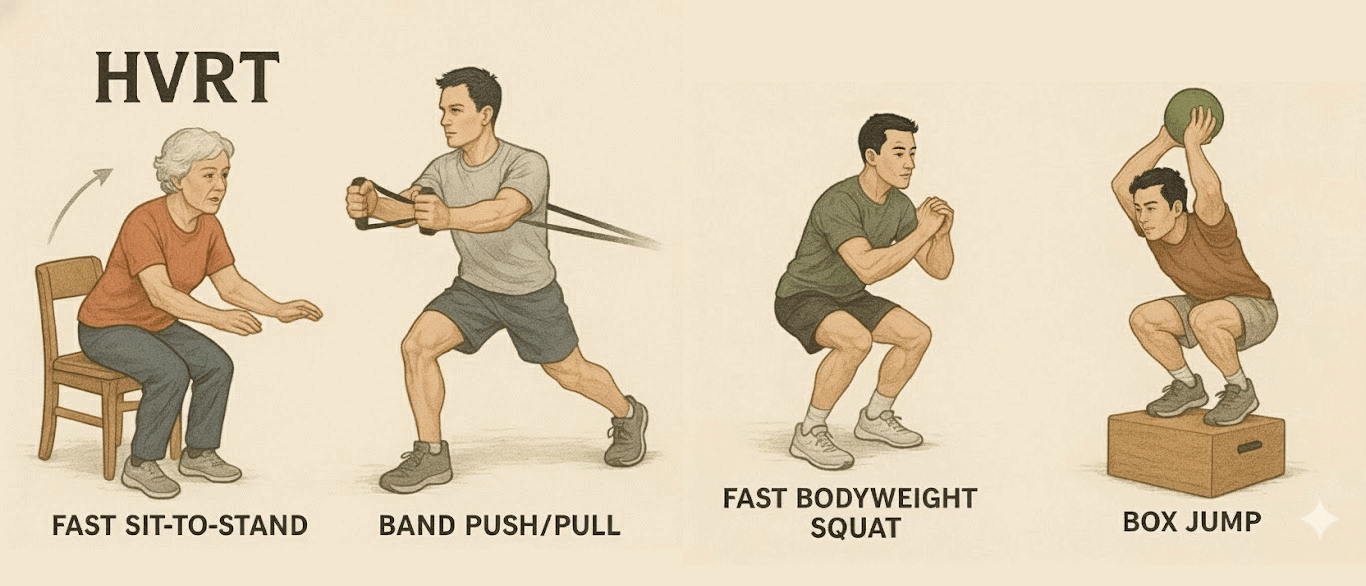
Painted by AI
III. Strengthening Bones With Muscle
Hip fractures often stem from a deeper problem: brittle bones — or what we commonly call osteoporosis.
Many people believe osteoporosis is just a calcium issue, and so they load up on supplements.
But here’s the truth: Calcium without movement is like bricks with no house to build. If you don’t use your body, the calcium has nowhere meaningful to go.
Why?
Because bones require mechanical tension from muscle as a signal to hold onto calcium.
The tension created when muscles pull on bones is what maintains bone density. If you sit still for long periods, your bones get the message that they’re not needed — and they begin to break down 10,11.
Research into the bone-muscle axis shows that when muscles contract, they release signaling molecules like Irisin and IGF-1, which promote bone formation. Bones, in return, secrete factors like osteocalcin and FGF23 that help regulate muscular performance during movement.
These two systems aren’t just connected — they’re biological co-dependents.
Taking calcium without training is like stockpiling bricks but never building anything. The excess ends up in the wrong places — potentially increasing your risk for kidney stones.
So what should you do?
- Resistance training (like squats or rowing) can significantly slow down the loss of bone mass 14.
- Impact-based exercises (like jumping, weighted walking, HIIT, or high-velocity resistance training) provide a more potent signal to bones, making them denser and stronger 15.
Exercise variety matters. When it comes to signaling bones to grow stronger, HIIT and HVRT may outperform traditional slow, heavy lifting.
IV. Preserving the Freedom to Move in Old Age With Muscle
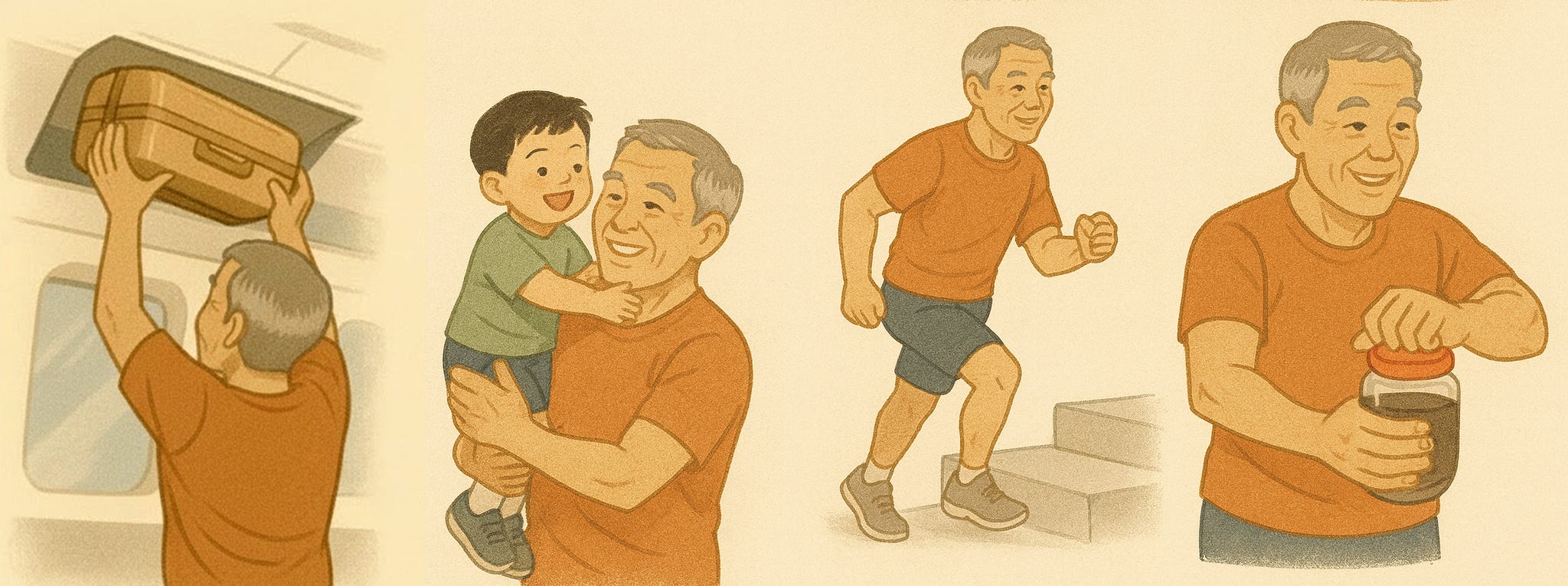
· At what age do you want to lift your suitcase into a train or airplane overhead bin for the last time?
· Would you like to still carry your grandchildren — or even great-grandchildren — when you’re in your 80s?
· Still want to take the stairs two flights at a time?
· Still want to twist open stubborn jars or manage household chores with ease?
These everyday movements are not trivial. They are the baseline of independent living.
Muscle mass declines by 3–8% per decade, while muscle strength declines even faster — 14–16% per decade 16,17.
So if you want to lift a 10 kg suitcase overhead at age 80, it likely means you should be able to press 20 kg or more today.
If you hope to carry a 15 kg grandchild without injury at 80, you’ll need to be able to squat 25–30 kg now.
Climbing stairs is a combination of leg strength and cardiovascular fitness. Losing this ability is often the beginning of losing the freedom to leave your home.
Your ability to lift and grip also determines whether you can carry groceries, clean, or simply live with dignity.
In fact, research shows that grip strength is an independent predictor of all-cause mortality 18. Stronger grip = longer life. Because muscle doesn’t just represent strength — it reflects metabolic reserve and whole-body health.
Think of the muscle you build when you’re young as retirement savings.
Just like VO₂Max is the financial capital of your cardiovascular system, muscle is the capital of your movement system.
Painted by AI
V. Muscle: Your Immune Reserve and Aging Buffer
Muscle plays one last — but hugely underappreciated — role:
It’s your immune system’s supply chain, your backup energy reserve, and your biological shock absorber during aging.
Under stress — fever, illness, surgery, appetite loss, or infection — muscle serves as a critical fallback system [19–22]:
- It releases amino acids (like glutamine) that help build antibodies and acute-phase proteins.
- It provides glucose via gluconeogenesis when you can’t eat.
- It prevents frailty syndrome, the collapse of multiple physiological systems.
Whether or not you recover from a health crisis often hinges on how much muscle reserve you’ve built.
In Summary: The Many Lives of Muscle
Looking fit is just the most visible perk of having muscle.
In our previous article, we explored how muscle impacts glucose regulation, metabolism, and hormones.
This time, we focused on its structural value — how it supports bones, maintains independence, and protects against frailty.
To put it simply:
· On the inside, muscle is a hormone-producing factory; on the outside, it’s your body’s armor.
· It manages your blood sugar; it protects your bones.
· It gives you strength when you’re young — and dignity when you’re old.
More Takeaways
1.Muscle is good — as long as you use it. It plays a vital role in glucose control, hormone secretion, structural support, and metabolism.
2.Muscle naturally declines. Build a surplus while you can. Today’s strength training is tomorrow’s life insurance.
3.Comprehensive anti-aging goes beyond brute strength. Explosiveness, coordination, balance, and neuromuscular agility matter just as much.
4.Training isn’t just about lifting heavy. High-Velocity Resistance Training (HVRT) is more effective than slow heavy lifting when it comes to fall prevention, improving reaction speed, dynamic balance, and neuromuscular coordination. It may also provide a stronger signal for boosting bone mineral density (BMD).
Diversity is key. A mix of resistance, cardio, functional, and impact training helps activate a broader range of myokines — the secret messengers of muscular health.
Muscle isn’t just for youth — it’s for life.
Intervention recommendations are geared toward generally healthy individuals. If you have existing health conditions, always follow your doctor’s instructions.
References
[1]Attia, Peter, and Bill Gifford. Outlive: The Science and Art of Longevity. Harmony Books, 2023.
[2]World Health Organization. “Falls.” WHO Fact Sheet, 26 Apr. 2021.
[3]World Health Organization. “Injuries and Violence.” 19 June 2024.
[4]World Health Organization. Global Status Report on Road Safety 2023. Geneva: WHO, 2023.
[5]GBD 2019 Fracture Collaborators. Global, regional, and national burden of bone fractures in 204 countries and territories, 1990–2019: a systematic analysis from the Global Burden of Disease Study 2019. Lancet Healthy Longev. 2021 Sep;2(9):e580-e592.
[6]Downey C, Kelly M, Quinlan JF. Changing trends in the mortality rate at 1-year post hip fracture — a systematic review. World J Orthop. 2019 Mar 18;10(3):166–175.
[7]Maffiuletti, Nicola A., et al. “Rate of Force Development: Physiological and Methodological Considerations.” European Journal of Applied Physiology, 2016.
[8]Fielding, Roger A., et al. “High-Velocity Resistance Training Increases Skeletal Muscle Peak Power in Older Women.” J Am Geriatr Soc, 2002.
[9]de Vos NJ, Singh NA, Ross DA, Stavrinos TM, Orr R, Fiatarone Singh MA. Optimal load for increasing muscle power during explosive resistance training in older adults. J Gerontol A Biol Sci Med Sci. 2005 May;60(5):638–47.
[10]Wang L, You X, Zhang L, Zhang C, Zou W. Mechanical regulation of bone remodeling. Bone Res. 2022 Feb 18;10(1):16.
[11]Klein-Nulend J, Bacabac RG, Bakker AD. Mechanical loading and how it affects bone cells: the role of the osteocyte cytoskeleton in maintaining our skeleton. Eur Cell Mater. 2012 Sep 24;24:278–91.
[12]Mera, Paula, et al. “Osteocalcin Signaling in Myofibers Is Necessary and Sufficient for Optimum Adaptation to Exercise.” Cell Metabolism, 2016.
[13]Severinsen MCK, Pedersen BK. Muscle-Organ Crosstalk: The Emerging Roles of Myokines. Endocr Rev. 2020 Aug 1;41(4):594–609.
[14]Watson, Shelley L., et al. “High-Intensity Resistance and Impact Training Improves Bone Mineral Density and Physical Function in Postmenopausal Women with Low Bone Mass: The LIFTMOR Randomized Controlled Trial.” Journal of Bone and Mineral Research, 2018
[15]Brooke-Wavell, Katherine, et al. “Strong, Steady and Straight: UK Consensus Statement on Physical Activity and Exercise for Osteoporosis.” British Journal of Sports Medicine, vol. 56, no. 15, 2022, pp.
[16]Hughes, Virginia A., et al. “Longitudinal Muscle Strength Changes in Older Adults.” The Journals of Gerontology: Series A, 2001.
[17]Goodpaster, Bret H., et al. “The Loss of Skeletal Muscle Strength, Mass, and Quality in Older Adults.” The Journals of Gerontology: Series A, 2006.
[18]Leong, Darryl P., et al. “Prognostic Value of Grip Strength: Findings from the Prospective Urban Rural Epidemiology (PURE) Study.” The Lancet, vol. 386, no. 9990, 2015, pp.
[19]Wolfe, Robert R. “The Underappreciated Role of Muscle in Health and Disease.” The American Journal of Clinical Nutrition, vol. 84, no. 3, 2006, pp. 475–482.
[20]Cruzat, Valeria, et al. “Glutamine: Metabolism and Immune Function, Supplementation and Clinical Translation.” Nutrients, vol. 10, no. 11, 2018, Article 1564.
[21]Puthucheary, Zudin A., et al. “Acute Skeletal Muscle Wasting in Critical Illness.” JAMA, vol. 310, no. 15, 2013, pp. 1591–1600.
[22]Clegg, Andrew, et al. “Frailty in Elderly People.” The Lancet, vol. 381, no. 9868, 2013, pp. 752–762.
[23]Dyer SM, Crotty M, Fairhall N, Magaziner J, Beaupre LA, Cameron ID, Sherrington C; Fragility Fracture Network (FFN) Rehabilitation Research Special Interest Group. A critical review of the long-term disability outcomes following hip fracture. BMC Geriatr. 2016 Sep 2;16(1):158.
[24]AI Research