In the last two entries, we explored the dual identity of muscle:
- It’s the body’s largest glucose-handling and hormone-secreting organ, playing a critical role in metabolic regulation;
- It’s also a carbon-based suit of armor — supporting daily function while protecting us from falls, frailty, and fractures.
So, how should we train muscle effectively?
Most people immediately think of resistance training. And yes, that’s the right instinct.
But at Prime Lab, we aim to approach things more systematically — and more holistically.
Because muscle doesn’t serve a single function, your training shouldn’t either. Building strong, intelligent muscle requires a multi-dimensional approach.
After studying and practicing, I’ve come to see muscle training through three key lenses:
- Volume: The overall mass of muscle — your metabolic reserve and glucose sink
- Functionality: The performance layer — strength, speed, balance, coordination
- Symmetry: The structural dimension — how muscle is distributed, aligned, and integrated
Let’s break these down.
1. Volume: The Foundation for Metabolic Health
Volume is the most visible — and arguably the most foundational — dimension of muscle.
The greater your overall muscle mass, the better your ability to regulate blood sugar. In fact, research has shown strong correlations between larger muscle volume and the following health metrics 1:
- Higher basal metabolic rate
- Lower insulin resistance
- Enhanced immune and anti-inflammatory capacity
And the best way to grow muscle volume? Conventional resistance training. In other words, lifting.
How to optimize muscle volume training 2:
- Train major muscle groups: Prioritize compound movements that target legs, glutes, back, and chest.
- Use moderate to high loads: Aim for 60–80% of your 1RM (Repetition Maximum), with 8–12 reps per set.
- Hit your protein target: Generally 1.4–1.8g per kg of bodyweight per day. For older adults, higher intakes may be needed (up to 2.2g/kg/day under certain conditions).
- Slight caloric surplus: Add 100–300 kcal/day to support muscle repair and synthesis 4.
- Prioritize recovery: Muscle growth happens between workouts, not during them. Train each major muscle group about twice a week, with adequate sleep and rest days 5.
- Progressively overload: Add weight or reps incrementally every week to keep muscles adapting.
RM stands for Repetition Maximum — the maximum number of repetitions you can perform with proper form at a given load.
For example, 1 RM means the maximum weight you can lift once with correct technique.
So when we say 60–80% of 1 RM, it means you’re training with a load that’s 60–80 percent of your one‑rep maximum, performing 8–12 repetitions per set at that intensity.
Remember: hypertrophy doesn’t happen in the gym. It happens during recovery. Don’t neglect the “hidden reps” of sleep, nutrition, and rest.
Volume training lays the groundwork, but muscle has more to offer than just mass.
2. Functionality: The Dynamic Operating System of Your Muscles
Stand up right now. Close your eyes. Try balancing on one leg.
Can you hold it for 15 seconds?
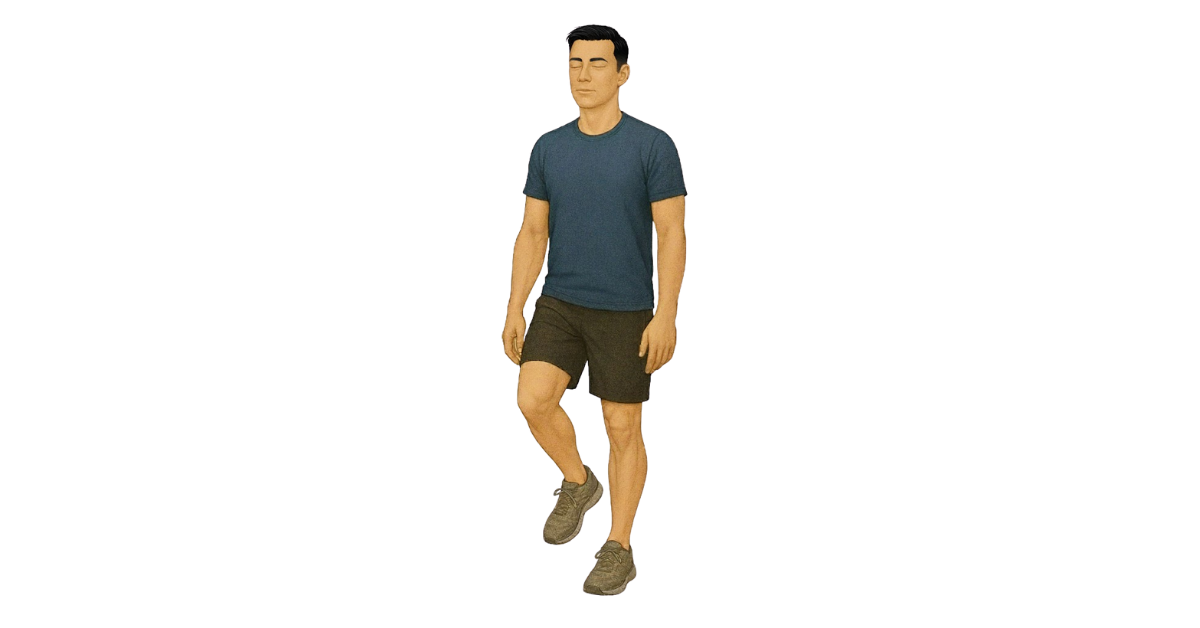
Painted by AI
If you’re between 40–60 and couldn’t, your balance — and by extension, your neuromuscular system — needs attention.
Why does this matter?
Because falls are a leading cause of disability and death in older adults. And balance is a key reflection of muscle functionality: how well your muscles respond to real-world, unscripted scenarios.
This one-leg balance test is actually a gold standard in geriatric medicine for assessing proprioception and fall risk 7.
Functionality is all about operational quality. It’s not just about how strong you are — it’s about how well your brain and muscles coordinate force.
🏋🏻 From Raw Strength to Neuromuscular Coordination
You might be able to press 100 kg on a machine, yet feel sore just lifting a suitcase. The difference isn’t in strength itself — it’s in neuromuscular coordination efficiency.
Every time you exert force, your nervous system sends electrical signals to your muscle fibers.
When you don’t train — or train in only one pattern — those signals slow down. That’s why reaction time declines with age, and why older adults are more prone to falls.
We need to reactivate the high‑speed circuits between the brain and muscle 8.
Your muscle’s “dynamic operating system” shows up in three key functions 9:
- Balance & Stability — making strength usable, controllable, and stable in real‑world situations.
- Neuromuscular Coordination — maintaining agility and reaction time as coordination declines.
- Rate of Force Development (RFD) — the ability to generate force instantly when you start to lose balance, taking that crucial step to prevent a fall or injury.
In daily life, strength is never used in isolation; it’s a seamless blend of all three. Take fall prevention as an example.
- Balance and core stability keep you steady — even on uneven or slippery ground.
- If you do stumble, neuromuscular coordination helps you react in time, and high RFD lets you “step out” before gravity wins.
If your “eyes‑closed single‑leg balance test” didn’t last 15 seconds, don’t worry. Targeted practice can significantly improve these functions in weeks. Try it daily while brushing your teeth — start with eyes open, then closed. After a month, most people see noticeable gains in control and balance.
Each of these three functional traits corresponds to a distinct type of muscle training 10:
- Balance & Stability → Functional Strength Training
- Rate of Force Development → High‑Velocity Resistance Training (HVRT)
- Neuromuscular Reaction → Plyometrics
Let’s look at them in detail.
🧩 Functional Strength Training
Functional strength training mirrors real‑world movement — pushing, pulling, twisting, rotating, balancing, and stabilizing. It teaches muscle groups to work together, not in isolation.
Typical moves include lunges, single‑leg deadlifts, Cable rotations, farmer’s walks, and BOSU balance trainings.
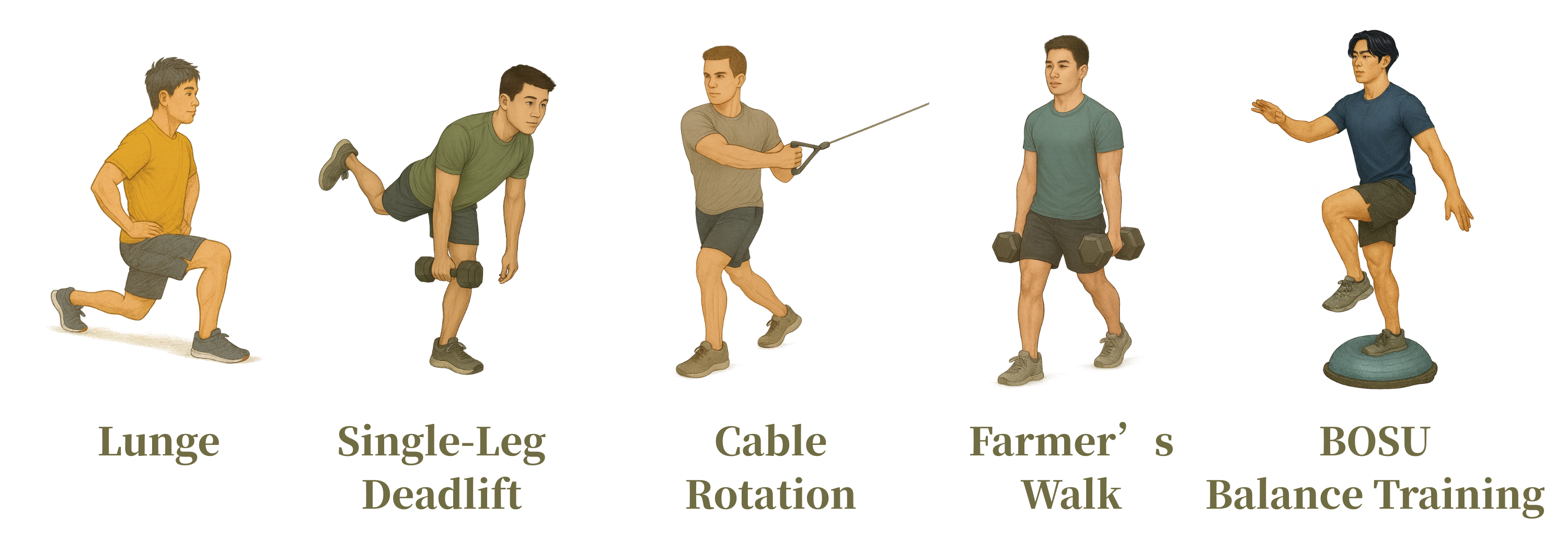
Painted by AI
Loads are usually moderate (around 60–70% of HRmax, or RPE 6–7/10), focusing on control and stability, emphasizing the “whole‑body chain” working as one.
The goal isn’t to chase a single strength maximum, but to move steady, flexibly, and pain‑free — in the real world.
⚡ High‑Velocity Resistance Training (HVRT)
Unlike conventional resistance training, HVRT uses moderate loads (about 40–60% of 1 RM) but emphasizes speed and explosive power. It builds not only muscle size, but also the quality of force production.
Representative movements include kettlebell swings, med ball slams, speed squats, and power rows.
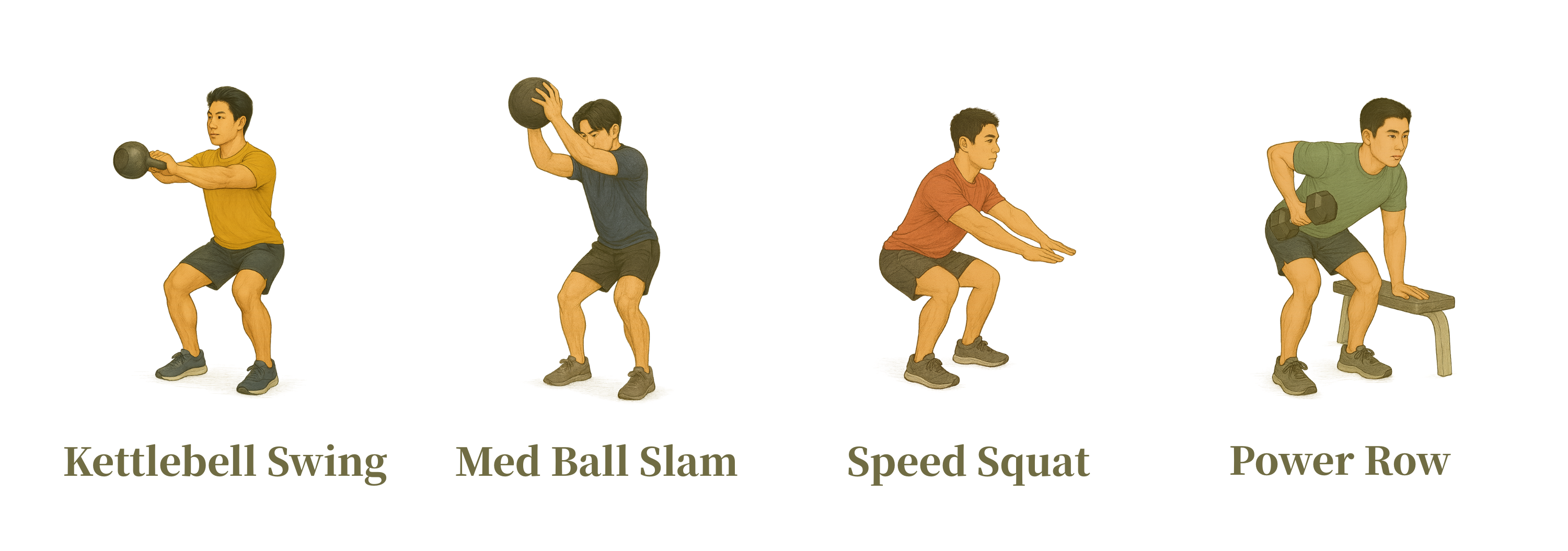
Painted by AI
Heart rate typically sits in the 70–85% HRmax range (RPE 7–8/10), hovering at the edge of HIIT intensity.
HVRT improves your rate of force development, fast‑twitch muscle activation, and bone density — an ideal trio for preventing falls, frailty, and aging‑related decline.
🌀 Plyometrics
Plyometrics teaches your body to be fast again.
It taps into the stretch–shortening cycle (SSC) — training muscles to store and release energy like springs during rapid stretch‑and‑contract phases.
Common examples: box jumps, step‑up jumps, bounding, clap push‑ups, and chest passes.
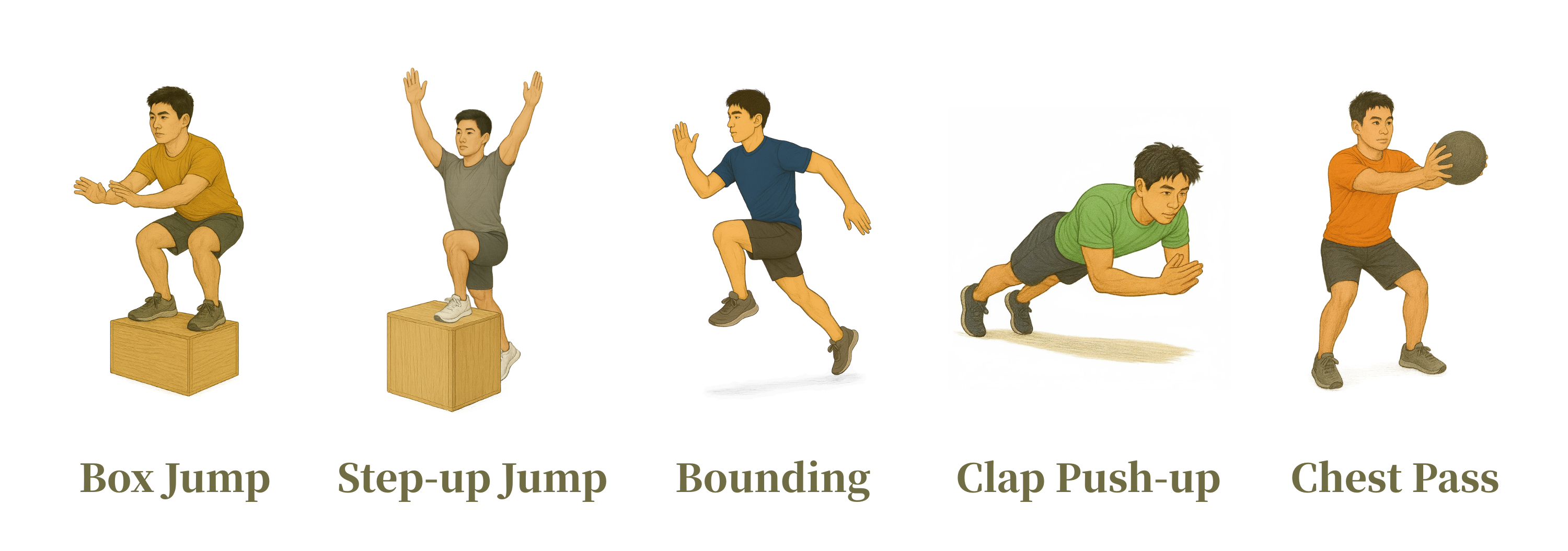
This type of training typically hits 80–90% HRmax (RPE 8–9/10), a high‑intensity, short‑duration power zone.
Its goal isn’t muscle volume, but reaction speed, agility, and stretch‑reflex sensitivity — helping you move “one step faster than gravity.”
While plyometrics may enter HIIT‑level heart‑rate zones, their purposes differ. HIIT targets the metabolic and cardiovascular systems — improving energy turnover and VO₂ Max through repeated high‑intensity intervals. Plyometrics targets the neuromuscular system — enhancing reaction and explosiveness through microbursts of elastic energy. In short: Plyo trains instant power; HIIT trains sustained power.
So think of it this way:
- Functional Strength Training is your movement‑calibration system — teaching muscles to generate force correctly.
- HVRT is your accelerator — building the ability to produce fast, clean power.
- Plyometrics is your reaction engine — training your nervous system to move quicker and smarter.
It’s worth noting that both HVRT and Plyometrics are excellent for bone density. They each create rapid‑loading stress through contraction and recoil.
Plyometrics, with its jump‑based impact, delivers the strongest mechanical signal for bone remodeling, particularly effective for the femur and tibia.
HVRT’s pull‑driven tension stresses bone through muscular traction, strengthening the spine and hips 11.
Together, these three modalities — Functional Strength, HVRT, and Plyometrics — teach your nerves, bones, muscles, and joints to work as one integrated system.
They retrain your body to handle the beautiful, chaotic complexity of real‑world movement.
A summary chart:
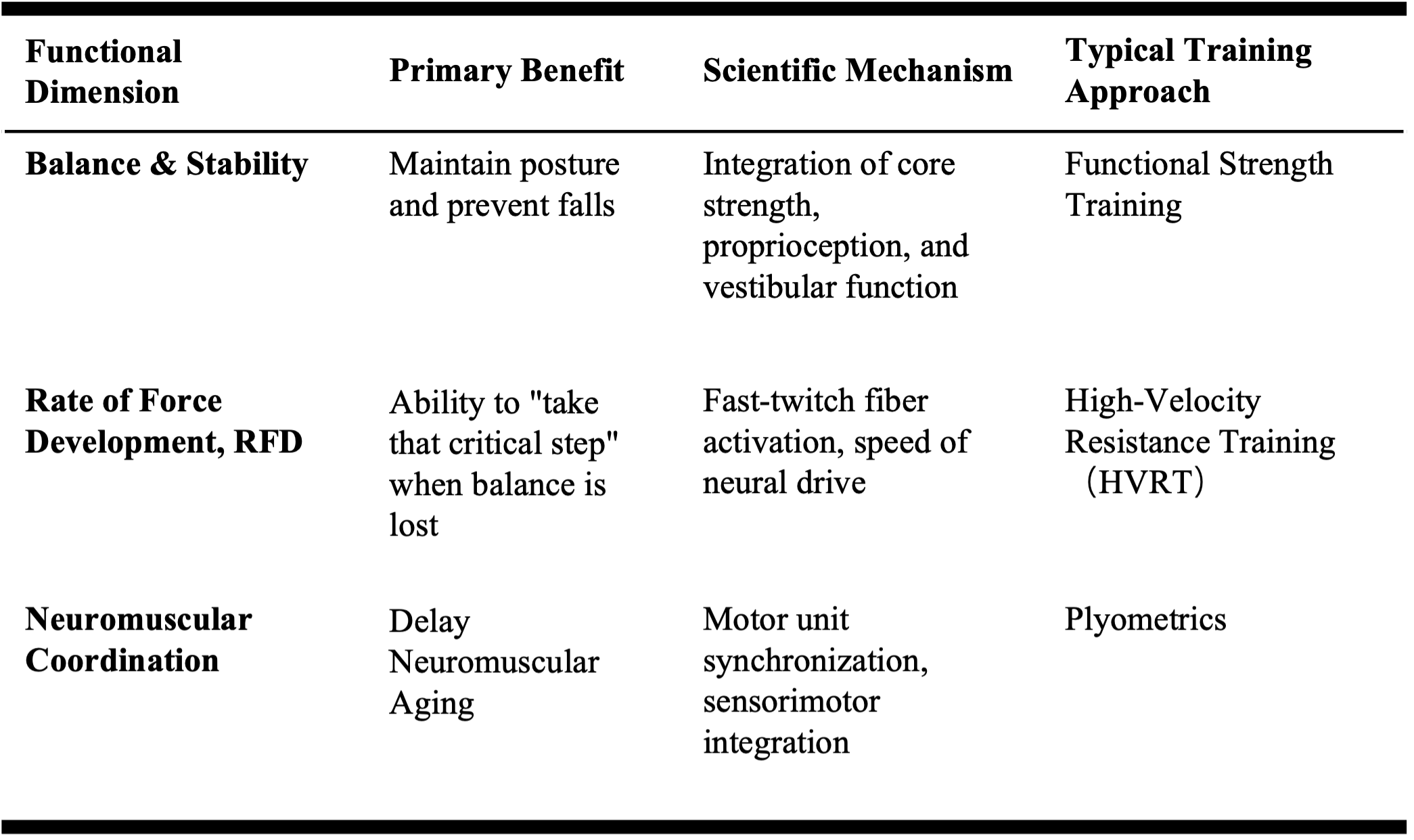
3. Symmetry: The Structural Balance System of Your Muscles
“Symmetry” may sound like an aesthetic concept, but it’s fundamentally structural.
Imbalance in the body is the quiet origin of most chronic strain and degeneration.
We often assume pain comes from what’s “damaged.” But on a structural level, pain often stems from misaligned force lines — the body’s internal mechanics falling out of sync.
The human body is pulled and supported by hundreds of interconnected muscle and fascia chains. When one area stays chronically tight and another remains weak, the transmission of force drifts off its intended path.
Think of it this way:
- Hours at the computer → tight chest, weak back → rounded shoulders and slouching posture.
- Long periods of sitting → tight hip flexors, inhibited glutes → anterior pelvic tilt and lumbar compression.
- Running with poor mechanics → overactive quads, tight calves → knee valgus and patellar pain.
- Even a “healthy” activity can create imbalance if practiced exclusively — overworking certain muscles while underusing others.
What looks like a “posture issue” is often an energy distribution imbalance within the body’s structural system. Over time, this leads to uneven joint loading, compensatory movement patterns, and eventually, wear and injury.
⚖️ Rebuilding Symmetry: Two Core Approaches
1️⃣ Stretching and Myofascial Release
Muscles are not isolated units; fascia connects them into a web of tension.
Dynamic stretching, foam rolling, and fascial release restore tissue glide and elasticity — allowing force to travel smoothly through the body.
For example, during breaks from desk work, I often perform what many coaches call “the world’s greatest stretch” — it opens up the hips, chest, and shoulders all at once.
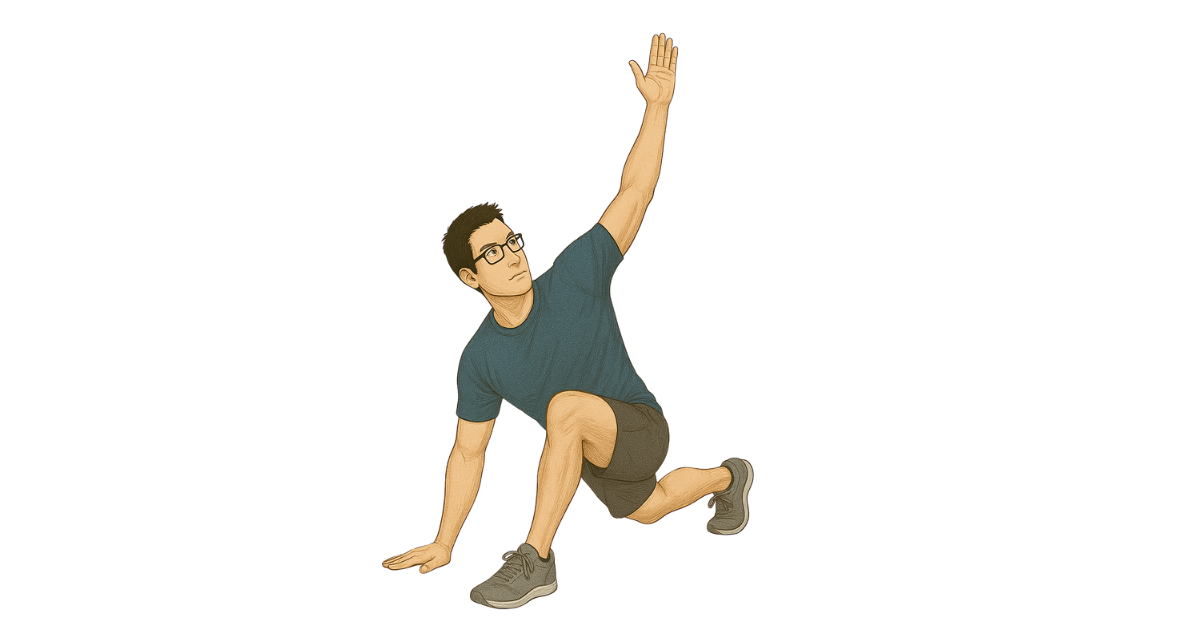
The World’s Greatest Stretch (Painted by AI)
After a run, I use a foam roller to release the tensor fasciae latae (TFL) and iliotibial band (IT band), which helps prevent runner’s knee.
2️⃣ Postural and Gait Correction
Due to modern habits — hours of sitting and leaning forward — most people develop tight anterior chains and weak posterior chains.
The fix lies in postural awareness combined with low‑intensity corrective training that gradually re‑educates muscle balance.
This is the key to making the body “sustainably usable.”
Over time, it can:
- Reduce chronic pain and overuse injuries
- Optimize joint loading
- Slow degenerative changes (in the spine, knees, shoulders)
- Preserve lifelong movement capacity and graceful posture
Ideally, these adjustments should be guided by a professional physiotherapist or movement specialist who understands your body.
They can help you manage acute pain when it arises, and more importantly, identify asymmetries before they turn into injuries — through targeted rehabilitation, postural tuning, and gait correction 12.
Recommended Training Balance: Three Sessions a Week for Three‑Dimensional Gains
You don’t need to dissect your training plan into endless details — or live in the gym.
A simple, sustainable structure works best:
👉 Three resistance/strength sessions per week (every other day). Use the remaining days for aerobic work — Zone 2, HIIT, or sports.
Within each session, blend all three dimensions: Volume + Functionality + Symmetry.
Each workout lasts about 60–75 minutes, roughly divided as follows:
- 50% — Volume: classic resistance training for muscle mass
- 35% — Functionality: movement, speed, and coordination work
- 15% — Symmetry: dynamic stretching, core stability, foam rolling, and balance training
Every 2–4 weeks, check in with a rehab or movement therapist familiar with your body for fine‑tuning or manual adjustments. If you feel pain or discomfort, consult immediately.
Once a month, review and adjust your training load, reps, or exercise selection.
Summary: The Three‑Dimensional Coordinate System of Muscle Training
Muscle training has never been a single‑threaded “iron‑pumping” routine — it’s a three‑dimensional architecture of adaptation and sustainability.
- Volume — the foundation of energy and metabolism, your reserve fund for glucose control, disease prevention, and longevity.
- Functionality — the ability to move that strength with agility and intelligence in the real world.
- Symmetry — the structure that keeps force aligned, preventing degeneration, strain, and pain.
These three dimensions are interwoven and mutually reinforcing.
Without Volume, there’s no metabolic or strength base. Without Functionality, strength remains rigid and clumsy. Without Symmetry, even the strongest muscles will go off track — and eventually break down.
Muscle is infrastructure. Training it isn’t just about aesthetics or performance — it’s about constructing a sustainably engineered human system that can carry you through a long, powerful, and pain‑free life.
Intervention recommendations are geared toward generally healthy individuals. If you have existing health conditions, always follow your doctor’s instructions.
References
[1]Haines, M. S., et al. “Association between muscle mass and insulin sensitivity: implications for metabolic health.” Journal of Clinical Endocrinology & Metabolism, vol. , 2020.
[2]Currier BS, et al. Resistance training prescription for muscle strength and hypertrophy in healthy adults: a systematic review and Bayesian network meta-analysis. Br J Sports Med. 2023 Sep;57(18):1211–1220.
[3]Morton, R. W., et al. “A systematic review, meta-analysis and meta-regression of protein supplementation on resistance training–induced gains in muscle mass and strength.” British Journal of Sports Medicine, 2018
[4]Slater, G. J., and Phillips, S. M. “Is an Energy Surplus Required to Maximize Skeletal Muscle Hypertrophy Associated with Resistance Training?” Nutrition & Metabolism, 2019.
[5]Schoenfeld, B. J., et al. “Effects of Resistance Training Frequency on Measures of Muscle Hypertrophy: A Systematic Review and Meta-Analysis.” Sports Medicine, 2016.
[6]Han, J., et al. “Assessing proprioception: A critical review of methods.” Journal of Sport and Health Science, 2015.
[7]Blodgett, J. M., et al. “One-legged balance performance and fall risk in mid- to older-aged adults.” BMC Geriatrics, 2022.
[8]Guizelini, P. C., et al. “Effect of resistance training on muscle strength and rate of force development in older adults: A systematic review and meta-analysis.” Ageing Research Reviews / Applied Physiology, 2018.
[9]Gollie JM, Harris-Love MO, Patel SS, Shara NM, Blackman MR. Rate of Force Development Is Related to Maximal Force and Sit-to-Stand Performance in Men With Stages 3b and 4 Chronic Kidney Disease. Front Rehabil Sci. 2021 Sep 28;2:734705.
[10]Ramirez-Campillo, R., et al. “Effects of Plyometric Training on Physical Performance: An Updated Systematic Review and Meta-analysis.” Sports Medicine-Open, 2023
[11]Grgic J, Schoenfeld BJ, Mikulic P. Effects of plyometric vs. resistance training on skeletal muscle hypertrophy: A review. J Sport Health Sci. 2021 Sep;10(5):530–536.
[12]Labanca, L., et al. “Balance and proprioception impairment, assessment tools, and rehabilitation training after total hip arthroplasty: a review.” Journal of Clinical Medicine, 2021.
[13]AI Research