Picking up from where we left off, today let’s explore a form of exercise that may look gentle on the surface but could very well be the most intimate and enduring practice for nurturing your relationship with mitochondria:
— Zone 2 aerobic training.
It’s not a high-intensity workout that leaves your muscles trembling, nor is it the kind of marathon conquest that dominates your Instagram feed. But it is quiet, efficient, kind, and long-lasting — arguably one of the best-kept secrets in the longevity game.
What Is Zone 2?
In exercise physiology, training intensity is generally divided into five heart rate zones (Zone 1 to Zone 5):
- Zone 1 (<60% HRmax): This is the “leisure walk” zone — you’re moving, but just barely. It’s beneficial for health, but doesn’t count as real training.
- Zone 2 (60–70% HRmax): Light to moderate aerobic intensity. The simplest way to identify it? You can still talk, but you can’t sing.
- Zone 3–4 (70–90% HRmax): Moderate to high intensity. Lactate begins to accumulate, heart rate spikes, breathing becomes labored.
- Zone 5 (90–100% HRmax): All-out sprints. This is your classic HIIT zone, powered mainly by glucose.
Using HRmax (maximum heart rate) is a convenient, though approximate, way to determine your Zone 2 range. More accurate methods would factor in heart rate reserve (HRR) or lactate threshold.
The most commonly used formula for estimating HRmax is:
HRmax ≈ 220 − your age (in bpm)
So for someone who’s 40 years old, their estimated HRmax would be 180 bpm. That means their Zone 2 range is roughly 108–126 bpm.
Here are a few other terms you might come across:
- HRR (Heart Rate Reserve): HRmax minus resting heart rate. Zone 2 is often defined as 40–59% of HRR1.
- MICT (Moderate-Intensity Continuous Training): A more technical name for what is essentially Zone 22.
- LT1 / VT1: The first lactate and ventilatory thresholds, respectively. These represent the point at which blood lactate and breathing patterns start to change — and they often mark the upper edge of Zone 2 (typically when blood lactate < 2 mmol/L). Recent studies suggest that LT1/VT1 are the most accurate way to individually calibrate Zone 2 intensity3.
If that all feels a bit much, don’t worry — here’s the rule of thumb to remember:
Zone 2 is when you can still talk, but you can’t sing.
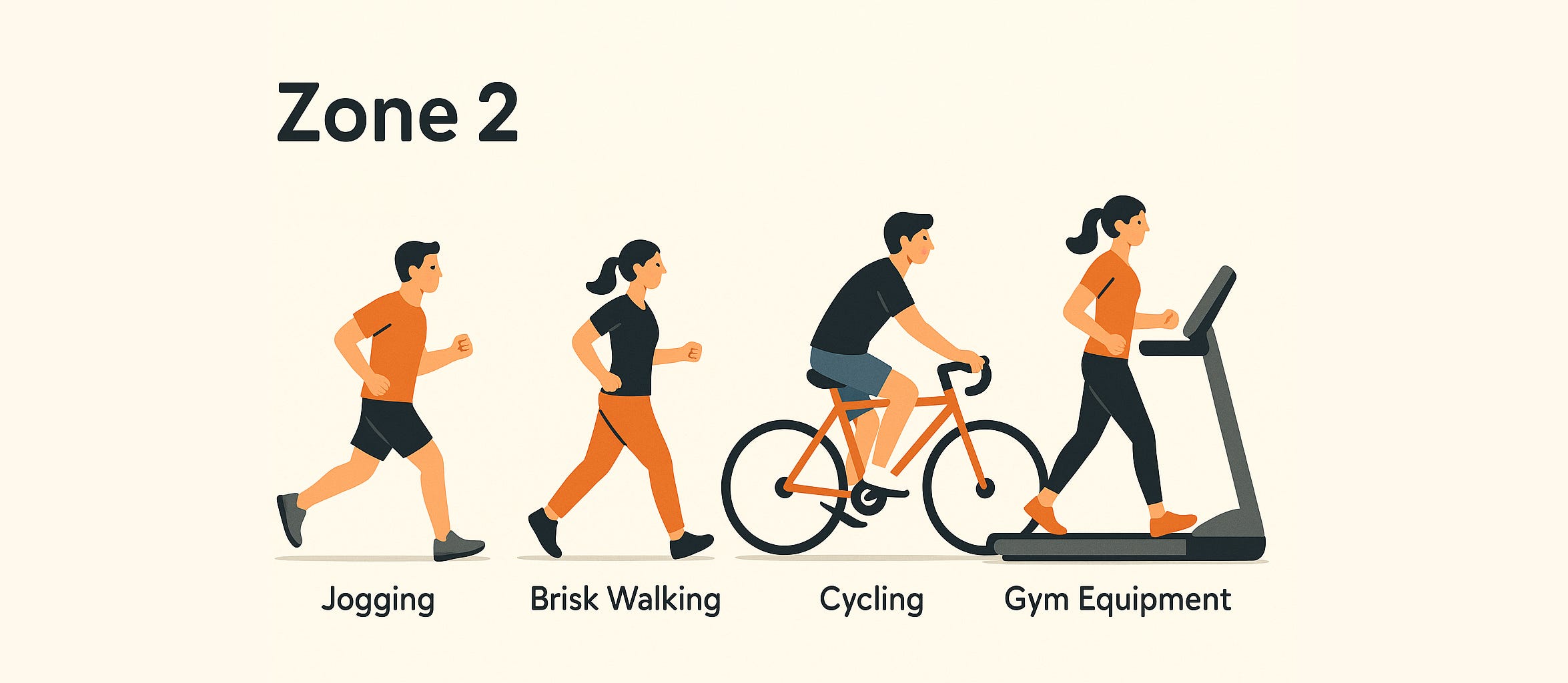
Personally, that puts my Zone 2 range at 107–130 bpm. I can get there by jogging slowly, power walking, cycling, or using gym machines like ellipticals, treadmills, or rowers — if the rhythm is right, they all work beautifully for Zone 2.
Painted by AI
Why Is Zone 2 So Powerful?
1️⃣ It’s Where Your Mitochondria Thrive — and Where FatMax Lives
FatMax — the point at which your body burns fat at the highest rate — typically falls within the Zone 2 range.
FatMax refers to the specific intensity that pushes your body’s maximum fat oxidation rate (MFO). MFO is measured in grams of fat burned per minute. FatMax, then, is the peak of that curve — the most efficient fat-burning intensity.
Why is that so important[5–8]?
- Because fat can only be oxidized inside mitochondria. Unlike glucose, which can be metabolized in the cytoplasm, fat has no shortcut. Your mitochondria have to do all the work.
- And FatMax intensity is where your mitochondria can’t slack off — they’re forced into high gear, using fat as the primary fuel.
This relationship between intensity and fat oxidation forms a parabolic curve: As exercise intensity rises from rest to moderate levels, fat oxidation increases. But beyond a certain point, the body starts relying more on carbohydrates for energy — and fat oxidation actually declines4.
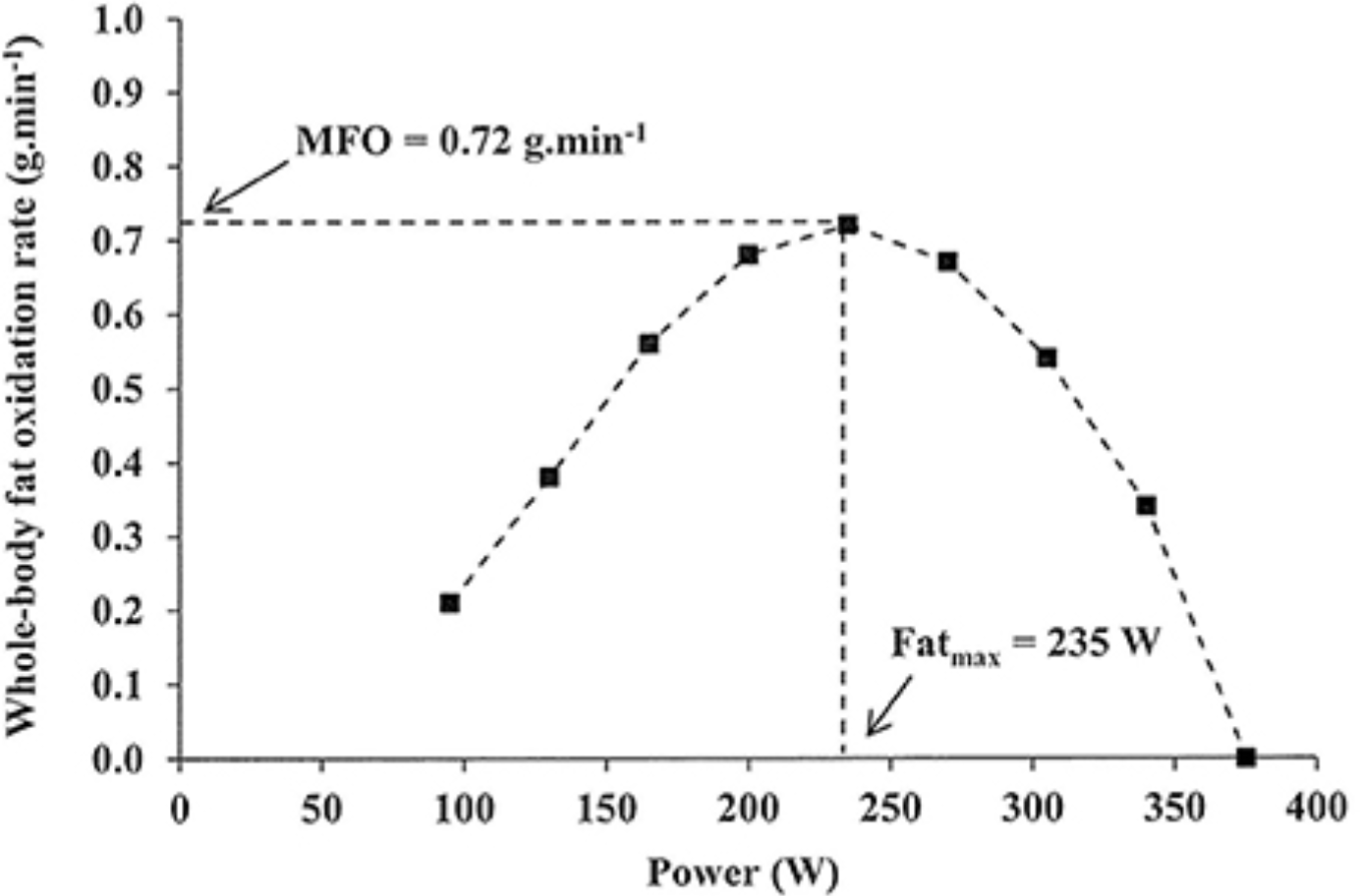
Graph showing fat oxidation in graded cycling test after overnight fast
- Zone 2 creates a “clean metabolic environment”: It sits below the lactate threshold. There’s no lactate overload, so mitochondria can work undisturbed.
- Several key longevity pathways are activated at once: PGC-1α (mitochondrial biogenesis)、AMPK (energy sensing)、VEGF (capillary formation)are all upregulated — leading to increased mitochondrial quantity, enhanced function, and greater vascular density.
Walk too slow, and your mitochondria slack off. Run too fast, and the body switches to glycolysis, lactate spikes, and you’re no longer training mitochondria.
The healthier your mitochondria, the more fat you can burn — and the more efficiently you do it.
2️⃣ It Trains the Type I Muscle Fibers with the Most Mitochondria
At Zone 2 intensity, the work is done mainly by Type I slow-twitch muscle fibers 9— the very ones that are naturally rich in mitochondria and excel at slow, steady, endurance-based effort.
These fibers preferentially shuttle fatty acids into mitochondria for β-oxidation, producing a constant stream of energy.
If the intensity climbs too high, you start recruiting more Type II fast-twitch fibers, especially Type IIx, which have lower mitochondrial density. These fibers rely more on anaerobic glycolysis, which generates more lactate10,11 and burns less fat.
People with poor mitochondrial function often hit their lactate threshold at relatively low intensity. That means their bodies default to anaerobic glycolysis too early — producing ATP quickly, but inefficiently (only 2 ATP per glucose, compared to 30–32 via aerobic metabolism), and creating excess lactate in the process.
That’s why Zone 2 doesn’t just burn fat — it also trains the exact muscle fibers richest in mitochondria, reinforcing your body’s fat-burning capacity at its root.

Painted by AI
3️⃣ Zone 2: A Gentle Coach for Metabolic Flexibility
Metabolic flexibility14 is your body’s ability to smoothly switch between its two primary fuel sources — glucose and fatty acids — depending on the context.
- After a meal? You should be able to clear glucose efficiently and stabilize your blood sugar.
- Fasting? Your body should tap into fat reserves without triggering a crisis.
- Exercising? You should transition smoothly between energy systems — without crashing.
Elite endurance athletes like Jared Tallent — the 2012 Olympic gold medalist in the 50km race walk — can still rely on fat as their primary energy source even when working at extremely high outputs. That’s metabolic flexibility in action.
On the flip side, people with poor metabolic flexibility — think sedentary office workers or those with insulin resistance — have to rely on glucose almost immediately, even during low-intensity activity. Their bodies hit the lactate threshold too early, despite carrying plenty of fat that simply can’t be accessed. This creates a vicious cycle15,16.
What follows is metabolic rigidity: surging blood sugar, insulin resistance, fat accumulation, chronic inflammation — and a fast track toward type 2 diabetes and cardiovascular disease17.
Zone 2, with its mitochondria-centered training effect, becomes the ideal playground to restore metabolic flexibility. In this zone, your mitochondria are retrained to remember how to burn fat, and your muscles re-learn to rely on fatty acids rather than defaulting to glucose. Over time, this rebuilds your body’s capacity to adapt to different fuel environments — handling post-meal glucose with ease, while staying energetic and fat-fueled during fasting states.
Put simply, Zone 2 is a metabolic reset button, driven by its sustained and targeted activation of your mitochondrial system.
4️⃣ In Zone 2, Volume Is the Secret Weapon
Many types of exercise can give your mitochondria a temporary jolt. But to truly increase the number and quality of mitochondria, you need a long-game mindset.
What makes Zone 2 so precious isn’t that it’s intense — it’s that you can do more of it.
- It’s safe and sustainable.
- Doesn’t eat away at your muscle mass.
- Recovery is fast, making it ideal for daily training.
- Low barrier to entry — you can start with a brisk walk.
If you’ve ever seen those “150–300 minutes of aerobic exercise per week” guidelines and felt overwhelmed, Zone 2 is your way in. Because with Zone 2, the volume feels manageable — and the rewards, disproportionate.
Imagine this: You’re 80 years old. Sprint intervals and HIIT might be too much. But a brisk 30-minute Zone 2 walk each morning? That’s still on the table. It keeps your metabolism humming, your blood sugar stable, and frailty at bay.
Zone 2 is the green potion you picked up as a beginner in the Longevity Game — only to find out it’s your endgame weapon, too.
An easy start, and a life-long companion.
The One Drawback: It Doesn’t Feel Like Exercise
The first time I tried a Zone 2 jog, my honest reaction was:
Wait… this is it? This slow?!
I’m used to running at a 6–7 min/km pace, with my heart rate soaring past 150 bpm. But to stay within my Zone 2 range (107–130 bpm), I had to drop to a 9 or even 10 min/km pace. It felt almost embarrassing — like I was only taking a walk, and being overtaken by retirees out for a stroll.
Worse still, it’s hard to stay “in the zone.” One moment you’re too fast and your heart rate spikes — so you stop and walk. Then it drops, and you jog again. That stop-and-go rhythm feels a bit lazy at first.
But the data doesn’t lie: this is exactly what Zone 2 should look like.
In his book Outlive, Peter Attia defines Zone 2 as 70–85% of HRmax, which for me is about 125–151 bpm. I trained at that level for a long time, but it was tough — and hard to sustain consistently. After reading more deeply, I found that the mainstream consensus places Zone 2 at 60–70% of HRmax, and that most mitochondrial research supports this lower range.
Attia may be using lactate threshold as a more individualized benchmark, which might explain the difference. But for most people, the 60–70% HRmax range is far more practical and sustainable — and that’s what matters most when you’re trying to build a habit.
In fact, it was at this gentler pace that I ran for over an hour for the first time in my life.
No elaborate plan. No warm-up. Just keeping my heart rate in the Zone 2 range. If it crept too high, I walked. When it settled, I ran again. With music in my ears and the scenery drifting by, I ended up running a full loop around Chaoyang Park in Beijing — plus some — and broke a satisfying sweat.
Compared to the “near-death experience” of high-intensity training, Zone 2’s comfort and low barrier to entry is what makes it sustainable — the key to forming a lifelong habit.
I even started doing “City Runs” on business trips — Zone 2-style.
Beijing’s Olympic Forest Park, Shanghai’s Suzhou Creek, Hangzhou’s West Lake Causeways, the riverside trails of Chongqing, Xuanwu Lake in Nanjing, the quiet shores of Aranya in Qinhuangdao…One hour. 6–7 kilometers. Not fast — but just enough to “slow-tour” a beautiful corner of each city.
And I love pulling my non-exercising friends in for a Zone 2 jog. We chat, we sweat a little, and for those who’ve fallen out of the fitness habit, it’s one of the easiest ways to get back in.

Painted by AI
In Summary
Zone 2 cardio is the quiet MVP in the Prime Life playbook.
It won’t win you a medal. It won’t get you shredded.
But it will quietly strengthen your mitochondria, boost your metabolic flexibility, improve insulin sensitivity, reduce fat, calm inflammation, and stabilize blood sugar — all in one go.
If Prime Life were a film, Zone 2 wouldn’t be the lead actor. It’s the background score — never flashy, never loud — but essential to setting the tone of the entire story.
Next time, don’t stress about whether you’re running “fast enough.” Try Zone 2: you can hold a conversation, breathe a little heavier, alternate between walking and jogging — no strain, no pain.
Before you even realize it, Zone 2 will have quietly re-written your metabolic curve and shifted your health trajectory.
Because the goal of life isn’t to burn out in a blaze.
It’s to glow — quietly, steadily — for as long as you can.
Intervention recommendations are geared toward generally healthy individuals. If you have existing health conditions, always follow your doctor’s instructions.
References19
[1]American College of Sports Medicine. “Exercising Your Way to Lowering Your Blood Pressure.” ACSM, 2025.
[2]Williams, C. J., et al. “A Multi-Center Comparison of O₂peak Trainability….” Frontiers in Physiology, 2019.
[3]Sitko, Sebastian et al. “What Is “Zone 2 Training”?: Experts’ Viewpoint on Definition, Training Methods, and Expected Adaptations.” International journal of sports physiology and performance, 1–4. 26 Feb. 2025
[4]Achten, Juul, and Asker E. Jeukendrup. “Maximal Fat Oxidation during Exercise in Trained Men.” International Journal of Sports Medicine, vol. 24, no. 8, 2003, pp. 603–608.
[5]Houten, Sander M., et al. “The Biochemistry and Physiology of Mitochondrial Fatty Acid β-Oxidation and Its Genetic Disorders.” Annual Review of Physiology, vol. 78, 2016, pp. 23–44.
[6]Maunder, Ed, et al. “Contextualising Maximal Fat Oxidation During Exercise: Determinants and Normative Values.” Frontiers in Physiology, vol. 9, 2018, article 599.
[7]Venables, Michelle C., Juul Achten, and Asker E. Jeukendrup. “Determinants of Fat Oxidation During Exercise in Healthy Men and Women: A Cross-Sectional Study.” Journal of Applied Physiology, vol. 98, no. 1, 2005, pp. 160–167.
[8]Amaro-Gahete, Francisco J., et al. “Optimizing Maximal Fat Oxidation Assessment by a Cumulative Workload Protocol.” Journal of Sports Science & Medicine, vol. 18, no. 4, 2019, pp. 769–776.
[9]Bawa, P. N. S. “Assessment of Size Ordered Recruitment.” Canadian Journal of Neurological Sciences, 2014.;Seiler, Stephen. “It’s about the Long Game, Not Epic Workouts.” Sports Medicine, 2024.
[10]Schiaffino, Stefano, and Carlo Reggiani. “Fiber Types in Mammalian Skeletal Muscles.” Physiological Reviews, vol. 91, no. 4, 2011, pp. 1447–1531.
[11]Brooks, George A. “The Science and Translation of Lactate Shuttle Theory.” Cell Metabolism, 2018
[12]Chaudhry, Rida, and Richard T. Ellison. “Biochemistry, Glycolysis.” StatPearls, 2023.
[13]Hinkle, Peter C. “P/O Ratios of Mitochondrial Oxidative Phosphorylation.” Biochimica et Biophysica Acta, 2005.
[14]Goodpaster, Bret H., and Lauren M. Sparks. “Metabolic Flexibility in Health and Disease.” Cell Metabolism, 2017.
[15]Burke, Louise M., et al. “Low-Carbohydrate, High-Fat Diet Impairs Exercise Economy and Negates Performance Benefits of Training in Elite Race Walkers.” The Journal of Physiology, 2017.
[16]Burke, Louise M. “Ketogenic Low-CHO, High-Fat Diet: The Future of Elite Endurance Sport?” The Journal of Physiology, 2021.
[17]San-Millán, Iñigo, and Lauren M. Sparks, et al. “Assessment of Metabolic Flexibility …” Sports Medicine, 2018.
[18]Attia, Peter, and Bill Gifford. Outlive: The Science and Art of Longevity. First edition, Harmony, 2023.
[19]AI Research