Zone 2 aerobic training is one of the most highly recommended practices in Prime Lab. It’s not just a longevity booster — it directly improves aging biomarkers. And thanks to its low risk and low strain, it’s a form of training you can do for life.
Even better, it’s endlessly adaptable. Whether it’s waking up your brain in the morning, managing post-meal blood sugar, or active recovery after resistance training — Zone 2 has a place.
Building on our previous article, this piece dives into how to practice Zone 2 effectively.
A Quick Recap: What is Zone 2?
If you missed the earlier explanation, here’s a quick refresher.
Zone 2 is a heart rate zone typically defined as:
- 60–70% of your max heart rate (HRmax) or
- 40–59% of your heart rate reserve (HRR)
- RPE (Rate of Perceived Exertion) ~10–12/20
- Just below the first lactate (LT1) or ventilatory threshold (VT1)
How it feels: You can speak in full sentences, but not sing. Slightly out of breath, but not gasping.
Physiological benefits:
- It sits at or near FatMax, prioritizing fat as a fuel source
- Boosts mitochondrial function and biogenesis
- Improves insulin sensitivity
- Enhances metabolic flexibility
- Helps regulate blood sugar and strengthens cardiovascular endurance
In short: it’s like a slow, steady metabolic recharge. Gentle, but deeply restorative.
1. When Should You Train? — Any Time Works, Each With Unique Benefits
The best time to train is the time you can consistently show up.
That said, different time slots offer different “bonus effects”:
✅ Fasted Morning Session: Kickstart Fat Burning
Zone 2 in the morning (fasted) is one of the most effective and gentle ways to activate the body.
Why it works:
- Lower glycogen levels = faster fat metabolism entry
- Heart rate is naturally lower = easier to stay in Zone 2
- Morning light exposure helps reset circadian hormones (melatonin and cortisol)
- Much gentler than HIIT — easy to stick with long term
Tip: Zone 2 while fasted typically does not cause hypoglycemia. But if you’re sensitive, start with 20–30 minutes and bring water + electrolytes just in case.
✅ 30–60 Minutes After Meals: The Blood Sugar Sweet Spot
Blood sugar typically spikes 15–30 minutes post-meal and peaks around 45–60 minutes. That’s your golden window: you’ve digested enough to avoid stomach discomfort, and it’s just in time to blunt the glucose spike.
Why it works:
- Flattens post-meal glucose and insulin spikes
- Boosts insulin sensitivity = less fat storage
- Still trains mitochondria effectively
Tip: If running upsets your stomach post-meal, opt for walking, cycling, or the elliptical.
2. How Long Per Session? — 10 Minutes Helps, 30+ Minutes Shines
Here’s what the research and experience say:
- 10′: Good for post-meal glucose control and breaking sedentary time. Not enough for deep mitochondrial benefit.
- <20–30′: Effective for beginners or quick post-meal sessions.
- 30–60′: The metabolic sweet spot — strong fat oxidation and mitochondrial signaling (e.g., PGC-1α, AMPK).
- 60–90′: Deeper adaptations, builds your “mitochondrial base.” Consider one “Base Day” per week.
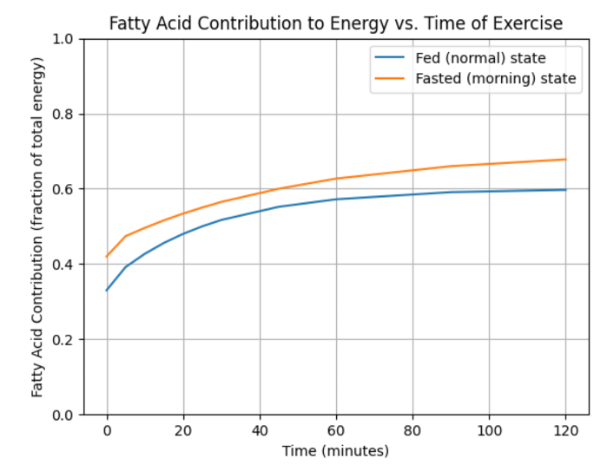
The chart below illustrates how Zone 2 training increases fat utilization under different conditions2,3,4:
Fed normal state (e.g., after a typical breakfast): Fat contributes about 35% of energy at the start, climbs quickly to around 50% within 20–30 minutes, and gradually rises to nearly 60% by 90–120 minutes.
Fasted morning state: Fat contribution starts at around 40%, increases rapidly to about 55% in 20–30 minutes, and continues to rise slowly to nearly 70% over 90–120 minutes.
The takeaway? 30–60 minutes is the golden window for maximizing mitochondrial fat utilization.
3. How Often Per Week? — Start at 90 Minutes, Aim for 300
- Minimum effective dose: 60–90′/week → Noticeable improvements in mood, sleep, post-meal glucose5,6
- Recommended dose: 150–300′/week → Maximal drop in all-cause mortality7,8,9
- Higher dose: 300–600′/week → Still beneficial, but diminishing returns8,9
Potential downsides:
Going well beyond 600′/week, especially with poor recovery or high-intensity load, may backfire — immune suppression, fatigue, injury risk. This is the “J-shaped curve.”10,11
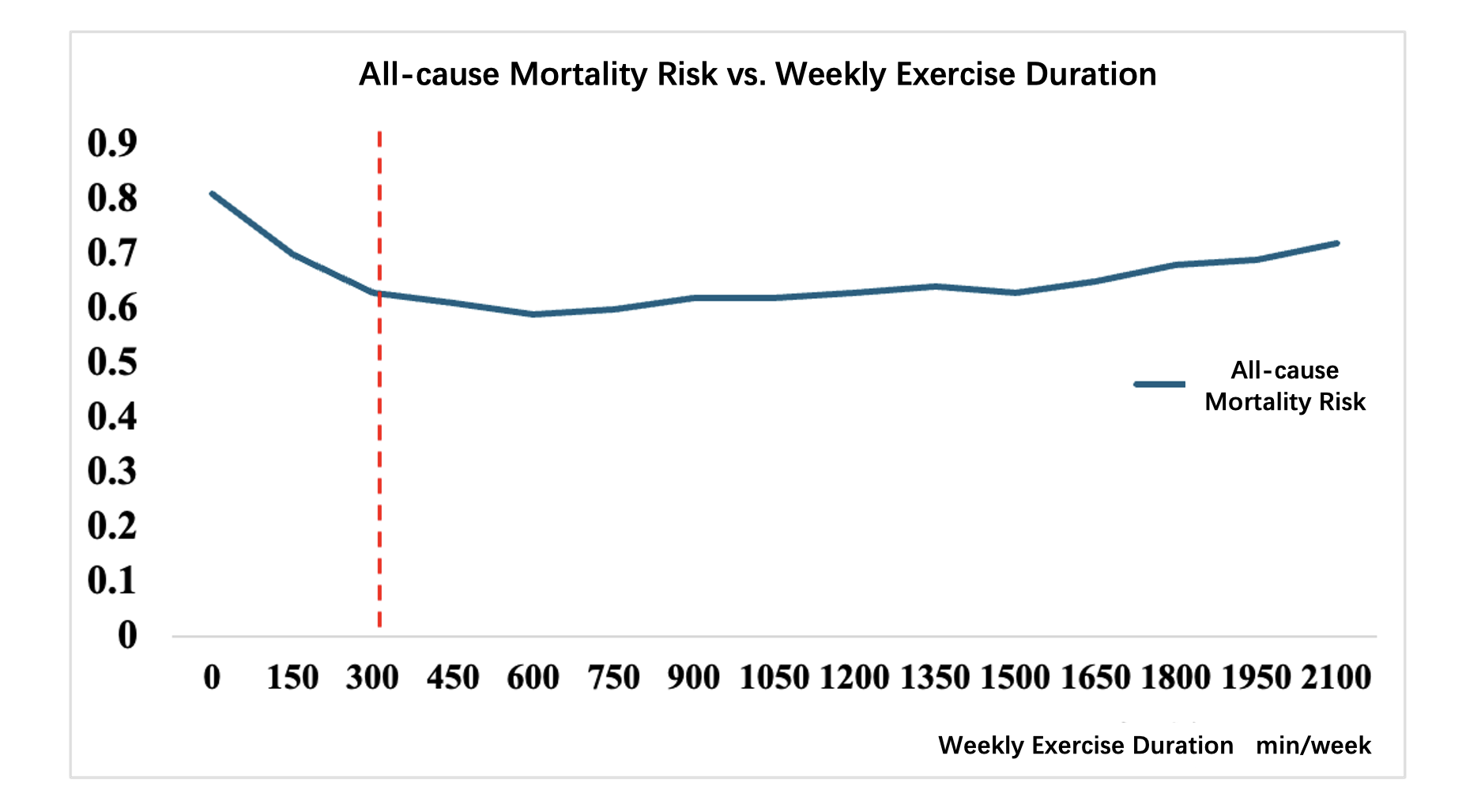
The figure shows that mortality reduction peaks around 300 min/week of moderate-intensity exercise, with diminishing returns beyond.
🏃🏻♀️ Zone 2 Makes You Stronger — Even at Lower Heart Rates
Below our last article, one reader commented: “I’ve been doing Zone 2 runs, and after a while, my pace improved. Now I can run 6–7 min/km within Zone 2 heart rate.”
That’s one of Zone 2’s secret gifts: it upgrades your body behind the scenes.
First comes a full-system upgrade of your mitochondria. Long-term Zone 2 training increases both the number and function of mitochondria, enabling your body to mobilize fat more efficiently, produce more energy, and convert it more steadily — all at the same heart rate.4 Over time, Zone 2 also stimulates the formation of new capillaries, enhancing the delivery of oxygen and metabolic substrates13,14. It trains the heart to handle greater venous return, boosting stroke volume with each beat15.
The net result? Same heart rate, but more power, more stable oxygen delivery, and less metabolic strain. You’re not “pushing harder” — but your body is quietly leveling up. That same 130 bpm used to give you an 8-min/km pace; now you’re cruising at 6-min/km, and still chatting with ease.
4. Choose the Right Modality for You
Zone 2 isn’t a specific sport — it’s a metabolic state.
If you’re new to exercise, brisk walking may already place you in Zone 2. As your fitness improves, you might level up to uphill walks, jog-walk combos, jogging, swimming, or stair climbing.
Choose the one that’s easy to stick with.
Common options:
- Jog/walk combos: Easy to start. Very popular.
- Cycling: Steady heart rate, joint-friendly.
- Elliptical/rower: Full-body, low-impact. (Rowing requires more technique.)
- Stair climbing: Easily spikes heart rate into Zone 3 — slow down deliberately.
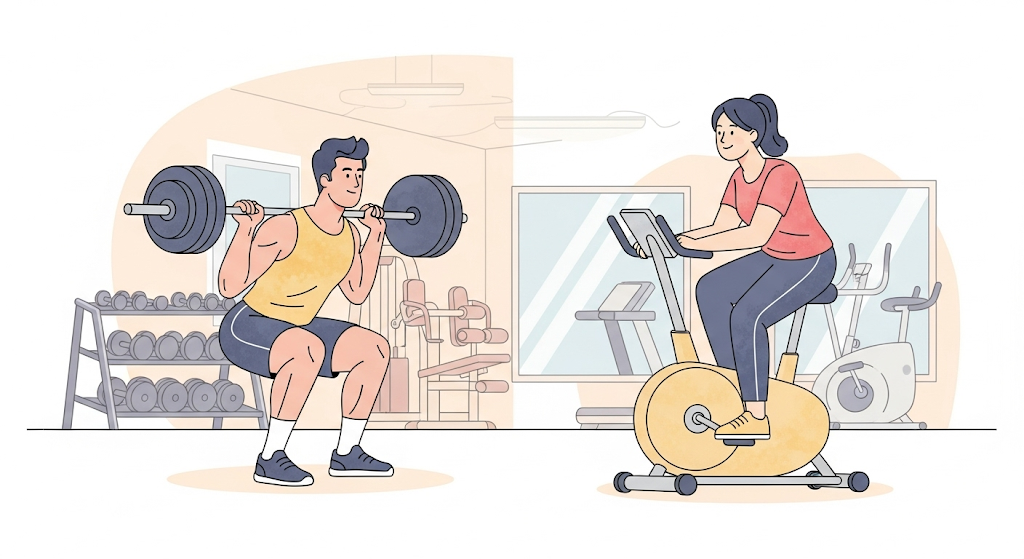
🚫 Can resistance training replace Zone 2?
No.
Even if your heart rate hits Zone 2 during resistance training, the metabolic environment is anaerobic and intermittent — not conducive to mitochondrial adaptation.
✅ But can you do Zone 2 after resistance training?
From a health and longevity perspective, it’s a smart move: performing 20–30 minutes of Zone 2 aerobic training after resistance workouts can significantly aid recovery. It helps utilize lactate as an energy substrate, improves blood circulation, and indirectly accelerates the clearance of metabolic byproducts — such as ammonia.
Research suggests that engaging in long-duration or high-intensity aerobic training (like HIIT or sustained moderate-to-high intensity cardio) after resistance training may blunt the muscle protein synthesis signals activated by lifting — specifically through the mTOR pathway. In contrast, Zone 2’s gentle intensity and low metabolic load mean that, when kept within a 20–30 minute window, it typically does not interfere with muscle growth[16–18].
Painted by AI
5. How Do I Know I’m in Zone 2?
This is about developing “heart rate intuition” — linking subjective perception to objective data.
Subjective tools:
- Talk test: You can talk comfortably, but not sing
- RPE score: The RPE (Rate of Perceived Exertion) score ranges from 6 — representing complete rest, roughly equivalent to a heart rate of 60 bpm — to 20, which reflects maximum effort: extremely uncomfortable and exhausting. Zone 2 typically feels like an RPE of 11–12 — a relatively light and sustainable level of exertion19,20.
Objective tools:
- Wearables: Calculate your personal Zone 2 heart rate range in advance (60–70% of HRmax or 40–59% of HRR — for example, mine falls between 105–130 bpm), and during training, regularly monitor it to align your objective heart rate with your subjective perception.
- Lactate testing: Advanced users can test for blood lactate <2.0 mmol/L
The goal? Better embodied awareness. So you can feel your Zone 2, not just measure it.
6. Zone 2: The All-Purpose Window for Cognitive Boosting
Zone 2 isn’t just a workout for the body — it’s a powerful training ground for the brain.
Moderate-intensity aerobic exercise increases cerebral blood flow and stimulates the release of BDNF (Brain-Derived Neurotrophic Factor) — a kind of “fertilizer” for neurons that supports learning, memory, and emotional regulation21,22.
Even better, because Zone 2 is low-intensity and steady, it fully supports multitasking. You can listen to music, podcasts, or lectures; brainstorm tough problems or outline writing ideas; or simply chat with a friend as you walk.
If you’re running, you can even turn Zone 2 into a time for inner practice — using a metronome to work on cadence, doing breathwork or mindfulness exercises, body scans, or grounding techniques like footstep awareness.
Zone 2 is a uniquely versatile space: move your body, nourish your brain, and calm your mind — all at once.

Painted by AI
7. What to Eat After Zone 2? Just Eat and Rest Normally
Zone 2 requires no special nutrition protocols. It’s wonderfully low-maintenance:
- After fasted morning sessions: Within 30–60 minutes, have a balanced meal with protein, carbs, quality fats, and electrolytes — essentially, a solid breakfast.
- After post-meal workouts: The session has already helped flatten the glucose curve from that meal. Resume normal eating.
- For longer sessions (>75–90 minutes): Consider small amounts of intra-session fuel (electrolytes + a bit of carbs), and refuel with carbs and protein afterward to support recovery.
8. Can You Train Twice a Day? Absolutely — With Smart Planning
Zone 2 is a perfect companion to other training modalities, but strategy matters.
- Prioritize: Make one session the focus of your day; let the other serve a supportive role. For example, strength training as the main event, followed by a light Zone 2 session for recovery.
- Stagger sessions: If doing two-a-days, space them 6–8 hours apart to minimize interference and improve recovery.
- Watch for fatigue signals: Decreased HRV (Heart Rate Variability), elevated morning resting heart rate, or worsening sleep are all signs it’s time to rest or scale back23.
- One of the best pairings for longevity is two sessions of resistance training per week, combined with consistent Zone 2. Strengthening the glutes, legs, and core provides essential injury insurance for your aerobic work.
In Summary
- Zone 2 is one of the most sustainable and versatile longevity tools available
- Flexible across time, format, and frequency — just find a version that works for you
- Aim for sessions over 30 minutes, starting from 90 min/week and building toward 150–300 min/week
- Combine objective heart rate data with subjective awareness to build heart rate mastery
- It strengthens both your body and your brain — a true mind-body upgrade
Intervention recommendations are geared toward generally healthy individuals. If you have existing health conditions, always follow your doctor’s instructions.
References
[1]AI Research
[2]Stephens, T. J., et al. “Progressive Increase in Human Skeletal Muscle AMPKα2 Activity and ACC Phosphorylation during Exercise.” American Journal of Physiology–Endocrinology and Metabolism, vol. 282, no. 3, 2002, pp. E688–E694.
[3]Little, J. P., et al. “Acute Endurance Exercise Increases the Nuclear Abundance of PGC-1α in Human Skeletal Muscle.” American Journal of Physiology–Regulatory, Integrative and Comparative Physiology, 2010.
[4]Mølmen, K. S., et al. “Effects of Exercise Training on Mitochondrial and Capillary Growth in Human Skeletal Muscle: A Systematic Review and Meta-Regression.” Sports Medicine, 2024.
[5]Colberg, S.R., et al. “Physical Activity/Exercise and Diabetes: A Position Statement of the American Diabetes Association.” Diabetes Care, 2016
[6]Bellini, A., et al. “Exercise Prescription for Postprandial Glycemic Management.” Nutrients, 2024.
[7]Bull, Fiona C., et al. World Health Organization 2020 Guidelines on Physical Activity and Sedentary Behaviour. World Health Organization, 2020.
[8]Ekelund, Ulf, et al. “Dose–response associations between accelerometry measured physical activity and sedentary time and all cause mortality: systematic review and harmonised meta-analysis.” BMJ, 2019;366:l4570.
[9]Fukushima, N., et al. “Dose-Response Relationship of Physical Activity with All-Cause and Cause-Specific Mortality.” Journal / 2024
[10]Gunzer W, Konrad M, Pail E. Exercise-induced immunodepression in endurance athletes and nutritional intervention with carbohydrate, protein and fat-what is possible, what is not? Nutrients. 2012 Sep;4(9):1187–1212.
[11]Schwellnus M, et al. How much is too much? (Part 2) International Olympic Committee consensus statement on load in sport and risk of illness. Br J Sports Med. 2016 Sep;50(17):1043–52.
[12]van Aggel-Leijssen, D. P. C., et al. “Effect of Exercise Training at Different Intensities on Fat Metabolism of Obese Men.” Journal of Applied Physiology, vol. 92, no. 4, 2002, pp. 1300–1309.
[13]Høier, Birgitte, and Ylva Hellsten. “Exercise-Induced Capillary Growth in Human Skeletal Muscle and the Dynamics of VEGF.” Microcirculation, vol. 21, no. 4, 2014, pp. 301–314.
[14]Gustafsson, T., et al. “Exercise-Induced Expression of Angiogenesis-Related Transcription and Growth Factors in Human Skeletal Muscle.” American Journal of Physiology–Heart and Circulatory Physiology, vol. 276, no. 2, 1999, pp. H679–H685.
[15]Pluim, Hein J., et al. “The Athlete’s Heart: A Meta-Analysis of Cardiac Structure and Function.” Circulation, vol. 101, no. 3, 2000, pp. 336–344.
[16]Apró, William, et al. “Resistance Exercise-Induced mTORC1 Signaling Is Not Impaired by Subsequent Endurance Exercise in Human Skeletal Muscle.” American Journal of Physiology–Endocrinology and Metabolism, vol. 305, no. 1, 2013, pp. E22–E32.
[17]Pugh, Jamie K., et al. “Acute Molecular Responses to Concurrent Resistance and High-Intensity Interval Exercise in Untrained Skeletal Muscle.” Physiological Reports, vol. 3, no. 4, 2015, e12364.
[18]Jones, T. W., et al. “Aerobic Exercise Intensity Does Not Affect the Anabolic Signaling Following Resistance Exercise in Endurance Athletes.” Scientific Reports, vol. 11, 2021, Article 10785.
[19]Centers for Disease Control and Prevention. “Measuring Physical Activity Intensity.” CDC, 2022.
[20]Grummt, M., et al. “Rating of Perceived Exertion: A Large Cross-Sectional Study…” International Journal of Environmental Research and Public Health, 2024
[21]Szuhany, K. L., et al. “A Meta-Analysis of Acute Exercise and BDNF.” Journal of Psychiatric Research, 2014.
[22]Dinoff, A., et al. “The Effect of Acute Exercise on Blood Concentrations of BDNF…” Neuroscience & Biobehavioral Reviews, 2017.
*[23]Halson, S. L. “Monitoring Training Load to Understand Fatigue in Athletes.” Sports Medicine, 2014.*