Paint by AI
If I had to pick just one metric to predict your future healthspan — it would be this:
VO₂Max, your maximal oxygen uptake.
Don’t let the technical name fool you — this is not a metric only elite athletes should care about. As early as 2016, the American Heart Association (AHA) declared that Cardiorespiratory Fitness (CRF) should be considered the fifth vital sign, on par with body temperature, heart rate, respiratory rate, and blood pressure. What’s more, VO₂Max is one of the most powerful predictors of longevity we have today2.
What Is VO₂Max? Your Body’s Horsepower, Measured
VO₂Max is defined as the maximum amount of oxygen (in milliliters) your body can utilize per kilogram of body weight per minute — mL·kg⁻¹·min⁻¹3.
Imagine the human body as an engine. For a 70kg adult4:
- At rest: Needs just ~250 mL of oxygen per minute.
- Light jogging: Jumps to 2500–3000 mL/min — 10–12x more.
- Sprinting at full effort: Can exceed 4000–5000 mL/min.
Eventually, there’s a ceiling — your engine hits a point where it can’t make any more energy aerobically, and must shift to the far less efficient anaerobic mode. That ceiling? Your VO₂Max.
On the micro level, VO₂Max reflects the peak output of your mitochondria — the cellular energy factories. On the macro level, it represents how well your entire physiological system works together under maximum load.
For context3,5:
- Average middle-aged Asian male: 30–38 mL·kg⁻¹·min⁻¹ (think: a family sedan)
- Trained amateur runner: 45–52 (a performance car)
- Elite endurance athlete: 70–80 (a Formula 1 racecar)
Despite the name, VO₂Max isn’t just about lung capacity. It’s about the body’s entire oxygen delivery and utilization system:
- A heart that pumps like a turbocharged water pump.
- Arteries and vessels that function like express highways.
- Muscles rich in mitochondria that convert O₂ into ATP.
- A metabolic system that shifts seamlessly between carbs and fat as fuel.
That final VO₂Max number? It’s your total-body horsepower. And the higher it is, the stronger and more resilient you are — and the lower your risk of dying from any cause.
Low VO₂Max: Deadlier Than Smoking
The data is shocking.
- A 2009 JAMA meta-analysis found that for every 1 MET increase in VO₂Max (approximately 3.5 mL·kg⁻¹·min⁻¹), all-cause mortality risk decreased by 13%, and cardiovascular mortality dropped by 15%6.
- In 2018, a study from the Cleveland Clinic involving 120,000 participants over roughly 10 years (average age 53.4 ± 12.6 years) showed that individuals in the lowest 20% of VO₂Max had a 5x higher risk of all-cause mortality compared to those in the highest tier7.
- A 2022 study published in JACC, analyzing 750,000 U.S. veterans, found that the lowest 20% in VO₂Max had 4.09 times the mortality risk of the top 2%. Even reaching just average VO₂Max levels was associated with a 50% reduction in death risk8.
By comparison:
- Smokers vs. non-smokers: mortality risk ratio ≈ 2x.
- Worst VO₂Max vs. best: risk ratio ≈ 4x–5x.
Translation: Low VO₂Max is more dangerous than smoking.
This is why the AHA insists that CRF deserves routine clinical evaluation, just like blood pressure, cholesterol, or BMI — because it’s independently predictive of mortality, and often more predictive than traditional risk factors2.
VO₂Max Has No Upper Limit: The Higher, the Better.
Most health metrics follow a “sweet spot” curve: too high or too low is bad. BMI, cholesterol, blood sugar — they all have risk zones on both ends.
But VO₂Max? It’s the rare exception.
That same 2018 Cleveland study found no upper ceiling — even in elite performers (top 2.3%, aged 50+, with VO₂Max around 55 mL·kg⁻¹·min⁻¹), mortality risk kept going down. No plateau7.
Of course, if you’re running 30km daily chasing VO₂Max and blow out your knees, that’s a problem with your methods, not the metric itself.
Viewed in isolation, VO₂Max is a pure upside indicator.
VO₂Max Declines with Age — And It Matters
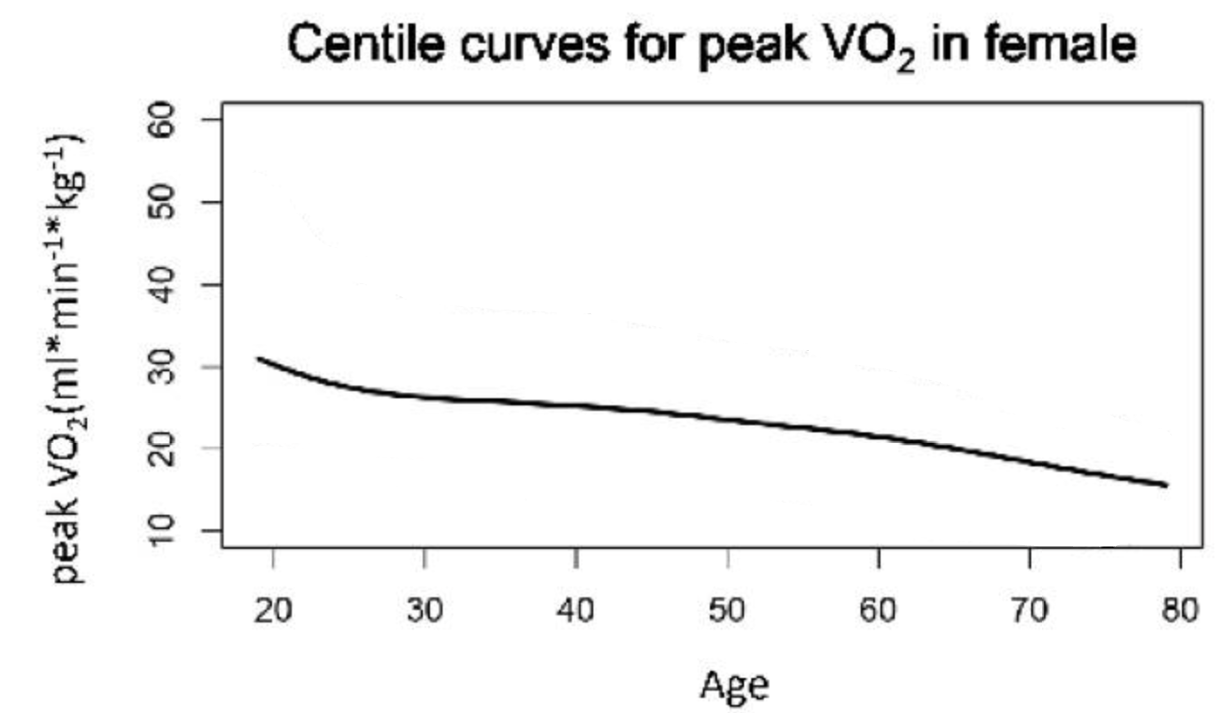
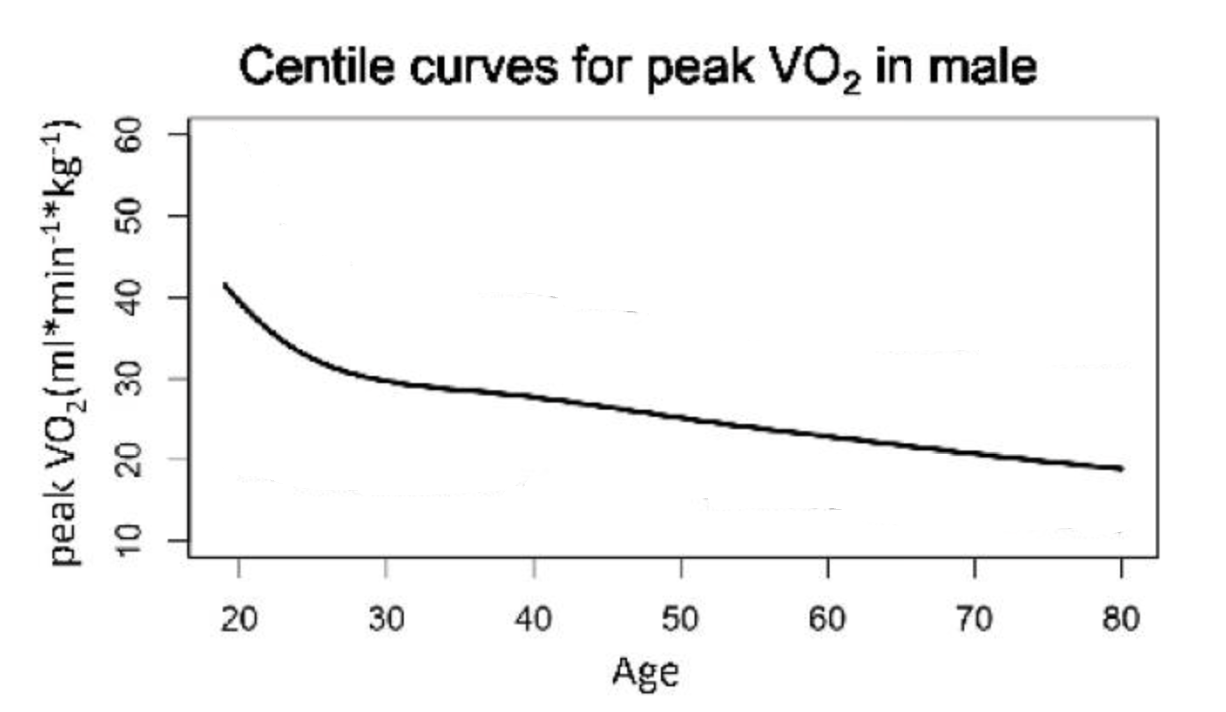
Here’s how VO₂Max typically changes with age in Asian populations9:
And here’s what it looks like in endurance-trained vs. sedentary individuals10:
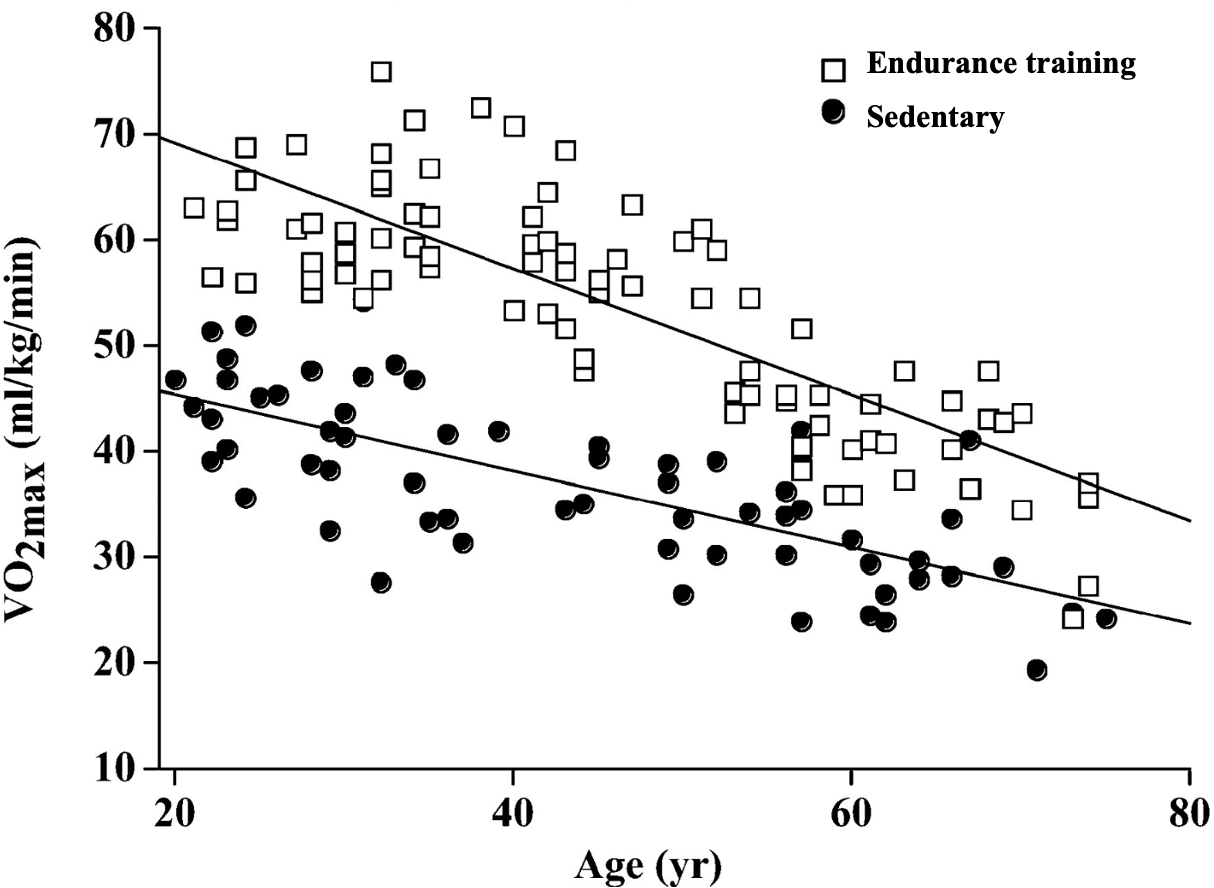
On average, VO₂Max declines ~10% per decade after your 20s. Between 20–30 years old, the drop can be even steeper (up to 20%).
When it falls below 18 mL·kg⁻¹·min⁻¹ in men or 15 in women, your independence in daily living begins to suffer. That’s the point where basic physical function starts to break down11,12.
Which means — just having “average” VO₂Max now isn’t enough.
If our goal is to live healthily to 100, then 60 years from now, we’ll still need enough VO₂Max to maintain independent living:
- Light housework and gardening: requires ~10 mL·kg⁻¹·min⁻¹
- Brisk walking: 14
- Threshold for independent living: 18 (men) / 15 (women)
- Playing 18 holes of golf (walking): 14–18
- Recreational tennis: 18–25
- Uphill walking (5–10% incline): 21–32
- Jogging (8-min pace): 24–28
- Hiking with a pack: 32–42
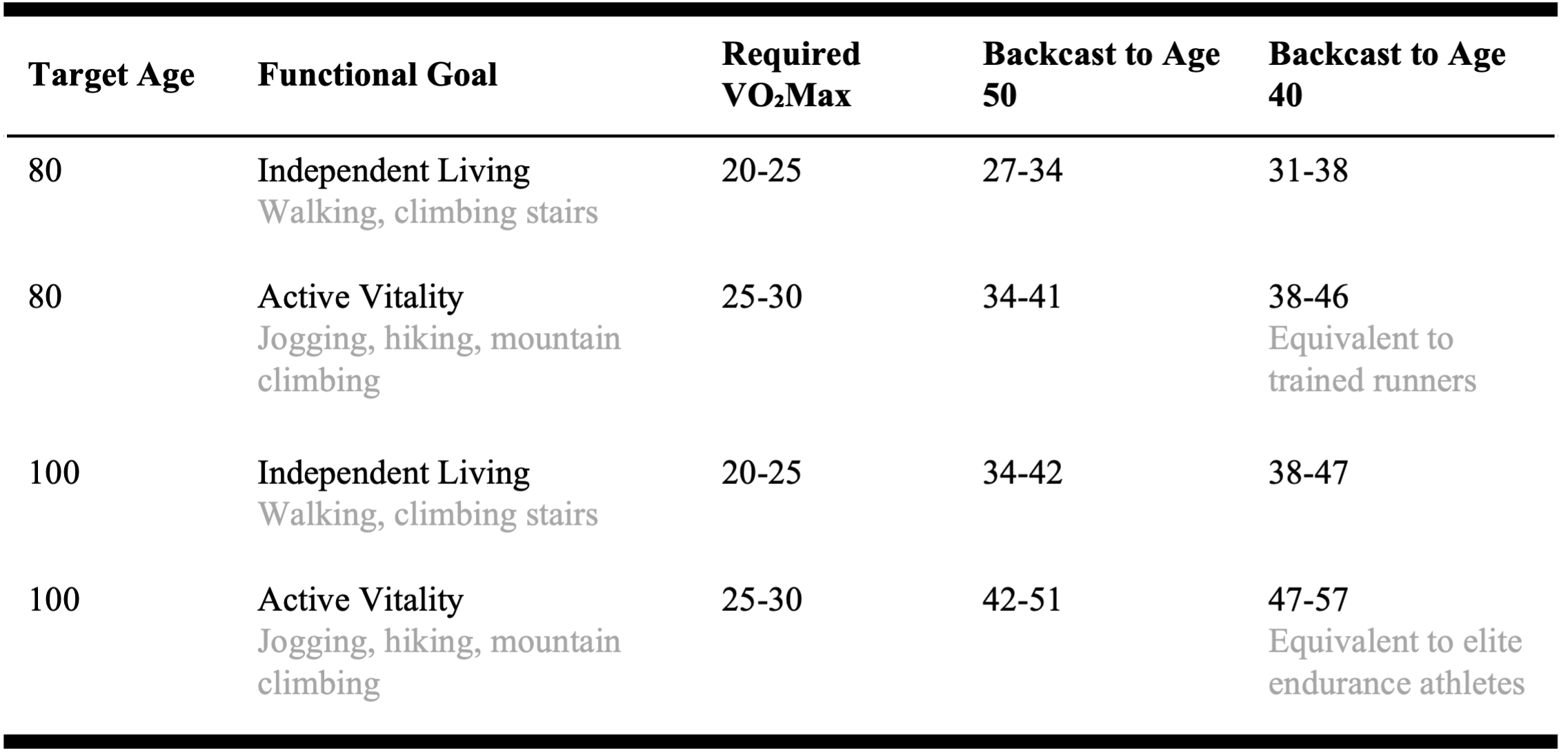
So, to remain independent and active between 80 and 100 years old, we’ll ideally need a VO₂Max of 20–25 (to do our own chores, walk comfortably, stay mobile). Even better would be 28–35, which gives us the freedom to hike, jog, and enjoy vigorous movement.
Let’s reverse-engineer this.
Assuming, based on research, that VO₂Max declines by an average of 10% per decade after age 40, we can do a simple thought experiment:
To reach:
- 20–25 VO₂Max at 80, we need 31–38 at age 40
- 25–30 VO₂Max at 80, we need 38–46 at age 40
In a 2013 study by Trappe et al., 9 lifelong endurance-trained male athletes in their 80s (average age ~81) were compared with 6 age-matched sedentary men. The results were dramatic:
- VO₂Max in the athlete group averaged 38 ± 1 mL·kg⁻¹·min⁻¹
- The sedentary group averaged only 21 ± 113
This difference is massive — those who trained had the cardiorespiratory fitness of someone decades younger, while the sedentary group was teetering on the edge of aerobic functional frailty.
The researchers concluded: these differences in VO₂Max translate directly to better resilience, mobility, and daily function. And maintaining a VO₂Max above 35 in your 80s? Not unrealistic. Entirely possible.
All it takes is a comparison between these benchmarks and your current numbers — to see how much room there is to grow.
Measuring VO₂Max: CPET
The gold standard for measuring VO₂Max is the Cardiopulmonary Exercise Test (CPET).
I took my first CPET in May this year at a professional lab. The test lasted over 30 minutes, requiring me to wear a breathing mask and push to the limit on a power-controlled bike until I could no longer continue. It was brutal.
My result: VO₂Max of 36.
Respectable. But if we reference the thresholds from earlier, that only puts me in the range of maintaining basic independence at age 80 — not vitality. I’ve got a long way to go.
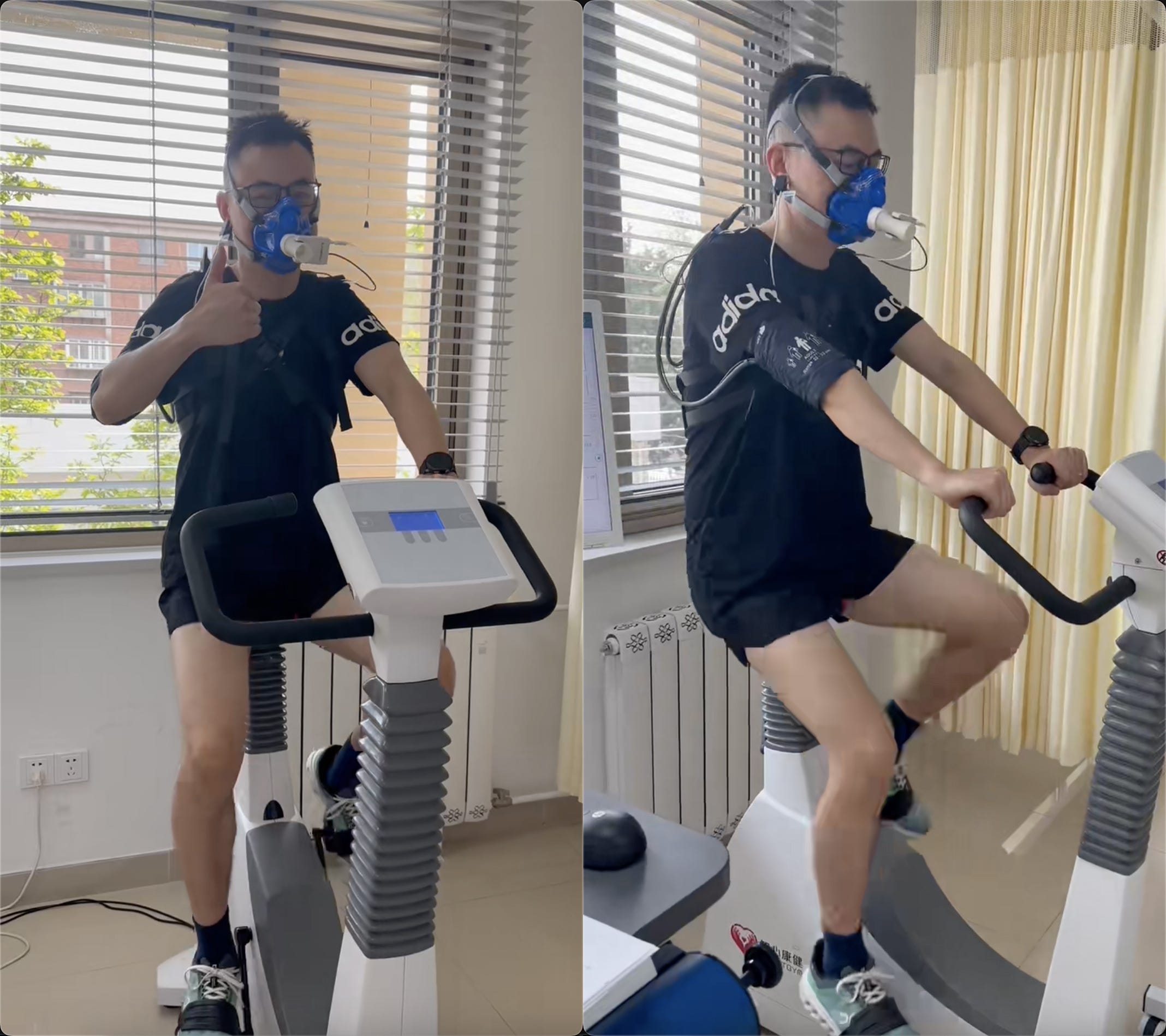
Primus taking CPET
I plan to test every six months. Not because VO₂Max is a static score, but because — like a CGM for blood glucose — this is part of a dynamic feedback loop. Measure → Adjust → Improve. Over and over again.
The number is always changing. What matters is whether it becomes a compass for action. And so, I’ve started adapting my daily life to focus on training my VO₂Max.
How to Train VO₂Max
According to a scientific review, 8–10 weeks of training can increase aerobic capacity in older adults by about 10%. With more than 20 weeks of training, the improvement can reach 17%. Which means that consistent training not only slows VO₂Max decline — it can actually reverse it.
Just like with mitochondrial activation, training VO₂Max requires a long-term commitment14,15.

Painted by AI
🏃 Aerobic Training Works — All of It
All forms of aerobic training help. Even moderate-intensity continuous training (MICT) over 8–12 weeks can increase VO₂Max by 5–15% in previously sedentary people. But this effect is mostly a beginner’s bonus — the improvement curve flattens quickly and varies a lot between individuals15.
Which makes sense.
Zone 2 training is like cruising at a steady pace — it doesn’t push your limits, but it builds stamina and endurance.
But VO₂Max is about max capacity under stress. To push that ceiling, you need a much stronger stimulus.
Still, Zone 2 plays a critical role: it dramatically increases mitochondrial density and capillary networks, which are the foundational building blocks for improving VO₂Max.
Without this solid Zone 2 base, jumping straight into something like HIIT may backfire — limited gains, higher fatigue, injury risk.
Build the runway first. Then launch the rocket.
🧗 HIIT: Break Through the Ceiling
If Zone 2 lays the foundation, High-Intensity Interval Training (HIIT) breaks through the ceiling.
Short bursts of high-intensity effort push the cardiovascular system to its upper limit, expanding the VO₂Max ceiling by engaging both aerobic and anaerobic energy systems.
That said, HIIT is not for beginners. If you’re new to training, I recommend starting with 5–6 months of consistent Zone 2 before introducing HIIT.
Also, before diving into VO₂Max-focused training, get a full health screening to rule out cardiovascular risks — HIIT’s load and intensity are in a totally different league than Zone 2.
💡 Zone 2 + HIIT: Complementary, Not Competitive
Zone 2 and HIIT aren’t rivals — they’re two complementary tools for improving VO₂Max, and both deserve a long-term place in your routine.
- Zone 2 builds mitochondrial function and heart efficiency steadily. It’s about raising your floor.
- HIIT delivers sharp spikes in effort that push your maximum limits. It’s about raising your ceiling.
A smart training plan doesn’t try to “burn out” every day — it knows how to balance both. Even elite athletes follow this philosophy:
- The pyramid model builds on a vast base of Zone 2 training.
- The polarized model puts ~80% of training in Zones 1–2, and the rest in high-intensity sessions, while minimizing mid-intensity “gray zone” efforts.
You need both the floor and the ceiling.
Steady groundwork. Occasional breakthroughs. That’s how VO₂Max reaches new heights.
In Summary
If there’s only one number you could use to judge your body’s total engine performance — and predict your healthspan decades into the future — it’s VO₂Max.
It’s not just a cardiorespiratory measure. It’s your whole-body horsepower under pressure. The higher it is, the more strength and vitality you’ll carry into your later years. And the lower it is? It’s riskier than smoking.
The good news: VO₂Max is trainable.
And the best approach? A lifelong commitment to aerobic training, combining Zone 2 and HIIT.
Raise the floor. Push the ceiling.
VO₂Max is a number worth chasing — for life.
Intervention recommendations are geared toward generally healthy individuals. If you have existing health conditions, always follow your doctor’s instructions.
References
[1]AI Research
[2]Ross, R., et al. “Importance of Assessing Cardiorespiratory Fitness in Clinical Practice: A Case for Fitness as a Clinical Vital Sign.” Circulation, vol. 134, no. 24, 2016, pp. e653–e699.
[3]Joyner, Michael J., and Edward F. Coyle. “Endurance Exercise Performance: The Physiology of Champions.” The Journal of Physiology, vol. 586, no. 1, 2007, pp.
[4]Ainsworth, Barbara E., et al. “2011 Compendium of Physical Activities: A Second Update of Codes and MET Values.” Medicine & Science in Sports & Exercise, vol. 43, no. 8, 2011, pp. 1575–1581.
[5]Akiyama, Hiroshi, et al. “Estimated Standard Values of Aerobic Capacity According to Sex and Age in a Japanese Population: A Scoping Review.” PLOS ONE, vol. 18, no. 9, 2023, e0286936.
[6]Kodama, Satoru, et al. “Cardiorespiratory Fitness as a Quantitative Predictor of All-Cause Mortality and Cardiovascular Events in Healthy Men and Women: A Meta-Analysis.” JAMA, vol. 301, no. 19, 2009, pp. 2024–2035.
[7]Mandsager, Kyle, et al. “Association of Cardiorespiratory Fitness with Long-Term Mortality among Adults Undergoing Exercise Treadmill Testing.” JAMA Network Open, vol. 1, no. 6, 2018, e183605.
[8]Barlow, C. E., et al. “Association of Fitness, Mortality, and Health Care Utilization in a Large Veteran Population.” Journal of the American College of Cardiology, vol. 79, no. 22, 2022, pp.
[9]Wang Y, Li H, Wang J, Zhao W, Zeng Z, Hao L, Yuan Y, Lin Y, Wu Y, Wang Z. Normal References of Peak Oxygen Uptake for Cardiorespiratory Fitness Measured with Cardiopulmonary Exercise Testing in Chinese Adults. J Clin Med. 2022 Aug 21;11(16):4904. [10]Pimentel AE, Gentile CL, Tanaka H, Seals DR, Gates PE. Greater rate of decline in maximal aerobic capacity with age in endurance-trained than in sedentary men. J Appl Physiol (1985). 2003 Jun;94(6):2406–13.
[11]Fleg, Jerome L., et al. “Accelerated Longitudinal Decline of Aerobic Capacity in Healthy Older Adults.” Journal of Applied Physiology, vol. 99, no. 3, 2005, pp. 1113–1120.
[12]Arena, Ross, and Jonathan Myers. “Cardiopulmonary Exercise Testing.” Cleveland Clinic Journal of Medicine, vol. 84, no. 2, 2017, pp. 161–172.
[13]Trappe, Scott, et al. “New Records in Aerobic Power among Octogenarian Lifelong Endurance Athletes.” Journal of Applied Physiology, vol. 114, no. 1, 2013, pp. 3–10.
[14]Huang, Guang, et al. “Dose-Response Relationship of Cardiorespiratory Fitness Adaptation to Controlled Endurance Training in Sedentary Adults.” Journal of Applied Physiology, vol. 99, no. 1, 2005, pp. 111–119.
[15]Marriott, Harrison E., and Mark S. Lamb. “High-Intensity Interval Training in Older Adults: A Scoping Review.” Sports Medicine — Open, vol. 7, no. 1, 2021, Article 49.