You’ve probably seen videos like this:
A breathless fitness influencer shouts into the camera, “Tabata! Just 4 minutes! Burn fat for 72 hours!”
And in that moment, I wavered too. Jogging an hour every day — could it really be less effective than hopping up and down for four minutes?
Is HIIT really that superior to Zone 2?
Today, let’s take a deep dive — through the lens of both science and Prime Life practice — into the showdown between these two fat-burning strategies.
What Exactly is HIIT, and Why Does Everyone Love It?
HIIT stands for High Intensity Interval Training. It’s as simple (and brutal) as it sounds:
Short bursts of max effort → short recovery → repeat.
One classic protocol: 4 minutes of hard effort (85–95% HRmax) + 4 minutes of recovery (heart rate ~100–125 bpm), repeated 4 times. 12
But there are countless variations — like Tabata (20 seconds sprint + 10 seconds rest × 8 rounds), CrossFit-style functional movements, even jump rope, rowing, push-ups, burpees. Almost any form of exercise can be turned into HIIT.
Think of it as a roller coaster: skyrocket your cardiovascular load, let it dip briefly, then launch again.
HIIT has long been hailed as a fat-burning miracle. And in the gasping, sweaty agony of those workouts, it does feel like you’re melting fat by the gallon.
But here’s the truth: HIIT’s real strength isn’t in fat-burning. It’s in training VO₂Max — your maximal oxygen uptake.
For fat loss, Zone 2 still reigns supreme.
So, Who’s the Real Fat-Burning Champion?
Let’s cool our heads and start with a simple equation:
Fat burned = Total energy burned per unit time × Fat’s share of that energy × Duration
There are three key variables here. Let’s break them down.
🔥 Variable 1: Calories burned per unit time — HIIT wins
The harder you exercise, the more calories you burn. One minute of sprinting burns way more than one minute of slow jogging. No contest — HIIT dominates here.
📏 Variable 2: Percentage of energy from fat — Zone 2 wins
This is where most people get it wrong.
The higher the intensity, the less your body uses fat as fuel.
Why?
- Glycogen (carbs) = fast energy
- Fat = slow, takes time to mobilize
When the body is engaged in high-intensity exercise, it needs energy rapidly, so it has no choice but to rely more heavily on glucose — whether through aerobic or anaerobic metabolism (and anaerobic pathways can deliver energy even faster).
Actual numbers:
- At rest (e.g. sleeping), up to 60–70% of energy comes from fat 1.
- In Zone 2, fat contribution remains high: 40–60%.
- During HIIT (85–95% HRmax, roughly 85–90% VO₂Max), your body shifts to rapid sugar burning. Fat drops to just 10–20% of energy 2,3,4.
- If you exceed your lactate threshold (LT2) — which for sedentary individuals might be just 50–60% VO₂Max (higher for trained athletes) — you rely even more on anaerobic glycolysis (sugar), and fat oxidation is largely suppressed 5.
🍦 Variable 1 × Variable 2 = Fat burned per minute — Zone 2 wins
As intensity increases, calorie burn rises — but fat’s share decreases. At low intensity, fat usage is high — but calorie burn is low.
The sweet spot? Fatmax — the point where your body burns the most fat per minute.
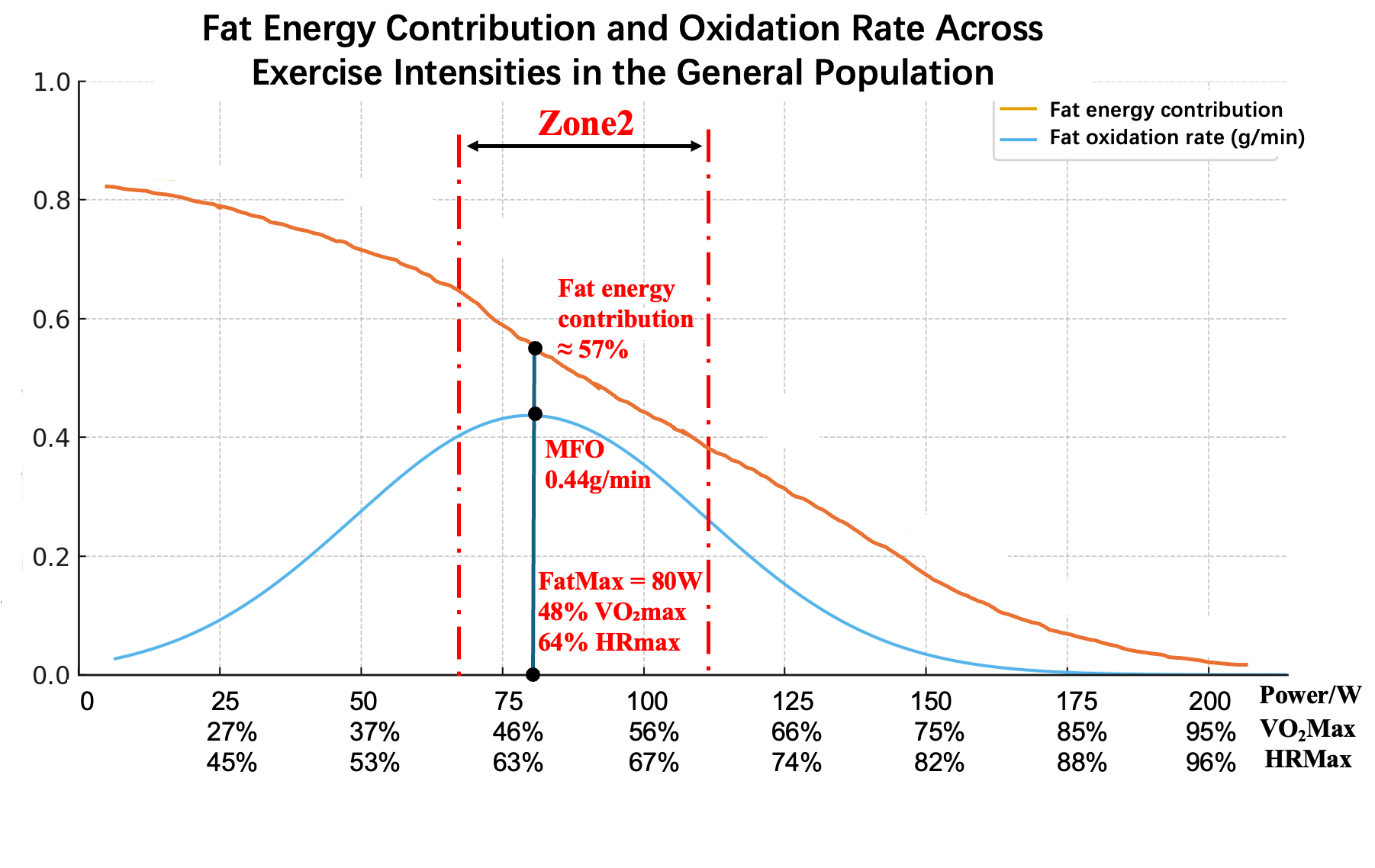
The chart above illustrates how fat’s contribution to energy and fat oxidation rate change across different exercise intensities in the general population. For most people (i.e., non-endurance-trained individuals), Zone 2 delivers both the highest fat oxidation rate and a relatively high fat contribution to total energy — with FatMax typically occurring around 80 watts of output.
For endurance-trained athletes, their overall power output is significantly higher. To reach their peak fat-burning rate, exercise intensity may need to exceed 200 watts.
Elite endurance athletes can push their Fatmax to Zone 3 or 4, thanks to superior mitochondrial function — but for most, Zone 2 is ideal.
Bottom line: Zone 2 is the most fat-efficient zone per unit time.
⏳ Variable 3: Duration — Zone 2 wins
Fat loss isn’t about short bursts — it’s about total accumulation.
HIIT is intense, but hard to sustain. You shouldn’t do it every day.
Zone 2 is steady and sustainable — sessions can last 45–90 minutes, and recovery is fast. You can do it almost daily.
🏅 Verdict: Zone 2 is the true fat-burning ace
Let’s stack it all together:
- HIIT wins on calorie burn per minute.
- Zone 2 dominates on fat percentage and total duration.
So, no matter what short videos claim — Zone 2 is the real fat-burn king.

Painted by AI
HIIT’s “Afterburn Effect”? Not That Magical
A lot of HIIT’s hype comes from the afterburn effect, or EPOC (Excess Post-Exercise Oxygen Consumption).
It’s real: After intense workouts, your body uses extra oxygen (and energy) to repair muscle damage, clear lactate, restore hormones, and regulate body temperature. Your metabolism stays elevated for hours 6.
But the magnitude is modest. Studies show EPOC only accounts for about 6–15% extra calorie burn compared to the exercise session itself 7.
It’s like earning a bit of interest — not the mythical “burn fat for 72 hours after 4 minutes of work.”
Real fat loss still depends on one thing: total caloric expenditure — your principal, not the interest.
So Where Does HIIT Shine?
The answer is VO₂Max.
Systematic reviews from 2022–2025 show:HIIT is often more effective than MICT (Moderate-Intensity Continuous Training) at improving VO₂Max — especially over shorter time frames. After 12+ weeks, the gap narrows, and MICT can yield similar gains. But HIIT remains more time-efficient — you get similar VO₂Max improvements in less time 8,9.
And VO₂Max is a big deal.
A 2018 Cleveland Clinic study of 120,000 people found: those in the lowest fitness group had a 5× higher all-cause mortality risk than those in the elite VO₂Max group — no “too much” threshold was found 10.
So:
- Zone 2 builds your foundation — mitochondrial health, fat metabolism, capillary density.
- HIIT raises the ceiling — heart-lung performance, VO₂Max, peak output.
If Zone 2 is the building’s foundation, HIIT is the rooftop spire.
Both matter — for healthspan, performance, and longevity.

Painted by AI
The Allure and Cost of HIIT
HIIT’s strengths are obvious:
- Highly time-efficient: Over the long term, just 10 minutes of HIIT can deliver VO₂Max improvements comparable to 50 minutes of moderate-intensity continuous training (MICT) 11,12.
- Training versatility: Running, cycling, swimming, weightlifting, jump rope, functional workouts — almost any modality can be adapted into a HIIT format.
- Cardiopulmonary intensity: It pushes your body to its true limits.
But the cost is just as real:
- Pain: Hitting >90% of your max heart rate? That “chest about to explode” feeling — only those who’ve done it will understand.
- Risk: For individuals with cardiovascular history, jumping into HIIT can be dangerous. Even for healthy people, HIIT carries a higher risk of injury than Zone 2.
While the absolute adverse event rate is low in medically supervised cardiac rehab settings (comparable to MICT), beginners and those at high risk still require medical screening and a gradual ramp-up.
- Difficult to sustain: Many people try it once and walk away thinking, “If this is what exercise feels like, I’d rather skip it,” leading to total abandonment of training.
- Longer recovery: Post-HIIT sessions demand more rest — unlike Zone 2, which can be done daily.
So, HIIT is like a sharp blade. In the right hands, it can carve out health and longevity. But used carelessly, it’s easy to hurt yourself.
In Summary
There are no shortcuts in the world of training.
- Zone 2 is your fat-burning ace — a quiet compounding force.
- HIIT is your cardiopulmonary king — shaping VO₂Max through high-intensity spikes.
Zone 2 builds the foundation. HIIT delivers the breakthrough.
Zone 2 is where you begin. HIIT is where you advance.
Yes, both are ideal — but remember: Lay the groundwork before climbing the tower.
And One More Thing…
Let me end on this note:
“Fat-burning” is not the core goal of Prime Life’s exercise framework.
What we’re really pursuing is:
- Higher physical performance
- More stable metabolism
- A longer, healthier lifespan
“Getting lean” is just a byproduct. The real mission is extending the high-performance arc of your Prime Curve.
At Prime Lab, here’s how we define the frontline goals of training:
- Break sedentary patterns
- Activate mitochondria (Zone 2)
- Boost VO₂Max (HIIT)
- Build muscle (resistance training)
- Improve mobility and stability (Pilates/yoga/stretching/rehab)
- Enhance neurological health (racket sports / social movement)
Fat loss will happen naturally in this process — it doesn’t need to be hunted down.
It will happen. It just doesn’t need to be the main event.
📌 Next Entry: We’ll dive deep into the practical side of HIIT — how to structure it, avoid injuries, and build a sustainable positive-feedback loop.
Stay tuned.
Intervention recommendations are geared toward generally healthy individuals. If you have existing health conditions, always follow your doctor’s instructions.
References
[1]Melzer, Katharina. “Carbohydrate and Fat Utilization During Rest and Physical Activity.” Clinical Nutrition ESPEN, 2011.
[2]Brooks, George A., and Jean Mercier. “Balance of Carbohydrate and Lipid Utilization during Exercise: The ‘Crossover’ Concept.” J Appl Physiol, vol. 76, no. 6, 1994, pp. 2356–2363.
[3]Achten, Juul, and Asker E. Jeukendrup. “Maximal Fat Oxidation during Exercise in Trained Men.” J Appl Physiol, vol. 94, no. 6, 2003, pp. 2036–2042.
[4]Romijn, J. A., et al. “Regulation of Endogenous Fat and Carbohydrate Metabolism in Relation to Exercise Intensity and Duration.” J Appl Physiol, 1993.
[5]Coyle, Edward F., et al. “The Influence of Fitness Level on the Lactate-Threshold in Men and Women.” Medicine and Science in Sports and Exercise, vol. 22, no. 4, 1990, pp. 436–440.
[6]Børsheim, E., and O. Bahr. “Effect of Exercise Intensity, Duration and Mode on Post-Exercise Oxygen Consumption.” Sports Medicine, 2003.
[7]LaForgia, Joe, et al. “Effects of Exercise Intensity and Duration on the Excess Post-Exercise Oxygen Consumption.” Journal of Sports Sciences, 2006.
[8]Guo, Zong-Li, et al. “Effect of High-Intensity Interval Training vs. Moderate-Intensity Continuous Training on VO₂peak and Body Composition.” Int. J. Environ. Res. Public Health, 2023.
[9]Ellingsen, Øyvind, et al. “High-Intensity Interval Training in Patients with Heart Failure.” Circulation, 2017.
[10]Mandsager, Kyle, et al. “Association of Cardiorespiratory Fitness with Long-Term Mortality among Adults Undergoing Exercise Treadmill Testing.” JAMA Network Open, vol. 1, no. 6, 2018, e183605.
[11]Gillen, Jenna B., et al. “Twelve Weeks of Sprint Interval Training Improves Indices of Cardiometabolic Health as Much as Traditional Endurance Training despite a Fivefold Lower Exercise Volume.” PLOS ONE, 2016.
[12]Gibala, Martin J., et al. “Physiological Adaptations to Low-Volume, High-Intensity Interval Training in Health and Disease.” Journal of Physiology, 2012.
[13]AI Research